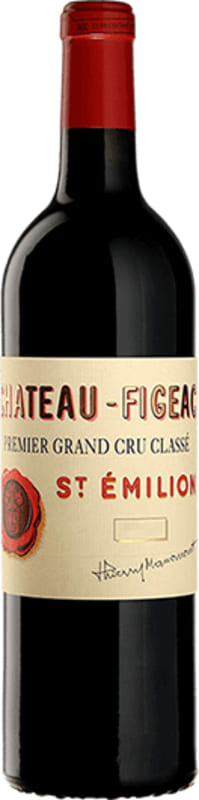


Winemaker Notes
With its pedigree style, Chateau Figeac epitomizes the elegance of the great wines of Bordeaux. Its unique style gradually shows through and develops over time.
This great wine displays a distinctive rich nose that has wonderful aromatic complexity. On the palate, the Cabernet Sauvignon reveals lovely floral aromas in the first year then, as the wine ages, great structure on the palate. The Cabernet Franc brings lots of freshness in the tannins, and the Merlot contributes roundness and flesh. The attack on the palate is clean, the texture is silky, and the complexity elegant. The characteristic freshness of Figeac is underpinned by great length of flavor. With its long aging potential, the wine goes on in time to reveal hints of forest floor, leather, cigar-box and licorice – always with its hallmark elegance.
Professional Ratings
-
James Suckling
Even in this super-ripe vintage Figeac retains its usual red bell pepper aroma (from the cabernet sauvignon grape) and that adds a light touch to the opulent fruit cake and spice character. The full fine tannins beautifully support the rich palate and make the finish very long and plush. A great 2009! Drink or hold. (Horizontal Tasting, London, 2019)
-
Wine Enthusiast
A ripe year like 2009 is kind to the Cabernet Sauvignon of Chateau Figeac. The wine is perfumed with new wood and sweet fruits, delicious black currant flavors giving both ripeness and freshness. The wine has weight and impressive density. A start of the vintage.
Cellar Selection -
Wine Spectator
Distinctive, with atypical (for St.-Emilion) force and drive to the black currant, roasted cedar and maduro tobacco flavors, which are supported by a dense, loam-tinged structure. Terrific roasted espresso, ganache and fig paste notes wait in reserve. Very muscular, but with the cut for balance. Best from 2017 through 2035.
-
Decanter
The colour remains deep and shows no sign of evolution. The nose, too, remains youthful, but it's broad and fleshy, with generous blackberry fruit. Plump and rounded, it's more forward than 2010, reflecting the vintage, but it's also very concentrated. The tannins are firm so the wine has great structure, if not the freshness and energy of the 2010. Long.
-
Jeb Dunnuck
The 2009 Château Figeac is the normal blend of close to equal parts Merlot, Cabernet Franc, and Cabernet Sauvignon. It’s a beautiful wine that has classic Figeac style, yet is more reserved and backward than most in the vintage. Forest floor, truffle, blackcurrants, cigar ash and green tobacco notes all emerge from this full-bodied, ripe, yet pure, elegant Saint-Emilion that has good acidity and plenty of length. The tannins are ripe, yet firm, it’s nicely balanced, and it blossoms with time in the glass. Nevertheless, it needs another 4-5 years of cellaring to hit prime time, and it should keep for 2-3 decades.
-
Robert Parker's Wine Advocate
The medium garnet colored 2009 Figeac features a very pretty perfume of rose hip tea, lilacs and cinnamon stick over a core of red and black currant preserves plus hints of dried herbs and sweaty saddles. Medium to full-bodied, the palate delivers bags of savory fruit layers with plenty of floral sparks, framed by rounded tannins, finishing on a earthy note.
-
Vinous
The 2009 Figeac has one of the more Oriental-inspired bouquets amongst its peer group, one that is extremely well defined with scents of pressed rose petals and rolled tobacco emerging with time. The palate is medium-bodied with supple tannin. Fresh and vibrant although disappointingly, it cuts off dramatically on the finish. Maybe with time it will just broaden out a little? I hope so because otherwise this is splendid. Tasted blind at Farr Vintners’ 2009 Bordeaux tasting.


One of the world’s most classic and popular styles of red wine, Bordeaux-inspired blends have spread from their homeland in France to nearly every corner of the New World. Typically based on either Cabernet Sauvignon or Merlot and supported by Cabernet Franc, Malbec and Petit Verdot, the best of these are densely hued, fragrant, full of fruit and boast a structure that begs for cellar time. Somm Secret—Blends from Bordeaux are generally earthier compared to those from the New World, which tend to be fruit-dominant.

Marked by its historic fortified village—perhaps the prettiest in all of Bordeaux, the St-Émilion appellation, along with its neighboring village of Pomerol, are leaders in quality on the Right Bank of Bordeaux. These Merlot-dominant red wines (complemented by various amounts of Cabernet Franc and/or Cabernet Sauvignon) remain some of the most admired and collected wines of the world.
St-Émilion has the longest history in wine production in Bordeaux—longer than the Left Bank—dating back to an 8th century monk named Saint Émilion who became a hermit in one of the many limestone caves scattered throughout the area.
Today St-Émilion is made up of hundreds of independent farmers dedicated to the same thing: growing Merlot and Cabernet Franc (and tiny amounts of Cabernet Sauvignon). While always roughly the same blend, the wines of St-Émilion vary considerably depending on the soil upon which they are grown—and the soils do vary considerably throughout the region.
The chateaux with the highest classification (Premier Grand Cru Classés) are on gravel-rich soils or steep, clay-limestone hillsides. There are only four given the highest rank, called Premier Grand Cru Classés A (Chateau Cheval Blanc, Ausone, Angélus, Pavie) and 14 are Premier Grand Cru Classés B. Much of the rest of the vineyards in the appellation are on flatter land where the soils are a mix of gravel, sand and alluvial matter.
Great wines from St-Émilion will be deep in color, and might have characteristics of blackberry liqueur, black raspberry, licorice, chocolate, grilled meat, earth or truffles. They will be bold, layered and lush.