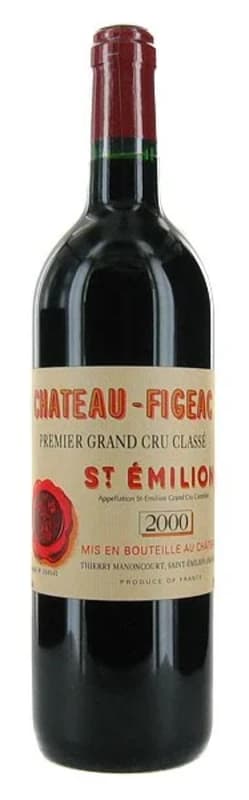


Winemaker Notes
Château-Figeac owes its distinctive character to the unique combination of Gunzian gravel outcrops and clay subsoil, several microclimates and the mix of Cabernet Sauvignon, Cabernet Franc and Merlot planted in the vineyard. This unusual blend, with its majority two-thirds Cabernet, gives the wine both structure and refinement, freshness and smoothness. Since the early years of the present century the wine has become more approachable in its youth, offering a more caressing mouthfeel, without losing its incomparable uprightness over the years.
Its ability to age for decades is quite exceptional, revealing an inimitable and complex bouquet as the years go by.
Professional Ratings
-
James Suckling
Spices, herbs, plums, and meat on the nose. Full and round, with soft tannins and a beautiful finish. Chocolate and fruit everywhere.
-
Jeb Dunnuck
Now fully mature, the 2000 Château Figeac has a deeper garnet hue along with a complex, exotic nose of ripe black fruits, sweet tobacco, cedar, and leafy, green herbs. It's resolved and medium-bodied, with a nicely balanced, layered mouthfeel and a good finish. There's more than a little classic Figeac herbal nuance, and I could easily see this being slightly controversial. Nevertheless, I like its complexity, and it has a round, soft texture and a good finish.
-
Wine Spectator
Overt rosemary, bay and tobacco notes lead the way, backed by dark fig and steeped black currant fruit flavors at the core. The finish is loamy-edged, with a serious tug of earth. There's nice flesh and density here.
-
Robert Parker's Wine Advocate
The nose is clean and fresh with strong graphite aromas, very Left Bank in style with black truffle and smoky notes developing. The palate is masculine and rather austere at first, though I notice that it gains fleshiness in the glass.


One of the world’s most classic and popular styles of red wine, Bordeaux-inspired blends have spread from their homeland in France to nearly every corner of the New World. Typically based on either Cabernet Sauvignon or Merlot and supported by Cabernet Franc, Malbec and Petit Verdot, the best of these are densely hued, fragrant, full of fruit and boast a structure that begs for cellar time. Somm Secret—Blends from Bordeaux are generally earthier compared to those from the New World, which tend to be fruit-dominant.

Marked by its historic fortified village—perhaps the prettiest in all of Bordeaux, the St-Émilion appellation, along with its neighboring village of Pomerol, are leaders in quality on the Right Bank of Bordeaux. These Merlot-dominant red wines (complemented by various amounts of Cabernet Franc and/or Cabernet Sauvignon) remain some of the most admired and collected wines of the world.
St-Émilion has the longest history in wine production in Bordeaux—longer than the Left Bank—dating back to an 8th century monk named Saint Émilion who became a hermit in one of the many limestone caves scattered throughout the area.
Today St-Émilion is made up of hundreds of independent farmers dedicated to the same thing: growing Merlot and Cabernet Franc (and tiny amounts of Cabernet Sauvignon). While always roughly the same blend, the wines of St-Émilion vary considerably depending on the soil upon which they are grown—and the soils do vary considerably throughout the region.
The chateaux with the highest classification (Premier Grand Cru Classés) are on gravel-rich soils or steep, clay-limestone hillsides. There are only four given the highest rank, called Premier Grand Cru Classés A (Chateau Cheval Blanc, Ausone, Angélus, Pavie) and 14 are Premier Grand Cru Classés B. Much of the rest of the vineyards in the appellation are on flatter land where the soils are a mix of gravel, sand and alluvial matter.
Great wines from St-Émilion will be deep in color, and might have characteristics of blackberry liqueur, black raspberry, licorice, chocolate, grilled meat, earth or truffles. They will be bold, layered and lush.