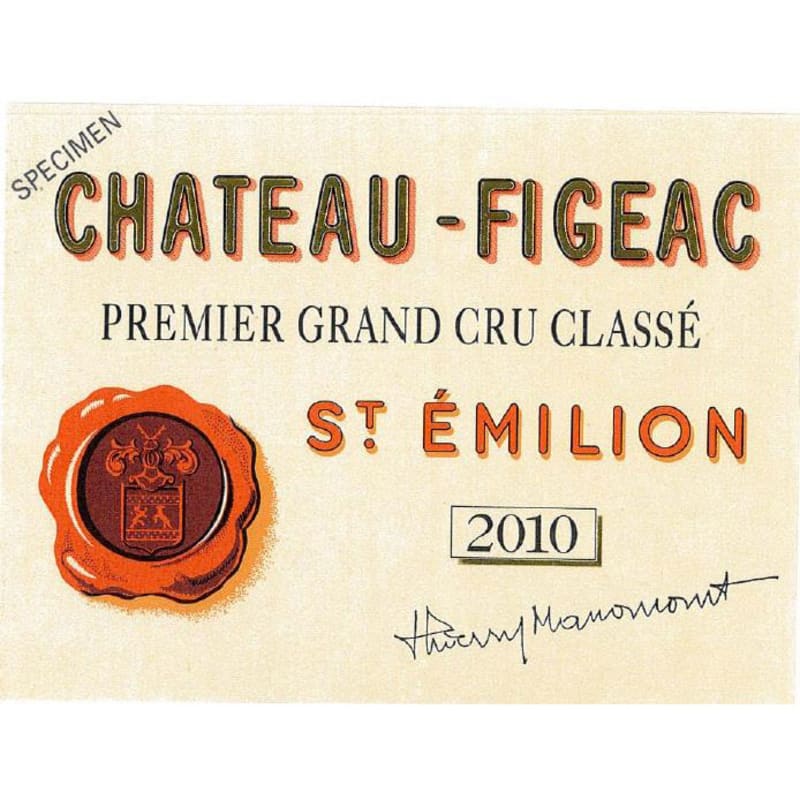

Winemaker Notes
Professional Ratings
-
James Suckling
Intense aromas of wet earth, leaves, sweet berries and cinnamon follow through to a full body, velvety and dense tannins and a long and flavorful finish. Opulent style. Just opening now, but this shows lots of stuffing, even if it does tighten down on the palate. Integrated and fine.
-
Robert Parker's Wine Advocate
Deep garnet colored, the 2010 Figeac bursts from the glass with gregarious scents of baked blueberries, black cherry compote and chocolate box with hints of camphor, pencil lead and iron ore. Medium to full-bodied, the palate has beautifully ripe, velvety tannins and bold freshness supporting the generous fruit, finishing long and layered.
-
Wine Enthusiast
This Cabernet Sauvignon-dominated wine always stands out as a powerhouse of impressive tannins. In 2010, it is complex with a dense structure, tight mineral texture and dense wood. Underneath, the ripe black fruits bring the promise for the long-term future. Give this wine at least 10 years.
Cellar Selection
-
Wine Spectator
This is very tight, showing a prominent roasted apple wood and bittersweet cocoa frame more today, though the core of dense currant paste, blackberry pâte de fruit and plum sauce waits in reserve. Gorgeous singed spice, anise and toasted fig bread notes flitter through the finish, though this needs some time in the cellar to resolve itself fully. A very distinctive, structured expression of St.-Emilion.
-
Decanter
The tasting reinforces the opinion of the technical team at Figeac that 2010 is the greatest vintage produced at the estate in the past 30 years. ‘It’s a reference in terms of quality, finesse and balance,’ says technical director Frédéric Faye. The wine was produced from the classic blend of a third each Merlot, Cabernet Sauvignon and Cabernet Franc, with all three varieties achieving optimum maturity. In this respect the vintage conditions played a major part but following a soil study of the vineyard the harvest was also conducted in a more detailed fashion, individual parcels dissected and picked according to maturity. Stephen Brook Firm and rich blackberry nose, quite perfumed. Rich, sleek and silky, with fine concentration and svelte tannins. Firm but not extracted, with enough acidity to make the wine shapely. Spicy and very long. James Lawther MW Dark and concentrated with supple, juicy fruit. Plush and smooth on the palate. Full and dense, but balanced. Steven Spurrier Striking nose that is both extracted and fragrant, with lots of black fruits and lots of flesh, vigour and freshness – even the tannins are fresh. Really good length, and Cabernet Franc is to the fore.


One of the world’s most classic and popular styles of red wine, Bordeaux-inspired blends have spread from their homeland in France to nearly every corner of the New World. Typically based on either Cabernet Sauvignon or Merlot and supported by Cabernet Franc, Malbec and Petit Verdot, the best of these are densely hued, fragrant, full of fruit and boast a structure that begs for cellar time. Somm Secret—Blends from Bordeaux are generally earthier compared to those from the New World, which tend to be fruit-dominant.

Marked by its historic fortified village—perhaps the prettiest in all of Bordeaux, the St-Émilion appellation, along with its neighboring village of Pomerol, are leaders in quality on the Right Bank of Bordeaux. These Merlot-dominant red wines (complemented by various amounts of Cabernet Franc and/or Cabernet Sauvignon) remain some of the most admired and collected wines of the world.
St-Émilion has the longest history in wine production in Bordeaux—longer than the Left Bank—dating back to an 8th century monk named Saint Émilion who became a hermit in one of the many limestone caves scattered throughout the area.
Today St-Émilion is made up of hundreds of independent farmers dedicated to the same thing: growing Merlot and Cabernet Franc (and tiny amounts of Cabernet Sauvignon). While always roughly the same blend, the wines of St-Émilion vary considerably depending on the soil upon which they are grown—and the soils do vary considerably throughout the region.
The chateaux with the highest classification (Premier Grand Cru Classés) are on gravel-rich soils or steep, clay-limestone hillsides. There are only four given the highest rank, called Premier Grand Cru Classés A (Chateau Cheval Blanc, Ausone, Angélus, Pavie) and 14 are Premier Grand Cru Classés B. Much of the rest of the vineyards in the appellation are on flatter land where the soils are a mix of gravel, sand and alluvial matter.
Great wines from St-Émilion will be deep in color, and might have characteristics of blackberry liqueur, black raspberry, licorice, chocolate, grilled meat, earth or truffles. They will be bold, layered and lush.