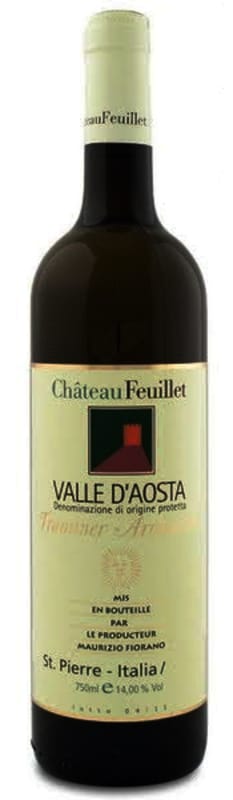


Winemaker Notes
Château Feuillet’s high-altitude, fully dry Moscato is one-of-a-kind. Expect bountiful aromas of wildflowers and bright fruit delivered with crunchy acidity and granitic minerality in an utterly thirst-quenching package.


While Muscat comes in a wide range of styles from dry to sweet, still to sparkling and even fortified, it's safe to say it is always alluringly aromatic and delightful. The two most important versions are the noble, Muscat Blanc à Petits Grains, making wines of considerable quality and Muscat of Alexandria, thought to be a progeny of the former. Somm Secret—Pliny the Elder wrote in the 13th century of a sweet, perfumed grape variety so attractive to bees that he referred to it as uva apiana, or “grape of the bees.” Most likely, he was describing Muscat.

Claiming an impressive list of autochthonous varieties, Valle d'Aosta is a long, narrow valley, formed by Italy’s extreme northwestern Alps. The region, a natural gateway between Italy and France, is also home to many grape migrants from France and its more southerly Italian neighbors. Not surprisingly, wine labels are often written in Italian and French.
The main whites here include: Petite Arvine and Prié blanc (Blanc de Morgex). For reds: Fumin, Cornalin, Mayolet, Petit Rouge, Premetta, Vuillermin, Neblou, and Vien de Nus are unique to the region. French ones that do well are Gamay noir, Pinot noir, Chardonnay and Pinot gris (confusingly called Malvoisie in Aosta but it is not related to Malvasia). Italian grapes common here include Moscato, Dolcetto, Barbera, Nebbiolo, and from farther away, Ciliegiolo.