
Winemaker Notes




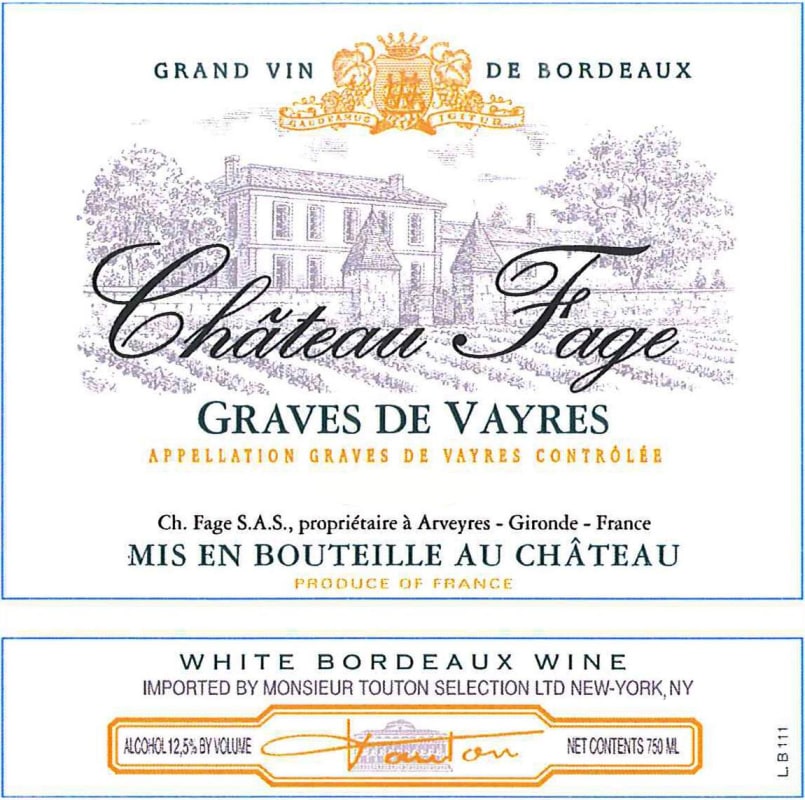
Château Fage is situated on the banks of the Dordogne in the Graves de Vayres appellation, facing the prestigious appellations of Saint-Emilion, Pomerol and Fronsac. The estate is one the reference château of the appellation, for the quality of its wines, as well as its capacity to produce substantial volumes.
Built in the 19th century, the castle dominates the Souloire valley. The estate extends over 110 acres of vines, forests and meadows. A blend of great homogeneity that characterizes this exceptional terroir located on the banks of the Dordogne in the Graves de Vayres appellation. Since 2015 a vineyard renewal program has been implemented. Several plots have been replanted, the soils have been worked in order to aerate them and decompact them. A sustainable agriculture policy has been put in place. In the cellar, the equipment has been renewed, in particular with a more efficient sorting machine. All this with the aim of achieving the level of quality that this terroir deserves.

Sometimes light and crisp, other times rich and creamy, Bordeaux White Blends typically consist of Sauvignon Blanc and Semillon. Often, a small amount of Muscadelle or Sauvignon Gris is included for added intrigue. Popularized in Bordeaux, the blend is often mimicked throughout the New World. Somm Secret—Sauternes and Barsac are usually reserved for dessert, but they can be served before, during or after a meal. Try these sweet wines as an aperitif with jamón ibérico, oysters with a spicy mignonette or during dinner alongside hearty Alsatian sausage.

French wine is nearly synonymous with fine wine and all things epicurean, France has a culture of wine production and consumption that is deeply rooted in tradition. Many of the world’s most beloved grape varieties originated here, as did the concept of “terroir”—soil type, elevation, slope and mesoclimate combine to produce resulting wines that convey a sense of place. Accordingly, most French wine is labeled by geographical location, rather than grape variety. So a general understaning of which grapes correspond to which regions can be helpful in navigating all of the types of French wine. Some of the greatest wine regions in the world are here, including Bordeaux, Burgundy, the Rhône and Champagne, but each part of the country has its own specialties and strengths.
Pinot Noir and Chardonnay are the king and queen of Burgundy, producing elegant French red and white wines with great acidity, the finest examples of which can age for decades. The same two grapes, along with Pinot Meunier, are used to make Champagne.
Of comparable renown is Bordeaux, focused on bold, structured red blends of Cabernet Sauvignon, Merlot, Cabernet Franc including sometimes a small amount of Petit Verdot or Malbec. The primary white varieties of Bordeaux are Sauvignon Blanc and Sémillon.
The northern Rhône Valley is responsible for single-varietal Syrah, while the south specializes in Grenache blends; Rhône's main white variety is Viognier.
Most of these grape varieties are planted throughout the country and beyond, extending their influence into other parts of Europe and New World appellations.