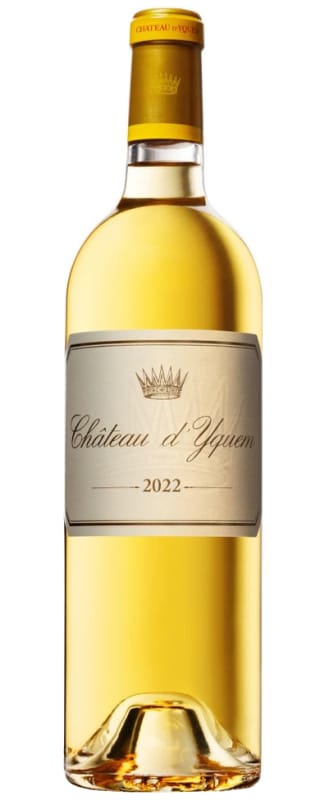


Winemaker Notes
The result of a sunny, extraordinary vintage, 2022 Château d'Yquem boasts a solid and powerful structure. The very first aromas immediately reveal intense botrytised notes – the hallmark of high-quality noble rot. These notes are suggestive of candied lemon and pear, as well as orange marmalade. Delicate floral aromas of lime blossom and frangipane mingle with this fruitiness, enhanced by the sweetness of blooming lily of the valley. The almond and gourmand nose foreshadows wonderful richness on the palate. Starting out lively with candied fruit flavors, 2022 Château d'Yquem is resolutely reminiscent of apricot jam. Rich and concentrated, it coats the palate, revealing notes of beeswax, caramel and quince paste. Its powdery texture is prolonged by a touch of salinity and lovely bitter notes on the finish, which enhance the candied bitter orange characteristic of Yquem wines.
Blend: 80% Sémillon, 20% Sauvignon Blanc
Professional Ratings
-
James Suckling
A perfect Yquem again after the 2021, which is fresher and more refined than the 2022. The perception of sweetness is super-knit. Lots of botrytis, with turmeric, saffron, cream, roasted meringue, pine nuts, spices and dried mangoes. This is a powerful, seductive and lush wine. Ornamented and richer this year than 2021, but there is so much charm and harmony. Long and spicy, with a hint of petrol at the end. Wow. The second most concentrated Yquem after 1945, according to the winemaker. About 160 grams of residual sugar. So approachable now, but better in five or six years. It will live forever.
-
Robert Parker's Wine Advocate
A blend of 80% Sémillon and 20% Sauvignon Blanc, the 2022 d'Yquem is a strong candidate for the title of wine of the vintage. Exhibiting a remarkably delicate, complex and energetic bouquet of rose, confit citrus, exotic fruits and orange marmalade, it's full-bodied, dense and deep with a pristine balance enhanced by a fleshy core of fruit, bright acids and beautiful, gastronomic bitterness and dry extracts that segue to a long, ethereal, delicately perfumed and refined finish. Lorenzo Pasquini and his team have perfectly understood the vintage by privileging the third tries, fully exposed to Botrytis cinerea, in the blend, bringing density and precision along with an energetic and splendidly balanced interplay of bitterness and sweetness. Residual sugar levels reach 160 grams per liter, marking it as the second-highest since the iconic 1945 vintage.
-
Vinous
The 2022 Yquem is a blend of 80% Sémillon and 20% Sauvignon Blanc with 160 g/L residual sugar and a total acidity of 5.39 g/L. It is the first certified organic vintage for the estate and has the lowest level of total sulphur ever: 234 g/L, high within the sphere of wine but comparatively low for Sauternes. The 2022 was aged for 24 months in new barrels that underwent slightly less drying than those used for red wines in order to retain some green tannins. Given the growing season, the 2022 Yquem has a surprisingly understated bouquet that demands coaxing. Scents of orange pith, passion fruit and quince are exquisitely defined, a hint of chamomile dancing around in the background. The palate is medium-bodied. Given the high level of residual sugar, what is surprising is that the 2022 does not seem a weighty or texturally unctuous Yquem, yet there is an intensity and concentration that is arresting. Vivid flavours of clementine, wild honey, quince and tangerine that effortlessly combine. The acidity almost nonchalantly counters the sensation of residual sugar, so it feels less than it actually is, the scintilla of salinity toward the finish tempting you back for more. This is a marvellous and quite cerebral Yquem for which patience is required. - Neal Martin
-
Wine Spectator
Starts slowly, with a creamy and seductive feel to its mix of warmed peach, fresh mango, glazed Anjou pear and mirabelle plum flavors. As this moves along, flashes of singed almond and coconut appear before the finish kicks into another gear, offering green fig, white tea and sweetened butter notes. The entire thing just sails through without a single bob of its hull in an impressive marriage of power and precision. Sémillon and Sauvignon Blanc. Best from 2028 through 2050.


Apart from the classics, we find many regional gems of different styles.
Late harvest wines are probably the easiest to understand. Grapes are picked so late that the sugars build up and residual sugar remains after the fermentation process. Ice wine, a style founded in Germany and there referred to as eiswein, is an extreme late harvest wine, produced from grapes frozen on the vine, and pressed while still frozen, resulting in a higher concentration of sugar. It is becoming a specialty of Canada as well, where it takes on the English name of ice wine.
Vin Santo, literally “holy wine,” is a Tuscan sweet wine made from drying the local white grapes Trebbiano Toscano and Malvasia in the winery and not pressing until somewhere between November and March.
Rutherglen is an historic wine region in northeast Victoria, Australia, famous for its fortified Topaque and Muscat with complex tawny characteristics.

Sweet and unctuous but delightfully charming, the finest Sauternes typically express flavors of exotic dried tropical fruit, candied apricot, dried citrus peel, honey or ginger and a zesty beam of acidity.
Sémillon, Sauvignon Blanc, Sauvignon Gris and Muscadelle are the grapes of Sauternes. But Sémillon's susceptibility to the requisite noble rot makes it the main variety and contributor to what makes Sauternes so unique. As a result, most Sauternes estates are planted to about 80% Sémillon. Sauvignon is prized for its balancing acidity and Muscadelle adds aromatic complexity to the blend with Sémillon.
Botrytis cinerea or “noble rot” is a fungus that grows on grapes only in specific conditions and its onset is crucial to the development of the most stunning of sweet wines.
In the fall, evening mists develop along the Garonne River, and settle into the small Sauternes district, creeping into the vineyards and sitting low until late morning. The next day, the sun has a chance to burn the moisture away, drying the grapes and concentrating their sugars and phenolic qualities. What distinguishes a fine Sauternes from a normal one is the producer’s willingness to wait and tend to the delicate botrytis-infected grapes through the end of the season.