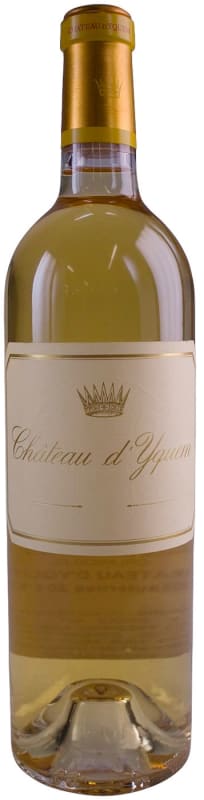


Winemaker Notes
Professional Ratings
-
James Suckling
This is an incredible young Yquem that is so vinous like a great vintage of Montrachet but then on the palate it turns to Yquem with spice, dried fruit and mushroom as well as sweet fruit. Last for minutes. Acidity is all there giving it a dynamic vibrance that jolts your senses. Special wine. It has a little more than than 140 grams of residual sugar, less than the legendary of 2001. But is very close in greatness. Let’s wait and see.
Barrel Sample: 99-100 Points -
Robert Parker's Wine Advocate
Following a very long harvest stretching nearly two months, the 2015 Château d'Yquem came in at 13.9% alcohol and 144 grams per liter of residual sugar, sporting a pH of 3.65 and six grams per liter of tartaric acid. None of these numbers, however, even remotely begin to tell you how profound this wine is. The nose opens with electric notes of ripe pineapples, green mango, orange blossoms and lemon tart with hints of fungi, lime zest, crushed rocks and jasmine. The freshness on the palate is just astonishing, permeating and lifting layer upon layer of tropical fruits and earthy notions, all encased in a sumptuous texture and culminating in a very, very long, mineral-tinged finish. Truly, this is a legendary vintage for d'Yquem. I've been conservative with my drinking window here, and I would not be at all surprised if our descendants are drinking this vintage well into the next century.
-
Wine Enthusiast
This wine is ethereal. It certainly offers attractive honey and bitter orange flavors but also a fresh character that gives the wine lift and crispness. It is, of course, going to age magnificently, although it is so delicious and refreshing now.
Barrel Sample: 96-98 Points -
Wine Spectator
Fresh-cut orange, peach and nectarine notes lead the way, followed by lightly singed almond and warm piecrust notes. Then another wave of green fig, warmed pear and coconut takes over on the finish. Rich and honeyed in feel, with obvious power, balanced by an energy in the inner core that should help this cruise in the cellar for some time. Best from 2020 through 2050.
-
Decanter
About 75% Sémillon and 25% Sauvignon Blanc. Very pure, intense aromas and flavours of peach, lemon curd, tangerine and marmalade botrytis notes. Boasts 144g/l sugar and 6.2 g/l total acidity. Very pure, long and racy rather than rich. It doesn't have the power of 2001 or 2009, nor the freshness of 2011 or 2014, but it is a great wine in the making. If the vintage allows, I'd go back to an 80%/20% Sem-Sauv blend to get back a little of that magical d'Yquem richness.


Apart from the classics, we find many regional gems of different styles.
Late harvest wines are probably the easiest to understand. Grapes are picked so late that the sugars build up and residual sugar remains after the fermentation process. Ice wine, a style founded in Germany and there referred to as eiswein, is an extreme late harvest wine, produced from grapes frozen on the vine, and pressed while still frozen, resulting in a higher concentration of sugar. It is becoming a specialty of Canada as well, where it takes on the English name of ice wine.
Vin Santo, literally “holy wine,” is a Tuscan sweet wine made from drying the local white grapes Trebbiano Toscano and Malvasia in the winery and not pressing until somewhere between November and March.
Rutherglen is an historic wine region in northeast Victoria, Australia, famous for its fortified Topaque and Muscat with complex tawny characteristics.

Sweet and unctuous but delightfully charming, the finest Sauternes typically express flavors of exotic dried tropical fruit, candied apricot, dried citrus peel, honey or ginger and a zesty beam of acidity.
Sémillon, Sauvignon Blanc, Sauvignon Gris and Muscadelle are the grapes of Sauternes. But Sémillon's susceptibility to the requisite noble rot makes it the main variety and contributor to what makes Sauternes so unique. As a result, most Sauternes estates are planted to about 80% Sémillon. Sauvignon is prized for its balancing acidity and Muscadelle adds aromatic complexity to the blend with Sémillon.
Botrytis cinerea or “noble rot” is a fungus that grows on grapes only in specific conditions and its onset is crucial to the development of the most stunning of sweet wines.
In the fall, evening mists develop along the Garonne River, and settle into the small Sauternes district, creeping into the vineyards and sitting low until late morning. The next day, the sun has a chance to burn the moisture away, drying the grapes and concentrating their sugars and phenolic qualities. What distinguishes a fine Sauternes from a normal one is the producer’s willingness to wait and tend to the delicate botrytis-infected grapes through the end of the season.