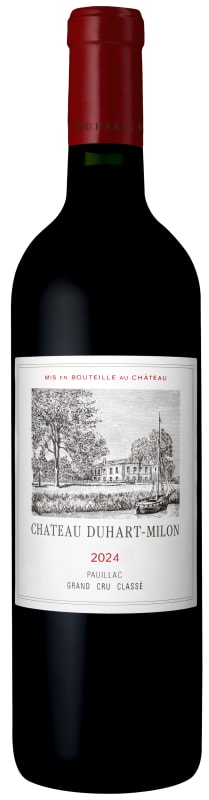


Winemaker Notes
Blend: 78% Cabernet-Sauvignon, 22% Merlot
This wine does not include the blanket 10% tariff imposed in April 2025. When the wines are shippable in fall of 2027, customers will have the option to pay any tariff in place at the time or to keep their wines stored in a temperature-controlled facility free of charge in France.
Professional Ratings
-
James Suckling
A lighter vintage that highlights finesse rather than power or concentration. Fresh blue fruit with a medium body and fine-grained tannins. Fresh but supple in a refined, medium-long finish. 78% cabernet sauvignon and 22% merlot.
Barrel Sample: 93-94 -
Decanter
Dark fragrant black berries with milk chocolate accents. Smells rich and heady. Smooth and sappy, this has a nice texture straight away, fine tannins have a soft chalkiness with some bramble fruit underneath alongside subtle tobacco, dark chocolate and liquorice saltiness. Calm and collected, gentle but still with structure and a slow strength. Great mouth-watering acidity and fruit all the way through. A yield of 32hl/ha. 3.75pH. 14% press. No Moulin de Duhart being offered En Primeur.
Barrel Sample: 93 -
Jeb Dunnuck
The 2024 Château Duhart-Milon is based on 78% Cabernet Sauvignon and 22% Merlot that was harvested between the 24th of September and the 8th of October. Ripe darker berries, framboise, subtle cassis as well as spicy, floral nuances all define the aromatics, and it's a medium-bodied, pretty, layered, graceful Pauillac. It has solid ripeness, a pure, layered mouthfeel, and outstanding length.
Barrel Sample: 91-93 -
Robert Parker's Wine Advocate
A blend of 78% Cabernet Sauvignon and 22% Merlot, the 2024 Duhart-Milon was cropped at 32 hectoliters per hectare, and it was here that the Lafite team concluded the harvest. Offering up aromas of cassis and red berries mingled with hints of violets, pen ink, licorice and toasty oak, it's medium to full-bodied, supple and fleshy, with a round, integrated, charming profile, concluding with a moderately persistent finish.
Barrel Sample: 90-93 -
Vinous
The 2024 Duhart-Milon opens with strong Cabernet Sauvignon inflections. Blue-toned fruit, lavender, spice and dried herbs open first, all framed by brisk acids and supporting tannins that lend shape. The 2024 includes 14% press wines, about the norm here. This is a very promising Duhart. –Antonio Galloni
Barrel Sample: 91-93


One of the world’s most classic and popular styles of red wine, Bordeaux-inspired blends have spread from their homeland in France to nearly every corner of the New World. Typically based on either Cabernet Sauvignon or Merlot and supported by Cabernet Franc, Malbec and Petit Verdot, the best of these are densely hued, fragrant, full of fruit and boast a structure that begs for cellar time. Somm Secret—Blends from Bordeaux are generally earthier compared to those from the New World, which tend to be fruit-dominant.

The leader on the Left Bank in number of first growth classified producers within its boundaries, Pauillac has more than any of the other appellations, at three of the five. Chateau Lafite Rothschild and Mouton Rothschild border St. Estephe on its northern end and Chateau Latour is at Pauillac’s southern end, bordering St. Julien.
While the first growths are certainly some of the better producers of the Left Bank, today they often compete with some of the “lower ranked” producers (second, third, fourth, fifth growth) in quality and value. The Left Bank of Bordeaux subscribes to an arguably outdated method of classification that goes back to 1855. The finest chateaux in that year were judged on the basis of reputation and trading price; changes in rank since then have been miniscule at best. Today producers such as Chateau Pontet-Canet, Chateau Grand Puy-Lacoste, Chateau Lynch-Bages, among others (all fifth growth) offer some of the most outstanding wines in all of Bordeaux.
Defining characteristics of fine wines from Pauillac (i.e. Cabernet-based Bordeaux Blends) include inky and juicy blackcurrant, cedar or cigar box and plush or chalky tannins.
Layers of gravel in the Pauillac region are key to its wines’ character and quality. The layers offer excellent drainage in the relatively flat topography of the region allowing water to run off into “jalles” or streams, which subsequently flow off into the Gironde.