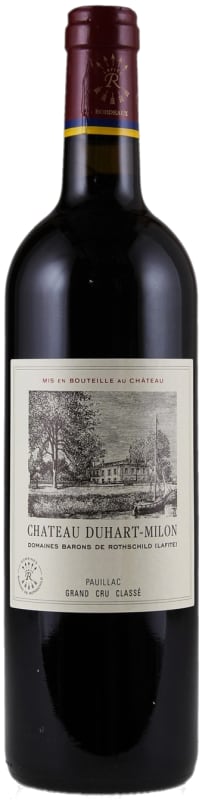


Winemaker Notes
Blend: 65% Cabernet Sauvignon, 35% Merlot
Professional Ratings
-
James Suckling
Sweet berries and cherries on the nose with sweet tobacco, lead pencil and blackcurrants. It’s full-bodied and very rich with layers of fruit and creamy tannins intertwined. Extremely long and creamy. Great Duhart. Try after 2026.
-
Decanter
One of the real successes of the Lafite stable in 2018. You get the rich, smooth texture straight off the nose, continued by a velvety texture and a full mouthfeel. Serious with a long life ahead. This is one of the more voluptuous Duhart-Milons that I have tasted, and will expand the audience for this wine in my opinion. Plenty of black fruits, bitter chocolate, liquorice, slate and pencil lead. Ticks the boxes of both Pauillac and Cabernet Sauvignon character. Very good-quality. Drinking Window 2026 - 2044
-
Wine Enthusiast
This is a ripe, classic Cabernet Sauvignon-based wine. Its strict initial character blossoms out into rich black-currant flavors that exude class. Backed by acidity and with hints of the wood aging still in place, the wine is just beginning its journey. Drink from 2027.
-
Wilfred Wong of Wine.com
COMMENTARY: I have tasted a lot of Château Duhart-Milon in my career, including many times at the Château Lafite-Rothschild, and the 2018 vintage comes across as one of the best efforts ever. TASTING NOTES: This wine is packed and extracted with black fruit, oak, and violets in its aromas and flavors. Pair it with oven-roasted rosemary and black peppercorn-accented leg of lamb. (Tasted: June 25, 2021, San Francisco, CA)
-
Robert Parker's Wine Advocate
The 2018 Duhart-Milon is composed of 65% Cabernet Sauvignon and 35% Merlot. With 14% alcohol, it has a deep garnet-purple color and a seductively ripe, opulent nose of plum preserves, blackberry pie and chocolate-covered cherries with hints of spice cake, potpourri, sandalwood and eucalyptus oil. Medium-bodied, it is jam-packed with rich, spicy black fruit preserves, with floral accents and a velvety texture, finishing long and fragrant. So. Good. Rating: 94+
-
Jeb Dunnuck
I was slightly disappointed in the 2018 Château Duhart-Milon, and while it's certainly a beautiful wine, it's not in the same league as the 2009, as I thought when tasting it from barrel. Nevertheless, it has impressive notes of red and black currants, new leather, tobacco leaf, and lead pencil shavings to go with a medium to full-bodied, beautifully balanced, elegant style on the palate. It has some up-front appeal, as the tannins are ripe and polished, yet it's going to improve over the coming 4-6 years or so and should hold nicely for 20 years or more.
-
Wine Spectator
This is packed with succulent blackberry and black currant fruit, along with mulling spice, sweet tobacco, licorice root and alder notes. Youthfully jumbled, but the pieces are there, the mouthfeel is alluring and the length is there for sure. For the cellar. Cabernet Sauvignon and Merlot. Best from 2025 through 2036.


One of the world’s most classic and popular styles of red wine, Bordeaux-inspired blends have spread from their homeland in France to nearly every corner of the New World. Typically based on either Cabernet Sauvignon or Merlot and supported by Cabernet Franc, Malbec and Petit Verdot, the best of these are densely hued, fragrant, full of fruit and boast a structure that begs for cellar time. Somm Secret—Blends from Bordeaux are generally earthier compared to those from the New World, which tend to be fruit-dominant.

The leader on the Left Bank in number of first growth classified producers within its boundaries, Pauillac has more than any of the other appellations, at three of the five. Chateau Lafite Rothschild and Mouton Rothschild border St. Estephe on its northern end and Chateau Latour is at Pauillac’s southern end, bordering St. Julien.
While the first growths are certainly some of the better producers of the Left Bank, today they often compete with some of the “lower ranked” producers (second, third, fourth, fifth growth) in quality and value. The Left Bank of Bordeaux subscribes to an arguably outdated method of classification that goes back to 1855. The finest chateaux in that year were judged on the basis of reputation and trading price; changes in rank since then have been miniscule at best. Today producers such as Chateau Pontet-Canet, Chateau Grand Puy-Lacoste, Chateau Lynch-Bages, among others (all fifth growth) offer some of the most outstanding wines in all of Bordeaux.
Defining characteristics of fine wines from Pauillac (i.e. Cabernet-based Bordeaux Blends) include inky and juicy blackcurrant, cedar or cigar box and plush or chalky tannins.
Layers of gravel in the Pauillac region are key to its wines’ character and quality. The layers offer excellent drainage in the relatively flat topography of the region allowing water to run off into “jalles” or streams, which subsequently flow off into the Gironde.