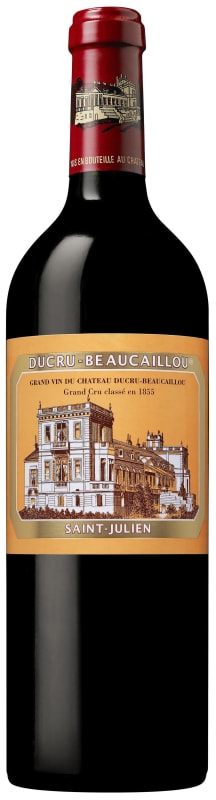


Winemaker Notes
The bouquet seduces with an alluring perfume that layers delicate violets, opulent crème de cassis and blackberry coulis, and exotic star anise with crystalline definition. A full body of densely concentrated fruits and tightly woven, mouthcoating tannins gives a luxurious draping texture to the palate. The opulent flavors are lifted by an exquisite freshness and a saline mineral edge defines the very long, succulent finish. With its juxtaposition of concentrated richness and finessed elegance, the 2022 has timeless glamour with a modern twist.
Blend: 82% Cabernet Sauvignon, 18% Merlot
Professional Ratings
-
Jeb Dunnuck
The Grand Vin 2022 Château Ducru-Beaucaillou checks in as 82% Cabernet Sauvignon and 18% Merlot that was raised all in new barrels. Its deep ruby/purple/plum hue is followed by an utterly heavenly Saint-Julien that has pure cassis and darker berry fruits, a core of violets, spring flowers, graphite, and spicy oak, full-bodied richness, and ultra-fine, polished tannins. It's as seamless, pure, and elegant as they come, while at the same time being intense, powerful, and concentrated.For the tech geeks out there, the 2022 hit 14% alcohol with a pH of 3.8 and an IPT of 95. It’s an absolute sensational Saint-Julien from this talented team. Rating: 98+
-
Decanter
Beautiful and beguiling nose, perfumed blackcurrants and dark fruits; damsons, plums, raspberries and rose petals. Lovely crunchy fruit, real bite and presence in the mouth. Excellent precision, tannins are succulent and ripe they fill the mouth with a juicy, intense granular texture. There is such depth to this - perfume, tobacco, earth, violets and concentrated fruits that have a verticality to them with an unprecedented 98% of Cabernet Sauvignon providing the support and the backbone. There is a crystalline purity to the fruit giving tension to the overall frame, it’s focused and driven all with excellent definition. This is not a wallflower of a wine - it’s charming and confident, strutting its stuff right now and giving you absolut St-Julien terroir and vintage markers in the glass with slate, graphite and liquorice salinity on show. Skilled winemaking on show.
Barrel Sample: 97 -
Robert Parker's Wine Advocate
One of the Médoc's most powerful wines this year is the 2022 Ducru-Beaucaillou, a blend of 82% Cabernet Sauvignon and 18% Merlot that opens in the glass with aromas of dark cherries and berries mingled with pencils shavings, vanilla pod and spices. Full-bodied, broad-shouldered and muscular, with a core of ripe but lively fruit underpinned by a chassis of powdery, liberally extracted tannin that asserts itself on the finish, it's a punchy, modern Saint-Julien reminiscent of a hypothetical blend of the 2018 and 2020.
Barrel Sample: 94-96 -
James Suckling
A great, powerful and proportional Ducru with everything in the right place. The aromas and flavors are very precise and beautiful with blackberry, raspberry and citrus undertones. Full-bodied and structured, it has polished electric tannins that are finely layered, well formed and very long. Remains cool on the palate. 82% cabernet sauvignon and 18% merlot.


One of the world’s most classic and popular styles of red wine, Bordeaux-inspired blends have spread from their homeland in France to nearly every corner of the New World. Typically based on either Cabernet Sauvignon or Merlot and supported by Cabernet Franc, Malbec and Petit Verdot, the best of these are densely hued, fragrant, full of fruit and boast a structure that begs for cellar time. Somm Secret—Blends from Bordeaux are generally earthier compared to those from the New World, which tend to be fruit-dominant.

An icon of balance and tradition, St. Julien boasts the highest proportion of classed growths in the Médoc. What it lacks in any first growths, it makes up in the rest: five amazing second growth chateaux, two superb third growths and four well-reputed fourth growths. While the actual class rankings set in 1855 (first, second, and so on the fifth) today do not necessarily indicate a score of quality, the classification system is important to understand in the context of Bordeaux history. Today rivalry among the classed chateaux only serves to elevate the appellation overall.
One of its best historically, the estate of Leoville, was the largest in the Médoc in the 18th century, before it was divided into the three second growths known today as Chateau Léoville-Las-Cases, Léoville-Poyferré and Léoville-Barton. Located in the north section, these are stone’s throw from Chateau Latour in Pauillac and share much in common with that well-esteemed estate.
The relatively homogeneous gravelly and rocky top soil on top of clay-limestone subsoil is broken only by a narrow strip of bank on either side of the “jalle,” or stream, that bisects the zone and flows into the Gironde.
St. Julien wines are for those wanting subtlety, balance and consistency in their Bordeaux. Rewarding and persistent, the best among these Bordeaux Blends are full of blueberry, blackberry, cassis, plum, tobacco and licorice. They are intense and complex and finish with fine, velvety tannins.