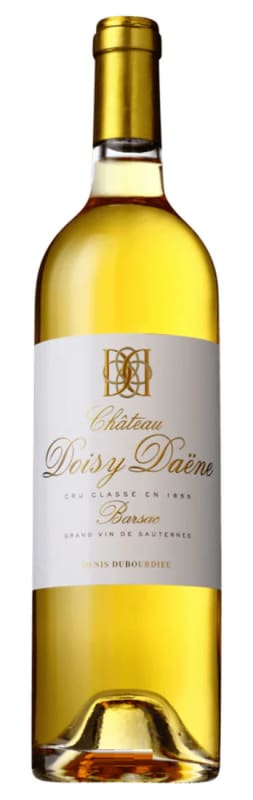


Winemaker Notes
Professional Ratings
-
James Suckling
There’s a wealth of rich, ripe apricots and sweetly fragrant peaches here, as well as a gently tropical edge. The palate is fleshy and richly sweet and offers smooth orange-marmalade flavors. Striking elegance and length here. A blend of semillon and sauvignon blanc. Drink or hold.
-
Robert Parker's Wine Advocate
Pale lemon in color, the 2016 Doisy Daëne leaps from the glass with flamboyant tropical fruit notions of warm pineapple, guava and passion fruit plus hints of lime cordial, fungi, musk perfume and chalk dust. The palate has loads of earthy/savory layers with great concentration and depth, finishing long and lively.
-
Decanter
I love the ginger-spiced quality that is so evident in the sweet wines this year, a gorgeous addition that deepens the experience. This feels like a drop of luxury, and on a second tasting I covet the seams of minerality that are clearly evident. A rich style. Drinking Window 2022 - 2050


Apart from the classics, we find many regional gems of different styles.
Late harvest wines are probably the easiest to understand. Grapes are picked so late that the sugars build up and residual sugar remains after the fermentation process. Ice wine, a style founded in Germany and there referred to as eiswein, is an extreme late harvest wine, produced from grapes frozen on the vine, and pressed while still frozen, resulting in a higher concentration of sugar. It is becoming a specialty of Canada as well, where it takes on the English name of ice wine.
Vin Santo, literally “holy wine,” is a Tuscan sweet wine made from drying the local white grapes Trebbiano Toscano and Malvasia in the winery and not pressing until somewhere between November and March.
Rutherglen is an historic wine region in northeast Victoria, Australia, famous for its fortified Topaque and Muscat with complex tawny characteristics.

Characterized by dried tropical fruit, candied apricot, citrus and honey, the sweet wines of Barsac are always balanced by a bright beam of acidity. While technically also part of the Sauternes region, Barsac’s sandy and limestone soils produce a lighter version in comparison. Its main grapes are the same: Sémillon, Sauvignon Blanc, Sauvignon Gris and Muscadelle.