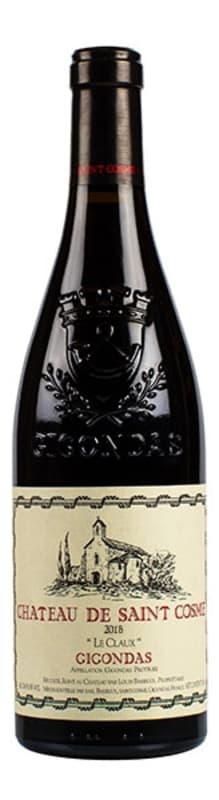


Winemaker Notes
Very old mixed plantings of Grenache in the ‘Le Claux’ named vineyard. Whole cluster fermentation. Miocene limestone marl in the Font des Papes alluvial fan.Twelve months’ ageing: 20% in new casks - 50% in casks used for one wine - 30% in casks used for two wines.
Le Claux, planted in 1870 on the very first American rootstocks resistant to phylloxera, had to be pulled up in 1914 because the vineyard was beginning to age and production was declining. At the time, there was little talk of quality but people wanted to produce large crops. My great-uncle Albert Vaton, a balloonist who was a prisoner in Germany during the First World War, wrote regularly to my grandmother who had stayed in Gigondas (yes, French and Germans exchanged letters from their respective prisoners...). When harvest time came, he would ask his sister if there was going to be a big crop. He never mentioned quality. In 1918, there were almost no men left. Uncle Albert died on November 9, 1918, 2 days before the armistice, and the vineyard was not uprooted due to lack of manpower. In the 1970s, the vineyard was so worn out that my father used monumental amounts of sheep manure to re-energize Le Claux.He stored the manure just around the corner from the house. I was a child and found the smell atrocious. I couldn't understand how my father could say that this manure was “extraordinary”!!! After all its ups and downs, Le Claux is now an old lady in good shape and we plant replacement vines there every year. I don't think we will ever uproot it. In 2018, Claux expresses its customary aromatics of tar, soot and blackberry which inevitably remind us of the array of aromas in a good Barolo: it’s all in the terroir... Peat, camphor, truffle, blackberry.
Professional Ratings
-
Robert Parker's Wine Advocate
Aromas of peony, pepper, violet and dark wild berries preface the 2018 Gigondas le Claux, a full-bodied, dense and tannic wine with velvety tannins, a multidimensional core of fruit, fleshy texture and a long, spicy and delicately peppery finish that exhales the controlled power. It has all the components in place for a long and lovely life in a bottle.
-
Jeb Dunnuck
Coming from a site just across the road from the Hominis Fides vineyard, the 2018 Gigondas Le Claux was not destemmed and brought up mostly in used, larger barrels. Beautifully Provençal notes of black raspberries, camphor, flowery incense, and peppery spice and emerge from the glass and this beauty is reminds me of a Grand Cru Red Burgundy on the palate with its seamless, elegant, layered texture. It’s not a blockbuster like the 2016 and 2017 yet shines for its complex aromatics and flawless balance. It also has more than enough structure to evolve for two decades.
-
Wine Spectator
Quite ripe, with waves of warmed plum sauce and blackberry preserves rolling through, wrapped liberally with licorice root, sage and lavender notes. Iron minerality runs through the finish, letting the fruit and savory notes meld wonderfully. Built for the cellar. Best from 2022 through 2035.
-
Wine & Spirits
Le Claux was planted in 1870 using the first phylloxera-resistant American rootstocks available in the region, and the vineyard still retains some of those original vines—about ten percent, Louis Barruol believes, crediting his father for his heroic efforts to revive them. Those old vines, planted in an alluvial fan, grew a particularly dark, brooding Gigondas in 2018. It’s chewy and dense, with black-fig and blackberry flavors and an intriguingly earthy, gamey funk, and yet there’s still crunch to the fruit, a vibrancy that keeps it from feeling too heavy. Built for a thick-cut steak, or a decade in the cellar.


With bold fruit flavors and accents of sweet spice, Grenache, Syrah and Mourvèdre form the base of the classic Rhône Red Blend, while Carignan, Cinsault and Counoise often come in to play. Though they originated from France’s southern Rhône Valley, with some creative interpretation, Rhône blends have also become popular in other countries. Somm Secret—Putting their own local spin on the Rhône Red Blend, those from Priorat often include Merlot and Cabernet Sauvignon. In California, it is not uncommon to see Petite Sirah make an appearance.

The Southern Rhône region of Gigondas extends northwest from the notably jagged wall of mountains called the Dentelles di Montmirail, whose highest point climbs to about 2,600 feet. The region and its wines have much in common with the neighboring Chateauneuf-du-Pape except that the vineyards of Gigondas exist at higher elevation and its soils, comprised mainly of crumbled limestone from the Dentelles, often produce a more dense and robust Grenache-based red wine.
The region has a history of fine winemaking, extending back to Roman times. But by the 20th century, Gigondas was merely lumped into the less distinct zone of Côtes du Rhône Villages. However, it was first among these satellite villages to earn its own appellation, which occurred in 1971.
Gigondas reds must be between 50 to 100% Grenache with Syrah and Mourvèdre comprising the bulk of the remainder of the blend. They tend express rustic flavors and aromas of wild blackberry, raspberry, fig, plum, as well as juniper, dried herbs, anise, smoke and river rock. The best are bold but balanced, and finish with impressively sexy and velvety tannins.
The Gigondas appellation also produces rosé but no white wines.