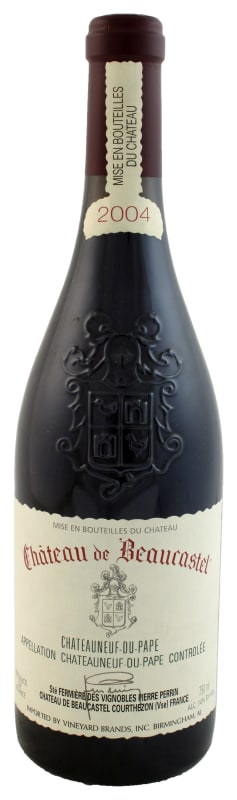


Winemaker Notes
The vineyard is a patchwork of all 13 permitted grape varieties, 70 hectares in all. The soil is the same porous, aerated blanket of Alpine diluvium (rounded stones) on a base of Miocene marine limestone that exists elsewhere on the estate. The vines are on average 50 years old and yields are never more than 30 hectolitres per hectare and often much less. It is a vibrant and healthy vineyard due to years of organic cultivation and close monitoring of the needs of each vine.
The red wine of Beaucastel as with Coudoulet de Beaucastel is a structured, intense yet lean drink, thanks in part to the large percentage of Mourvedre - about 30% - in the final cuvée. Its austere tannic backbone and resistant to oxidation help Beaucastel age gracefully.
Professional Ratings
-
Wine Spectator
Thoroughly primal, with a torrent of raspberry and boysenberry fruit rushing forth. Only shows hints of its full range, with licorice, incense, graphite and mocha flavors fluttering in the background. Has an iron-clad structure, with a long finish that shows great cut and grip.
-
Robert Parker's Wine Advocate
Showing brilliantly, with a deep, rich and layered profile, the straight 2004 Chateauneuf du Pape has gorgeous black cherry, earth, underbrush and background meatiness that gives way to a full-bodied, concentrated and pure feel on the palate. A foudre-aged blend of 30% Mourvedre, 30% Grenache, 10% Syrah and 5% Cinsault, with the balance a mix of the other permitted varieties, this knockout Chateauneuf du Pape will have another 10-15 years of prime drinking.
-
Jeb Dunnuck
Rich and meaty with stunning dark fruit, licorice, truffle and earthy notes; the 2004 Château de Beaucastel Châteauneuf-du-Pape has beautiful purity and impressive richness given the vintage. The palate is medium to full bodied with a tight, young and structured feel, plenty of fruit and ripe tannins on the finish. I'd be happy to have a couple of these in the cellar.
Rating: 93+ -
Wine & Spirits
This takes hours in the glass to reveal its potential. Then its silken texture begins to let up aromas of cedar and spice and the flavors deepen, becoming meatier even while brighter notes of red cherry begin to shine. Those flavors last, strong and long, feeling complete.


With bold fruit flavors and accents of sweet spice, Grenache, Syrah and Mourvèdre form the base of the classic Rhône Red Blend, while Carignan, Cinsault and Counoise often come in to play. Though they originated from France’s southern Rhône Valley, with some creative interpretation, Rhône blends have also become popular in other countries. Somm Secret—Putting their own local spin on the Rhône Red Blend, those from Priorat often include Merlot and Cabernet Sauvignon. In California, it is not uncommon to see Petite Sirah make an appearance.

Famous for its full-bodied, seductive and spicy reds with flavor and aroma characteristics reminiscent of black cherry, baked raspberry, garrigue, olive tapenade, lavender and baking spice, Châteauneuf-du-Pape is the leading sub-appellation of the southern Rhône River Valley. Large pebbles resembling river rocks, called "galets" in French, dominate most of the terrain. The stones hold heat and reflect it back up to the low-lying gobelet-trained vines. Though the galets are typical, they are not prominent in every vineyard. Chateau Rayas is the most obvious deviation with very sandy soil.
According to law, eighteen grape varieties are allowed in Châteauneuf-du-Pape and most wines are blends of some mix of these. For reds, Grenache is the star player with Mourvedre and Syrah coming typically second. Others used include Cinsault, Counoise and occasionally Muscardin, Vaccarèse, Picquepoul Noir and Terret Noir.
Only about 6-7% of wine from Châteauneuf-du-Pape is white wine. Blends and single-varietal bottlings are typically based on the soft and floral Grenache Blanc but Clairette, Bourboulenc and Roussanne are grown with some significance.
The wine of Chateauneuf-du-Pape takes its name from the relocation of the papal court to Avignon. The lore says that after moving in 1309, Pope Clément V (after whom Chateau Pape-Clément in Pessac-Léognan is named) ordered that vines were planted. But it was actually his successor, John XXII, who established the vineyards. The name however, Chateauneuf-du-Pape, translated as "the pope's new castle," didn’t really stick until the 19th century.