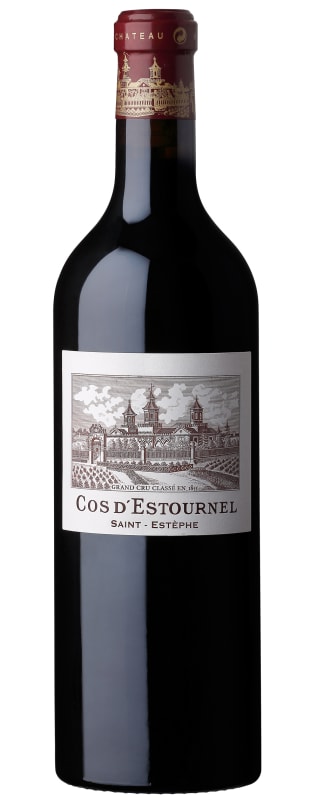


Winemaker Notes
Cos d'Estournel has become, in the eyes of lovers of fine wines, the archetype of a certain style of masculine elegance in which immense power is combined with grace and smoothness. Impressive when young for the intensity of its structure and explosive fruit, Cos d'Estournel evolves slowly to arrive, when completely mature (after ten to thirty years) at an admirable smoothness and aromatic complexity.
Professional Ratings
-
Jeb Dunnuck
The 2010 Château Cos D'Estournel is based on 78% Cabernet Sauvignon, 19% Merlot, 2% Cabernet Franc and the rest Petit Verdot that was pulled from just 55% of the total production and aged in 80% new French oak. Hitting 14.5% natural alcohol, this still dense purple-hued beauty offers extraordinary notes of blackcurrants, unsmoked tobacco, graphite, freshly sharpened pencils, and chocolate. Full-bodied, massively concentrated, and flawlessly balanced on the palate, it has building tannins, a skyscraper-like mouthfeel that opens up with time in the glass, and a great, great finish. Made in a much more focused, precise, and structured style compared to the more flamboyant 2009, it needs another 7-8 years of bottle age and will be a 50, 60, if not 75+ year wine.
-
James Suckling
Lifted nose of dried flowers, walnuts and dark fruits. Intense nose. A full-bodied wine, with powerful flavors of blackberries, coffee, dried herbs and spices. Super silky tannins and a long, long finish. Layered and flashy.
-
Vinous
The 2010 Cos d’Estournel has long been my preference over the 2009. That vintage kowtowed to the crowd and yes, to critics. The 2010 is less compromising but more intellectual. It has a scintillating, pixelated bouquet with intense black fruit, asphalt and mint aromas – vivid and bright, much more focused and certainly less flamboyant than the 2009. The palate is medium-bodied with a huge chassis; a Saint-Estèphe clearly built for the long-term with enormous grip and enthralling tension. As before, there is a liberal sprinkling of white pepper towards the finish and is exceptionally long. The 2010 is the finest Cos d’Estournel until the more finessed 2016 comes along. It is a deeply impressive wine but it will appeal more to those that prefer classic Bordeaux to one boasting tons of fruit, as pleasurable as that might be. Tasted at the Cos d’Estournel vertical in London.
-
Decanter
Darkly fragranced, with chocolate, blackcurrants and violets, ripe fruit and soft woody touches. Tense and compact, tannins with a lovely texture. Nice weight and balance. Silky and streamlined, polished and poised. Long, clean finish with a salty liquorice, tobacco mineral touch. Great structure, weight and definition.
-
Wilfred Wong of Wine.com
Cos is going back to its roots, the 2010 Ch Cos d'Estournel has returned to Saint-Estephe ways after flirting with flamboyancy. For a while, I was seeing so much lavish oak and extreme ripeness that I could not fine the stones and minerality in this wine. Of course, many of us drank and enjoyed those wines anyway. I really like this vintage for its return to purity. (Best Served: 2022-2040)
-
Robert Parker's Wine Advocate
Deep garnet in color, the 2010 Cos d'Estournel unfurls slowly, measuredly, releasing delicate notes of dried mulberries, stewed plums and blackcurrant pastilles before giving way to notions of potpourri, black cherry compote and chocolate box plus touches of dried sage, tobacco and new leather. Medium to full-bodied, the palate has a rock-solid foundation of very firm, grainy tannins and very lively acidity supporting the remarkable intensity of tightly wound fruit layers, finishing very long and fragrant. Give it another 4-5 years in bottle and this will be stunning!
-
Wine Enthusiast
This is a complex and rich wine dominated by superripe fruit. It is a wine of extremes, of fruit, of dark tannins allied to some bitterness from the black chocolate extract. Ripe plums and sweet black fruits are given a lift at the end with bright acidity.
-
Wine Spectator
An extremely well-sculpted, modern wine, with an enormous core of plum sauce, blackberry coulis and cassis fruit to match the ambitious roasted apple wood-, black tea- and tobacco-infused toast. Dense and chewy now, displaying the tannic spine of the vintage, this remains integrated, racy and incredibly long, offering a piercing chalky backbone that rivets everything together. Best from 2018 through 2038.


One of the world’s most classic and popular styles of red wine, Bordeaux-inspired blends have spread from their homeland in France to nearly every corner of the New World. Typically based on either Cabernet Sauvignon or Merlot and supported by Cabernet Franc, Malbec and Petit Verdot, the best of these are densely hued, fragrant, full of fruit and boast a structure that begs for cellar time. Somm Secret—Blends from Bordeaux are generally earthier compared to those from the New World, which tend to be fruit-dominant.

Deeply colored, concentrated, and distinctive, St. Estephe is the go-to for great, age-worthy and reliable Bordeaux reds. Separated from Pauillac merely by a stream, St. Estephe is the farthest northwest of the highest classed villages of the Haut Medoc and is therefore subject to the most intense maritime influence of the Atlantic.
St. Estephe soils are rich in gravel like all of the best sites of the Haut Medoc but here the formation of gravel over clay creates a cooler atmosphere for its vines compared to those in the villages farther downstream. This results in delayed ripening and wines with higher acidity compared to the other villages.
While they can seem a bit austere when young, St. Estephe reds prove to live very long in the cellar. Traitionally dominated by Cabernet Sauvignon, many producers now add a significant proportion of Merlot to the blend, which will soften any sharp edges of the more tannic, Cabernet.
The St. Estephe village contains two second growths, Chateau Montrose and Cos d’Estournel.