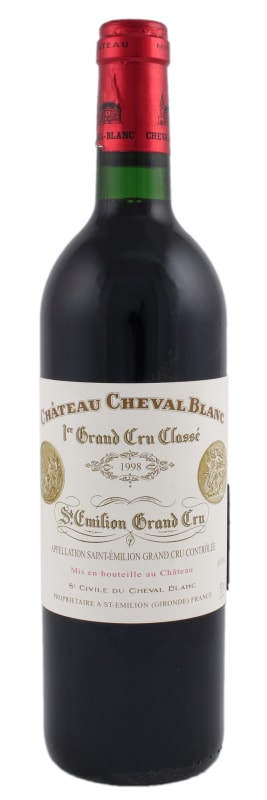


Winemaker Notes
Probably the greatest Cheval Blanc of the second half o the 20th century. To lay down a long time.
Professional Ratings
-
Decanter
The reference chateau of the vintage, this wine is showing its class here and then some. It was the first year with Bernard Arnault and Albert Frère as owners, with Pierre Lurton coming onboard from his former role at Clos Fourtet. 10% press wine was used, whereas today they use no press wine in the grand vin. It was aged in 100% new oak. The 36ha of vines yielded 32hl/ha, closer to their average than the relatively abundant 1989). The holdings have since expanded to 39ha with the addition of 3ha from Tour du Pin Figeac. 67% of production went in to the grand vin, the rest into Petit Cheval. This is seductive and rich but with a purity and precision. There's more Merlot in the blend than is typical because the clay soils produced the best quality grapes, and you can see its impact in the textural density - the proximity to Pomerol comes through.
-
Jeb Dunnuck
Another perfect wine is the 1998 Chateau Cheval Blanc, which is the usual blend of 55/45 Merlot and Cabernet Franc. Possessing an utterly captivating bouquet of sweet red and black fruits, forest floor, spice and dried flowers, it packs plenty of muscle and depth on the palate, yet is also expansive, elegant and seamless, with no hard edges. Just singing, with everything you could want; complexity, richness, elegance, depth, and length, drink this sensational beauty any time over the coming two decades. I’m sure it will keep longer, but why in the world would you wait.
-
Wine Spectator
Aromas of blueberry, sweet tobacco, leather and pipe tobacco turning to raisins and Christmas cake. What a wine. Full-bodied, with chewy tannins and a very well-integrated palate. Dark color. A big and powerful wine still. Blockbuster. Massive. Just a baby.—'88/'98 Bordeaux blind retrospective (2008). Best after 2013.
-
James Suckling
Aromas of rose petal and hints of fresh herbs such currant leaf. Tobacco, too. Medium body, very fine tannins and a balanced fruit. Extremely refined and polished. A beautiful harmony. So lovely now.
-
Robert Parker's Wine Advocate
I seriously underestimated this wine, as I have often tended to do with Cheval Blanc. A potentially immortal example that has gained significant weight since it has been bottled, this blend of 55% Cabernet Franc and 45% Merlot has a saturated purple color and a glorious nose of menthol, plums, mulberries, new saddle leather, cocoa, and vanilla. Remarkably fuller-bodied than I ever remembered it young, with an amazingly seamless texture and tremendous concentration and extract, this full-bodied yet gorgeously pure and elegant wine is impeccably balanced and certainly one of the all-time great Cheval Blancs. If it continues to improve as much as it has over the last three years since bottling, this wine will certainly rival the 2000, 1990, and 1982.
Rating: 96+ Points


One of the world’s most classic and popular styles of red wine, Bordeaux-inspired blends have spread from their homeland in France to nearly every corner of the New World. Typically based on either Cabernet Sauvignon or Merlot and supported by Cabernet Franc, Malbec and Petit Verdot, the best of these are densely hued, fragrant, full of fruit and boast a structure that begs for cellar time. Somm Secret—Blends from Bordeaux are generally earthier compared to those from the New World, which tend to be fruit-dominant.

Marked by its historic fortified village—perhaps the prettiest in all of Bordeaux, the St-Émilion appellation, along with its neighboring village of Pomerol, are leaders in quality on the Right Bank of Bordeaux. These Merlot-dominant red wines (complemented by various amounts of Cabernet Franc and/or Cabernet Sauvignon) remain some of the most admired and collected wines of the world.
St-Émilion has the longest history in wine production in Bordeaux—longer than the Left Bank—dating back to an 8th century monk named Saint Émilion who became a hermit in one of the many limestone caves scattered throughout the area.
Today St-Émilion is made up of hundreds of independent farmers dedicated to the same thing: growing Merlot and Cabernet Franc (and tiny amounts of Cabernet Sauvignon). While always roughly the same blend, the wines of St-Émilion vary considerably depending on the soil upon which they are grown—and the soils do vary considerably throughout the region.
The chateaux with the highest classification (Premier Grand Cru Classés) are on gravel-rich soils or steep, clay-limestone hillsides. There are only four given the highest rank, called Premier Grand Cru Classés A (Chateau Cheval Blanc, Ausone, Angélus, Pavie) and 14 are Premier Grand Cru Classés B. Much of the rest of the vineyards in the appellation are on flatter land where the soils are a mix of gravel, sand and alluvial matter.
Great wines from St-Émilion will be deep in color, and might have characteristics of blackberry liqueur, black raspberry, licorice, chocolate, grilled meat, earth or truffles. They will be bold, layered and lush.