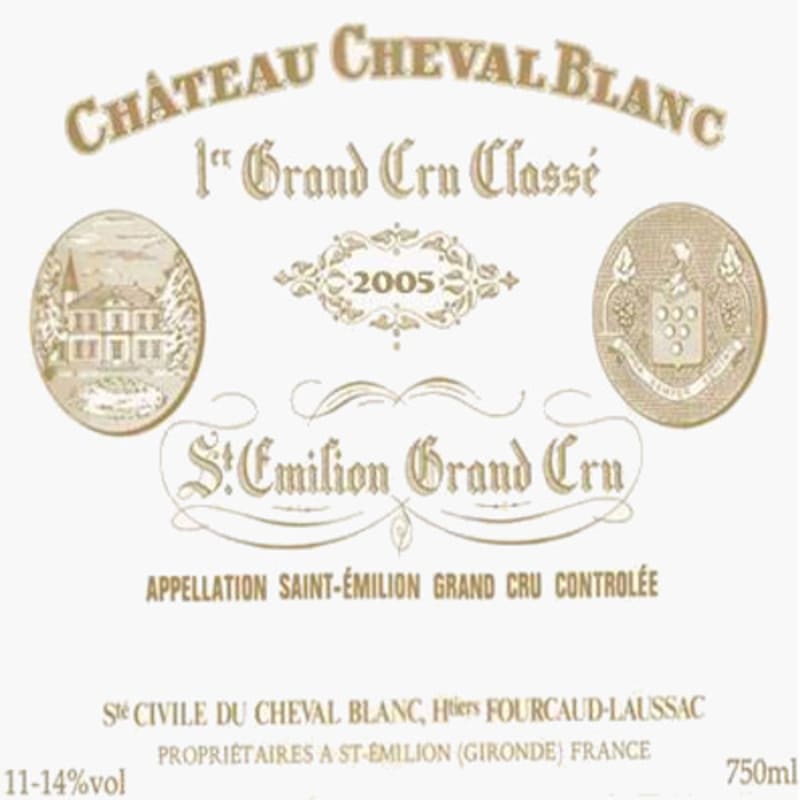

Winemaker Notes
Chateau Cheval Blanc produces a wine that has the ability to taste excellent at any age. It is in fact one of the most consistent wines in the world. Its subtlety and perfect harmony give Cheval Blanc its hallmark, combining power and elegance at the same time.
Professional Ratings
-
Robert Parker's Wine Advocate
The 2005 from Cheval Blanc is a quintessentially elegant, beautiful, deep bluish/ruby-colored wine from St.-Emilion, with raspberry, blueberry, and floral notes, impressive density, great precision, freshness and purity. Full-bodied, but extremely light on its feet, I don’t mean to gush, but it is super-intense, rich and just so meticulously crafted! This is another fabulous wine and a perfect expression for this vintage. It is difficult to forget the gorgeous blueberry and raspberry fruit, full body, sweet tannin, a multi-layered texture, and purity and palate presence of this stunning wine. Drink it over the next 20 years. P.S. In 2005, this was 50% Cabernet Franc and 50% Merlot
-
Jeb Dunnuck
What I think the 2010 will taste like in 4-5 years, the 2005 Cheval Blanc (It’s the normal blend of 55% Merlot and 45% Cabernet Franc) is another monumental wine from this estate that does everything right. Crème de cassis, spring flowers, exotic spices and dried soil nuances all soar from the glass of this still youthful, inky-colored, complex, nuanced Saint-Emilion. Like the 2010 and 2009, it’s beautifully concentrated, layered, deep and long, and is, I suspect, right on the edge of its plateau of maturity. It will keep for three decades or more.
-
James Suckling
This has a fabulous nose of black fruit, dark chocolate, nuts, and spices. It’s pretty much perfect. Full bodied, with beautiful fine tannins reminiscent of cashmere. A long, long finish rounds out this beautiful wine. Please don’t touch this until 2020. Find the wine
-
Wine Enthusiast
Plump, padded and comfortable is the initial impression. But this is also finely structured and dense, with tannins that are sweet, flavors of dark chocolate to go with the roundness and the enticing Cabernet Franc perfumes. In all, this is a great wine, with considerable aging potential, but with enough sweet fruit to make it attractive now.
-
Wine Spectator
This is really gorgeous on the nose, with blackberry, mineral, light vanilla bean and milk chocolate. Full-bodied, with ultrafine tannins and a long, caressing finish. This is racy and very beautiful. The tannins coat the palate, but leave a provoking impression. A Cheval for long-term aging. Best after 2017.
-
Wine & Spirits
The aristocracy of St-Emilion coasts on nonchalant power, with the grandeur you would expect from this site on the edge of Pomerol's sacred plateau. Part voluptuous, part lean, this has a layering of flavor that could fill a writer's notebook with the earthy, meaty and spicy directions of its complexities. It's distinguished by an exact ripeness, so that the Bretty funk that might eat a lesser wine is merely a way into the cool limestone architecture, a tannic underground cellar that will sustain the fresh fruit. For the ages.


One of the world’s most classic and popular styles of red wine, Bordeaux-inspired blends have spread from their homeland in France to nearly every corner of the New World. Typically based on either Cabernet Sauvignon or Merlot and supported by Cabernet Franc, Malbec and Petit Verdot, the best of these are densely hued, fragrant, full of fruit and boast a structure that begs for cellar time. Somm Secret—Blends from Bordeaux are generally earthier compared to those from the New World, which tend to be fruit-dominant.

Marked by its historic fortified village—perhaps the prettiest in all of Bordeaux, the St-Émilion appellation, along with its neighboring village of Pomerol, are leaders in quality on the Right Bank of Bordeaux. These Merlot-dominant red wines (complemented by various amounts of Cabernet Franc and/or Cabernet Sauvignon) remain some of the most admired and collected wines of the world.
St-Émilion has the longest history in wine production in Bordeaux—longer than the Left Bank—dating back to an 8th century monk named Saint Émilion who became a hermit in one of the many limestone caves scattered throughout the area.
Today St-Émilion is made up of hundreds of independent farmers dedicated to the same thing: growing Merlot and Cabernet Franc (and tiny amounts of Cabernet Sauvignon). While always roughly the same blend, the wines of St-Émilion vary considerably depending on the soil upon which they are grown—and the soils do vary considerably throughout the region.
The chateaux with the highest classification (Premier Grand Cru Classés) are on gravel-rich soils or steep, clay-limestone hillsides. There are only four given the highest rank, called Premier Grand Cru Classés A (Chateau Cheval Blanc, Ausone, Angélus, Pavie) and 14 are Premier Grand Cru Classés B. Much of the rest of the vineyards in the appellation are on flatter land where the soils are a mix of gravel, sand and alluvial matter.
Great wines from St-Émilion will be deep in color, and might have characteristics of blackberry liqueur, black raspberry, licorice, chocolate, grilled meat, earth or truffles. They will be bold, layered and lush.