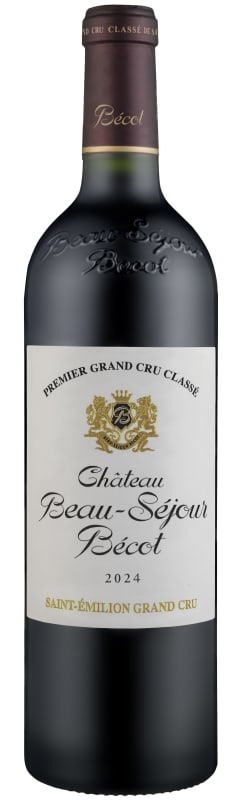


Winemaker Notes
Blend: 78% Merlot, 22% Cabernet Franc
This wine does not include the blanket 10% tariff imposed in April 2025. When the wines are shippable in fall of 2027, customers will have the option to pay any tariff in place at the time or to keep their wines stored in a temperature-controlled facility free of charge in France.
Professional Ratings
-
Vinous
The 2024 Beau-Séjour Bécot is deep, vivid and wonderfully alive. Dynamic and explosive, with striking inner perfume, Beau-Séjour Bécot is hauntingly beautiful. Blue/purplish fruit, lavender, menthol, licorice and rose petal soar out of the glass. Silky, refined tannins add to the wine's finesse. The increase of Cabernet Franc in the blend has added aromatic depth and textural elegance. There's a feeling of transparency here that is impossible to miss. Beau-Séjour Bécot has grown into one of the most distinctive wines in Bordeaux. Simply put, the 2024 is magnificent. That's all there is to it. Élevage is 55% in new oak, 15% in once-used barrels and the rest in 20HL casks. Tasted two times. –Antonio Galloni
Barrel Sample: 95-97 -
Decanter
Gorgeous fragrance, really quite deep and vivid, almost an opulence to the perfumed nose. Generous and filling, smooth, silky, round and so vibrant. Juicy and lifted but still with structure - this has acidity, a cool freshness, super fine silky tannins and a soft push from start to finish. Feels super classic and classy, refined and elegant with cool blue fruit and lots of saltiness, but so distinguished. You really feel the limestone in the glass. Still serious, you feel the Cabernet spiciness but you don't get the impression they struggled with ripeness at all. A great glass. Sappy, fruity, clean and salty. A true wine of place. A yield of 32hl/ha, 3.40pH.
Barrel Sample: 96 -
Jeb Dunnuck
The 2024 Château Beau-Séjour Bécot is 78% Merlot and 22% Cabernet Franc, aging in 55% new oak with a small part in foudre. Ripe black cherries, leafy herbs, damp earth, and crushed stone notes define the aromatics, and this beauty hits the palate with medium to full-bodied richness, an ultra-fine mouthfeel, gorgeous tannins, and a great finish. This is brilliant, and I'd put it up with the crème de la crème of the vintage, especially in this elegant, finesse-driven style. Tasted twice with consistent results.
Barrel Sample: 93-95 -
Robert Parker's Wine Advocate
A blend of 78% Merlot and 22% Cabernet Franc, the 2024 Beau-Séjour Bécot was picked in late September. Clusters were open rather than compact, lessening botrytis pressure, making it easier to wait to attain full maturity. Offering up aromas of dark berries, violets, rose petals and spices, it's medium to full-bodied, polished and layered, with beautifully refined tannin, integrated acidity and a long, aromatic finish. Once again, this impeccably managed estate has delivered a terrific performance in challenging conditions.
Barrel Sample: 93-95


One of the world’s most classic and popular styles of red wine, Bordeaux-inspired blends have spread from their homeland in France to nearly every corner of the New World. Typically based on either Cabernet Sauvignon or Merlot and supported by Cabernet Franc, Malbec and Petit Verdot, the best of these are densely hued, fragrant, full of fruit and boast a structure that begs for cellar time. Somm Secret—Blends from Bordeaux are generally earthier compared to those from the New World, which tend to be fruit-dominant.

Marked by its historic fortified village—perhaps the prettiest in all of Bordeaux, the St-Émilion appellation, along with its neighboring village of Pomerol, are leaders in quality on the Right Bank of Bordeaux. These Merlot-dominant red wines (complemented by various amounts of Cabernet Franc and/or Cabernet Sauvignon) remain some of the most admired and collected wines of the world.
St-Émilion has the longest history in wine production in Bordeaux—longer than the Left Bank—dating back to an 8th century monk named Saint Émilion who became a hermit in one of the many limestone caves scattered throughout the area.
Today St-Émilion is made up of hundreds of independent farmers dedicated to the same thing: growing Merlot and Cabernet Franc (and tiny amounts of Cabernet Sauvignon). While always roughly the same blend, the wines of St-Émilion vary considerably depending on the soil upon which they are grown—and the soils do vary considerably throughout the region.
The chateaux with the highest classification (Premier Grand Cru Classés) are on gravel-rich soils or steep, clay-limestone hillsides. There are only four given the highest rank, called Premier Grand Cru Classés A (Chateau Cheval Blanc, Ausone, Angélus, Pavie) and 14 are Premier Grand Cru Classés B. Much of the rest of the vineyards in the appellation are on flatter land where the soils are a mix of gravel, sand and alluvial matter.
Great wines from St-Émilion will be deep in color, and might have characteristics of blackberry liqueur, black raspberry, licorice, chocolate, grilled meat, earth or truffles. They will be bold, layered and lush.