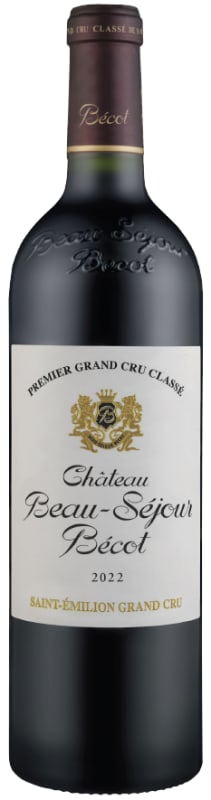


Winemaker Notes
#5 Wine Spectator Top 100 of 2025
#99 Jeb Dunnuck Top 100 of 2025
#8 Vinous Top 100 of 2025
Located immediately west of the magical town of Saint-Émilion on the Saint-Martin de Mazerat limestone plateau, Beau-Séjour Bécot is in the heart of the appellation.
Blend: 76% Merlot, 22% Cabernet Franc, 2% Cabernet Sauvignon
Professional Ratings
-
Vinous
The 2022 Beau-Séjour Bécot is a total stunner. What a wine! The 2022 was magnificent en primeur, and it is all that from bottle. The aromatics alone are mesmerizing. Crushed rose petal, mint, blood orange, new leather and cedar meld into a core of pliant red-toned fruit. More than anything else, I am so impressed with the wine's precision and finesse. I have never tasted a Beau-Séjour Bécot like this.
-
Jeb Dunnuck
Tasted on multiple occasions, the 2022 Château Beau-Séjour Bécot is flat-out sensational, as well as the finest wine I’ve tasted from this château. Powerful aromatics of red, blue, and black fruits as well as crushed stone and violets define the aromatics, and it’s full-bodied, incredibly concentrated, has integrated acidity, and ultra-fine tannins. Based on 76% Merlot, 22% Cabernet Franc, and the rest Cabernet Sauvignon, this heavenly Saint-Emilion will benefit from just 3-5 years of bottle age and have 30 years or more of overall longevity. Back up the truck.
-
Robert Parker's Wine Advocate
The 2022 Beau-Séjour Bécot has turned out brilliantly in bottle. Wafting from the glass with a complex bouquet of sweet wild berries mingled with rose petals, orange zest, violets, gentian and espresso roast, it's full-bodied, supple and suave, with a deep core of cool, layered fruit, beautifully vibrant flavors and polished structuring tannins, concluding with a saline finish. As I wrote when I tasted it from barrel, this is a Saint-Émilion of breathtaking perfume and harmony that will be worth a special effort to seek out.
-
Decanter
Floral notes on the nose. Tangy and sharp, lively and bright straight away, sweet and sour, so energetic and lively with a mineral grip from the fine, firm, grippy tannins. Lovely precision and almost delicate presentation of fruit. You really feel the mineral, salty, tangy aspect of the fruit, nothing feels overworked, all in balance, really quite thrilling and electric. Great purity and focus. Scintillating yet still with a lovely volume and roundness accented by tobacco, clove, liquorice and cinnamon touches. Really well worked and fresh - this feels very modern with such control to the fruit, tannins, acidity giving overall depth and complexity. Elegant but confident, taking the best density from clay density and freshness from limestone. A very singular charm with this wine.
Barrel Sample: 96 -
Wine Spectator
This is very fresh, expressive and focused, with violet, iris and rosehip notes darting to the fore, while flavors of sleek raspberry and red currant preserves race along behind. Almost flattering, but there’s a subtle chalky tension piercing the finish, which sails through. A dreamy wine. Merlot, Cabernet Franc and Cabernet Sauvignon.


One of the world’s most classic and popular styles of red wine, Bordeaux-inspired blends have spread from their homeland in France to nearly every corner of the New World. Typically based on either Cabernet Sauvignon or Merlot and supported by Cabernet Franc, Malbec and Petit Verdot, the best of these are densely hued, fragrant, full of fruit and boast a structure that begs for cellar time. Somm Secret—Blends from Bordeaux are generally earthier compared to those from the New World, which tend to be fruit-dominant.

Marked by its historic fortified village—perhaps the prettiest in all of Bordeaux, the St-Émilion appellation, along with its neighboring village of Pomerol, are leaders in quality on the Right Bank of Bordeaux. These Merlot-dominant red wines (complemented by various amounts of Cabernet Franc and/or Cabernet Sauvignon) remain some of the most admired and collected wines of the world.
St-Émilion has the longest history in wine production in Bordeaux—longer than the Left Bank—dating back to an 8th century monk named Saint Émilion who became a hermit in one of the many limestone caves scattered throughout the area.
Today St-Émilion is made up of hundreds of independent farmers dedicated to the same thing: growing Merlot and Cabernet Franc (and tiny amounts of Cabernet Sauvignon). While always roughly the same blend, the wines of St-Émilion vary considerably depending on the soil upon which they are grown—and the soils do vary considerably throughout the region.
The chateaux with the highest classification (Premier Grand Cru Classés) are on gravel-rich soils or steep, clay-limestone hillsides. There are only four given the highest rank, called Premier Grand Cru Classés A (Chateau Cheval Blanc, Ausone, Angélus, Pavie) and 14 are Premier Grand Cru Classés B. Much of the rest of the vineyards in the appellation are on flatter land where the soils are a mix of gravel, sand and alluvial matter.
Great wines from St-Émilion will be deep in color, and might have characteristics of blackberry liqueur, black raspberry, licorice, chocolate, grilled meat, earth or truffles. They will be bold, layered and lush.