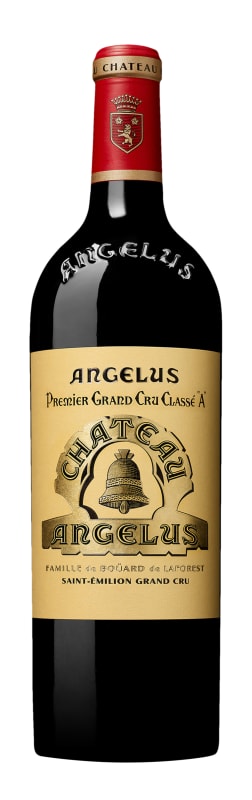


Winemaker Notes
Blend: 65% Merlot, 35% Cabernet Franc
Professional Ratings
-
James Suckling
This shows beautifully sensibility of generous fruit and soft and velvety tannins with an undertone of chocolate and cedar. Full-bodied, pure and supple with a direct delivery of vibrant fruit and real terroir expression. Savory at the end with hazelnut and crunchy-seed flavors. Reality check here. Incredible fruit quality.
Barrel Sample: 99-100 -
Robert Parker's Wine Advocate
“This year we have slightly less Cabernet Franc in the blend because we are only using the oldest vines, planted by my grandfather, as a tribute,” Stéphanie de Boüard-Rivoal said. “These are 60- to 80-year-old Cabernet Franc vines.” From 2018, 10% of the entire Angélus crop will be aged in large oak foudres. “These produce tighter, more perfumed, brighter wines from less oxygen exposure,” Stéphanie commented. The 2018 Angélus is blended of 65% Merlot and 35% Cabernet Franc, to be aged 18-22 months in barriques, 100% new, plus two new foudres. Deep garnet-purple in color, it slips slowly, sensuously out of the glass with beautiful black raspberries, kirsch, warm plums and red roses scents, building in intensity to reveal chocolate-covered cherries, raspberry coulis, black tea, woodsmoke and powdered cinnamon notions with a waft of black olives and charcuterie. Medium to full-bodied, the palate delivers a wonderfully profound, multilayered, seamless experience of red and black fruits intertwined with earth, spice and floral notions and framed by exquisitely ripe, satiny tannins, finishing with amazing freshness and length. Incredibly, finely, expertly, seamlessly knit. Stunning.
Barrel Sample: 97-100 -
Jeb Dunnuck
The grand vin, the 2018 Angélus, is magical juice in 2018 as well as possibly one of the wines of the vintage. While it shows a slightly more elegant style compared to past great vintages, it doesn’t lack for depth, density or richness. Thrilling notes of crème de cassis, toasted spice, graphite, incense, and tobacco leaf all flow to a full-bodied, powerful Saint-Émilion that has seamless tannins, a stacked mid-palate, no hard edges, and a finish that just won’t quit. Reminding me of an improved 2009, it’s going to be drinkable with just short-term cellaring and keep for 30 years or more. The blend of the 2018 is 65% Merlot and 35% Cabernet Franc that will spend 18-22 months in new barrels (and a small portion in foudre as well). Hats off to director Emmanuelle d’Aligny-Fulchi for keeping this estate at the top of the hierarchy in Saint-Émilion!
Barrel Sample: 97-99 -
Decanter
This is rich and complex from the very first nose, showing dense brambled fruit with real precision of expression. After a few minutes the aromatics explode, leaping out of the glass and giving an extra level of enjoyment to the wine. In the mouth, lovely vibrant tannins grip without any sense of urgency, joined by curls of woodsmoke and salt taffy through the finish. It's gorgeous and will make you smile with its mouthwatering finish.
Only the oldest Cabernet Francs, aged between 60 and 80 years, went into the grand vin in 2018, meaning a little less Cabernet Franc in the blend than usual. But these old vines, planted by Stephanie de Boüard's grandfather, are rich in flavour and give saline emphasis to the finish. It's the first year that they have worked entirely organically, with a 32hl/ha yield from the harvest, which ran from 24 September to 11 October.
Barrel Sample: 98 Points -
Wine Enthusiast
This is a dense, smoky wine, packed with ripe tannins and a line of fresh acidity that forms a fine contrast. It's a great wine that is rich in tannins while keeping elegance and finesse.
Barrel Sample: 96-98 -
Wine Spectator
Very gutsy in feel, with lots of tobacco leaf, loam and espresso notes swirling around a core of steeped black currant and warm fig fruit flavors. The muscular finish is a jumble right now, but there's ample acidity coiled within. A wine that clearly wants to stand out from the pack.
Barrel Sample: 95-98


One of the world’s most classic and popular styles of red wine, Bordeaux-inspired blends have spread from their homeland in France to nearly every corner of the New World. Typically based on either Cabernet Sauvignon or Merlot and supported by Cabernet Franc, Malbec and Petit Verdot, the best of these are densely hued, fragrant, full of fruit and boast a structure that begs for cellar time. Somm Secret—Blends from Bordeaux are generally earthier compared to those from the New World, which tend to be fruit-dominant.

Marked by its historic fortified village—perhaps the prettiest in all of Bordeaux, the St-Émilion appellation, along with its neighboring village of Pomerol, are leaders in quality on the Right Bank of Bordeaux. These Merlot-dominant red wines (complemented by various amounts of Cabernet Franc and/or Cabernet Sauvignon) remain some of the most admired and collected wines of the world.
St-Émilion has the longest history in wine production in Bordeaux—longer than the Left Bank—dating back to an 8th century monk named Saint Émilion who became a hermit in one of the many limestone caves scattered throughout the area.
Today St-Émilion is made up of hundreds of independent farmers dedicated to the same thing: growing Merlot and Cabernet Franc (and tiny amounts of Cabernet Sauvignon). While always roughly the same blend, the wines of St-Émilion vary considerably depending on the soil upon which they are grown—and the soils do vary considerably throughout the region.
The chateaux with the highest classification (Premier Grand Cru Classés) are on gravel-rich soils or steep, clay-limestone hillsides. There are only four given the highest rank, called Premier Grand Cru Classés A (Chateau Cheval Blanc, Ausone, Angélus, Pavie) and 14 are Premier Grand Cru Classés B. Much of the rest of the vineyards in the appellation are on flatter land where the soils are a mix of gravel, sand and alluvial matter.
Great wines from St-Émilion will be deep in color, and might have characteristics of blackberry liqueur, black raspberry, licorice, chocolate, grilled meat, earth or truffles. They will be bold, layered and lush.