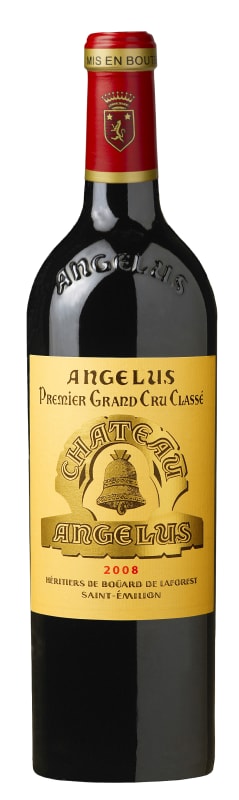


Winemaker Notes
The deep black Merlot with the Cabernet Franc that traditionally does so well at Angélus, produced outstandingly dense wines with thick, richly supple, round body. The aromas are reminiscent of black berries and plum as well as delicate mineral and flowery notes. Long and fresh on the palate, their concentration is expressed as a silky elegance.
Blend: 58% Merlot, 42% Cabernet Franc
Professional Ratings
-
Wine Enthusiast
A complete wine, from the black currant fruits through the balanced tannins to the acidity. It is sturdy, complex, a wine that is already singing and will age well.
Cellar Selection -
Robert Parker's Wine Advocate
A stunning success, this 7,000-case blend of 58% Merlot and 42% Cabernet Franc reveals a beautiful nose of black currants, black cherries, loamy soil and forest flora. Full-bodied, this deep, chewy, savory, broadly-flavored 2008 possesses sweet tannin, decent acidity and a long finish. Its 14% alcohol content is nearly as high as the 2009's and 2010's 14.5%. Already accessible, it should continue to age effortlessly for 20-25 years.
-
Connoisseurs' Guide
Chateau Angélus continues its winning ways of late with a very rich, fully ripened wine whose expression of substantial, sweet- currant fruit seems amplified with each sip. It combines volume and a full body with a fine sense of overall balance and plenty of grippy, yet integral tannins that provide it with great longevity. It is a deep and impressively filled effort that stands with the better bottlings of its district.
-
Wine Spectator
A ripe, flashy style, with alluring espresso and cocoa aromas giving way to layers of plum sauce, fig and prune. Dark and fleshy through the creamy-textured finish, with a flash of minerality checking in.


One of the world’s most classic and popular styles of red wine, Bordeaux-inspired blends have spread from their homeland in France to nearly every corner of the New World. Typically based on either Cabernet Sauvignon or Merlot and supported by Cabernet Franc, Malbec and Petit Verdot, the best of these are densely hued, fragrant, full of fruit and boast a structure that begs for cellar time. Somm Secret—Blends from Bordeaux are generally earthier compared to those from the New World, which tend to be fruit-dominant.

Marked by its historic fortified village—perhaps the prettiest in all of Bordeaux, the St-Émilion appellation, along with its neighboring village of Pomerol, are leaders in quality on the Right Bank of Bordeaux. These Merlot-dominant red wines (complemented by various amounts of Cabernet Franc and/or Cabernet Sauvignon) remain some of the most admired and collected wines of the world.
St-Émilion has the longest history in wine production in Bordeaux—longer than the Left Bank—dating back to an 8th century monk named Saint Émilion who became a hermit in one of the many limestone caves scattered throughout the area.
Today St-Émilion is made up of hundreds of independent farmers dedicated to the same thing: growing Merlot and Cabernet Franc (and tiny amounts of Cabernet Sauvignon). While always roughly the same blend, the wines of St-Émilion vary considerably depending on the soil upon which they are grown—and the soils do vary considerably throughout the region.
The chateaux with the highest classification (Premier Grand Cru Classés) are on gravel-rich soils or steep, clay-limestone hillsides. There are only four given the highest rank, called Premier Grand Cru Classés A (Chateau Cheval Blanc, Ausone, Angélus, Pavie) and 14 are Premier Grand Cru Classés B. Much of the rest of the vineyards in the appellation are on flatter land where the soils are a mix of gravel, sand and alluvial matter.
Great wines from St-Émilion will be deep in color, and might have characteristics of blackberry liqueur, black raspberry, licorice, chocolate, grilled meat, earth or truffles. They will be bold, layered and lush.