


Winemaker Notes
These wines are produced from grapes which come from eight villages. Four are from the Vallée du Brunet and the others come either from Écueil in the Montagne de Reims or from Verneuil in the Vallée de la Marne. In order to obtain this wine's salmon-colored hue and red fruit aromas, they incorporate around 10% red wine from the Damery terroir into the cuvée.
The Brut Rosé marries well with white meats and a wide range of desserts.
Blend: 50% Pinot Meunier, 30% Chardonnay, 20% Pinot Noir
Professional Ratings
-
Decanter
Red berries and flowers with blood orange and fresh grass. Gingerbread and spice add complexity. On the palate, vibrant acidity reveals round, salty red fruit and a persistent mousse. Herbaceous and weighty.
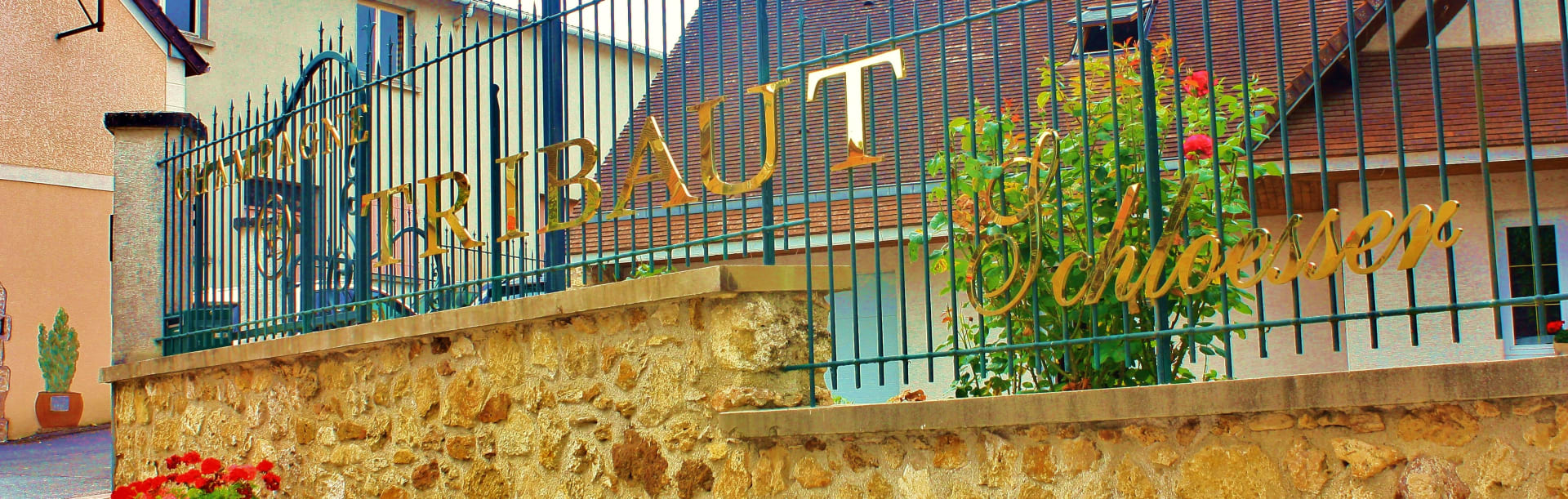


Across four generations, the family's passion for wine has defined their story. It all began in the early 20th century when René Schloesser, a young Luxembourg farmer, sought a new life in Champagne and crossed paths with Lucie Coutelas, a fellow farmer from Romery. In 1927, they wed, and when economic woes gripped France, they boldly started making and selling their own champagne with just 1,000 bottles, personally delivered by René on his bicycle to the railway that led to the Parisian market. After WWII, their maison thrived, reaching 5,000 bottles by 1950, as Suzanne, their daughter, wed Jean Tribaut, merging their vineyard holdings in Romery, Cormoyeux, and Fleury la Rivière marking the inception of the brand we now know as Champagne Tribaut-Schloesser.
Today, 4th generation brothers, Sébastien and Valentin, continue the tradition of crafting fine champagnes. They boast seven foudres and approximately twenty barrels, all at our disposal for the meticulous aging of their reserve wines. This process ensures that our wines mature in the unmistakable Tribaut style, a tradition that has been faithfully passed down through four generations of their family. Their vineyards are primarily situated in the picturesque villages of Romery, Cormoyeux, and Fleury la Rivière, nestled along the Marne Valley and the Montagne de Reims. Perched on south/southeast-facing hillsides with clay-limestone soils, their vineyards are home to exquisite Pinot Meunier and remarkably surprising Chardonnay grapes. Additionally, they proudly maintain vineyards in the renowned village of Aÿ, classified as Grand Cru and celebrated for its exceptional Pinot Noir.

What are the different types of sparkling rosé wine?
Rosé sparkling wines like Champagne, Prosecco, Cava, and others make a fun and festive alternative to regular bubbles—but don’t snub these as not as important as their clear counterparts. Rosé Champagnes (i.e., those coming from the Champagne region of France) are made in the same basic way as regular Champagne, from the same grapes and the same region. Most other regions where sparkling wine is produced, and where red grape varieties also grow, also make a rosé version.
How is sparkling rosé wine made?
There are two main methods to make rosé sparkling wine. Typically, either white wine is blended with red wine to make a rosé base wine, or only red grapes are used but spend a short period of time on their skins (maceration) to make rosé colored juice before pressing and fermentation. In either case the base wine goes through a second fermentation (the one that makes the bubbles) through any of the various sparkling wine making methods.
What gives rosé Champagne and sparkling wine their color and bubbles?
The bubbles in sparkling wine are formed when the base wine undergoes a secondary fermentation, which traps carbon dioxide inside the bottle or fermentation vessel. During this stage, the yeast cells can absorb some of the wine’s color but for the most part, the pink hue remains.
How do you serve rosé sparkling wine?
Treat rosé sparkling wine as you would treat any Champagne, Prosecco, Cava, and other sparkling wine of comparable quality. For storing in any long-term sense, these should be kept at cellar temperature, about 55F. For serving, cool to about 40F to 50F. As for drinking, the best glasses have a stem and a flute or tulip shape to allow the bead (bubbles) and beautiful rosé hue to show.
How long do rosé Champagne and sparkling wine last?
Most rosé versions of Prosecco, Champagne, Cava or others around the “$20 and under” price point are intended for early consumption. Those made using the traditional method with extended cellar time before release (e.g., Champagne or Crémant) can typically improve with age. If you are unsure, definitely consult our Customer Care team for guidance.

Associated with luxury, celebration, and romance, the region, Champagne, is home to the world’s most prized sparkling wine. In order to bear the label, ‘Champagne’, a sparkling wine must originate from this northeastern region of France—called Champagne—and adhere to strict quality standards. Made up of the three towns Reims, Épernay, and Aÿ, it was here that the traditional method of sparkling wine production was both invented and perfected, birthing a winemaking technique as well as a flavor profile that is now emulated worldwide.
Well-drained, limestone and chalky soil defines much of the region, which lend a mineral component to its wines. Champagne’s cold, continental climate promotes ample acidity in its grapes but weather differences from year to year can create significant variation between vintages. While vintage Champagnes are produced in exceptional years, non-vintage cuvées are produced annually from a blend of several years in order to produce Champagnes that maintain a consistent house style.
With nearly negligible exceptions, . These can be blended together or bottled as individual varietal Champagnes, depending on the final style of wine desired. Chardonnay, the only white variety, contributes freshness, elegance, lively acidity and notes of citrus, orchard fruit and white flowers. Pinot Noir and its relative Pinot Meunier, provide the backbone to many blends, adding structure, body and supple red fruit flavors. Wines with a large proportion of Pinot Meunier will be ready to drink earlier, while Pinot Noir contributes to longevity. Whether it is white or rosé, most Champagne is made from a blend of red and white grapes—and uniquely, rosé is often produce by blending together red and white wine. A Champagne made exclusively from Chardonnay will be labeled as ‘blanc de blancs,’ while ones comprised of only red grapes are called ‘blanc de noirs.’