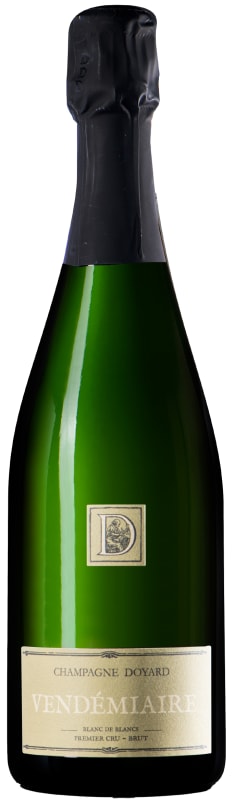


Winemaker Notes
An incisive, vinous Champagne that shows gorgeous notes of citrus peel, almond, oyster shells, and blood orange. Texturally elegant, this wine is downright electric with its chiseled and deeply concentrated mid-palate. The finish displays a magical tension between the wine’s intensity and its saline-infused core.
Professional Ratings
-
Wine & Spirits
If you like uncompromising Champagne, this wine is a steal. Guillaume Doyard focuses this cuvée on 45-year-old chardonnay vines he farms in Vertus, along with estate parcels in Le Mesnil-sur-Oger, Oger, Avize and Cramant. He ages a portion of the base wine in neutral barrels and, once bottled, en tirage for four years. (The current release is half 2014, the balance from the two prior vintages.) The first pour offers rich, gingery spice, its earthy fruit hinting at apricot and green olive, the long lees aging building textural depths. Come back to it a day later and the wine has opened to a racy purity, lasting with an umami savor and the pale richness of fresh hazelnuts.
-
Jeb Dunnuck
Based in Vertus, the NV Champagne Premier Cru Blanc de Blancs Vendemiaire Brut has a bright yellow hue. This release is based on the 2020 vintage and was aged for 45 months in the cellar before disgorgement with a 3 grams per liter dosage in March 2025. The nose is attractive and pure, though it has a ripe fruitiness upfront and is approachable with notes of fresh peach, poached citrus, fresh pastry, and a creamy suppleness of texture. The mousse is rounded and fills the palate, with a creamy texture and a refreshing lift on the finish. It’s a delightful, approachable wine that is highly versatile and can carry across seasons and meals.
-
Robert Parker's Wine Advocate
Doyard’s new NV Brut Blanc de Blancs Vendémiaire, disgorged in October 2025 with a dosage of four grams per liter, is based on the 2020 vintage and opens in the glass with aromas of nectarine, Granny Smith apple, carrot seed oil and freshly baked bread mingled with hints of orange. The palate is medium- to full-bodied and elegantly muscular, structured around a crisp core of fruit and bright acids, animated by a pinpoint mousse and concluding with a saline finish. As ever, the cuvée derives predominantly from Vertus, complemented by fruit from Avize, Oger, Le Mesnil-sur-Oger and Cramant, and is vinified in roughly equal parts in stainless steel and seasoned oak.
-
Wine Spectator
This sleek Champagne offers well-honed acidity, with flavors of poached apricot,candied kumquat, biscuit, spun honey and warm spices riding the lacy mousse.


A term typically reserved for Champagne and Sparkling Wines, non-vintage or simply “NV” on a label indicates a blend of finished wines from different vintages (years of harvest). To make non-vintage Champagne, typically the current year’s harvest (in other words, the current vintage) forms the base of the blend. Finished wines from previous years, called “vins de reserve” are blended in at approximately 10-50% of the total volume in order to achieve the flavor, complexity, body and acidity for the desired house style. A tiny proportion of Champagnes are made from a single vintage.
There are also some very large production still wines that may not claim one particular vintage. This would be at the discretion of the winemaker’s goals for character of the final wine.

Associated with luxury, celebration, and romance, the region, Champagne, is home to the world’s most prized sparkling wine. In order to bear the label, ‘Champagne’, a sparkling wine must originate from this northeastern region of France—called Champagne—and adhere to strict quality standards. Made up of the three towns Reims, Épernay, and Aÿ, it was here that the traditional method of sparkling wine production was both invented and perfected, birthing a winemaking technique as well as a flavor profile that is now emulated worldwide.
Well-drained, limestone and chalky soil defines much of the region, which lend a mineral component to its wines. Champagne’s cold, continental climate promotes ample acidity in its grapes but weather differences from year to year can create significant variation between vintages. While vintage Champagnes are produced in exceptional years, non-vintage cuvées are produced annually from a blend of several years in order to produce Champagnes that maintain a consistent house style.
With nearly negligible exceptions, . These can be blended together or bottled as individual varietal Champagnes, depending on the final style of wine desired. Chardonnay, the only white variety, contributes freshness, elegance, lively acidity and notes of citrus, orchard fruit and white flowers. Pinot Noir and its relative Pinot Meunier, provide the backbone to many blends, adding structure, body and supple red fruit flavors. Wines with a large proportion of Pinot Meunier will be ready to drink earlier, while Pinot Noir contributes to longevity. Whether it is white or rosé, most Champagne is made from a blend of red and white grapes—and uniquely, rosé is often produce by blending together red and white wine. A Champagne made exclusively from Chardonnay will be labeled as ‘blanc de blancs,’ while ones comprised of only red grapes are called ‘blanc de noirs.’