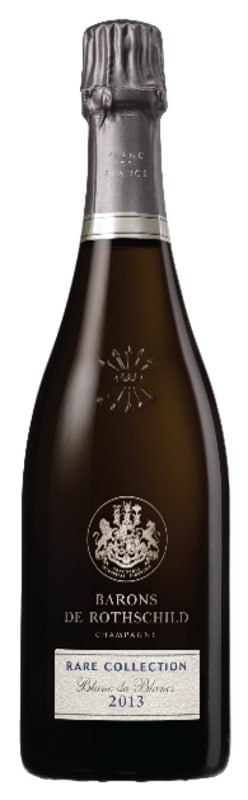


Winemaker Notes
Pale gold in color and crystalline in appearance. A fresh, mineral aromatic profile, characteristic of our Chardonnays from a cold vintage. Citrus notes blend elegantly with hints of dried apricot and toasted brioche. The finish is precise, well crafted and supported by saline and iodine notes. Direct and mineral from the outset, with lemony, zesty notes combined with incredible length. Hints of spice, white pepper and saffron give way to a more saline finish, characteristic of Rothschild Rare Collection vintages.
This exceptional champagne offers countless possibilities for gastronomic pairings and is particularly well suited to dishes with more delicate flavours. It is ideal with squid in a lemon sauce served with fresh garden vegetables, a delicately spiced chicken supreme or a veal medaillon with morel mushrooms.
Professional Ratings
-
James Suckling
What a beautiful nose of freshly toasted baguette, tarte au citron and a magical certain something. As rich and silky as it is animating, as sensual and fascinating as it is light-footed, this Blanc de Blancs is a masterpiece! Very long, racy and refined finish. A cuvee of wines from the Grand Crus of Avize plus Cramant, Oger and Le Mesnil. Just 4 g/l dosage. Drink or hold.
-
Decanter
Smells fruity and forward on the nose - expressive and alive with lime, peach and floral notes - very pretty aromatics. Fully flavoured, this has a zing and richness giving body and lovely high acidity with rounded buttery peach and apple and citrus fruit flavours. Frothy and filling in the mouth, this has a gorgeous structure, full bodied and ample, quite a serious take on the vintage where you feel the body more than just the fruit and lively bubbles but the power is controlled as is the sharp kick of bright acidity. Ends with a mineral, almost black pepper note, subtly reminding you this still is still young and has so much potential. A wine to enjoy today and age. Dosage 5g/l. Director Frédéric Mairesse, winemaker Guillaume Lété.
-
Robert Parker's Wine Advocate
This 2013 Rare Collection Blanc de Blancs is crafted with grapes sourced from four villages: Avize, Cramant, Oger and Le Mesnil-sur-Oger. Disgorged as an extra brut with five grams of dosage, it reveals a delicate, complex bouquet with aromas of apricot, fresh bread, pastry, almonds, smoke and dried apricot. Medium to full-bodied, it's fleshy and vinous, with a broad attack that segues into a deep core of fruit. It concludes with a chalky, mineral finish.


Representing the topmost expression of a Champagne house, a vintage Champagne is one made from the produce of a single, superior harvest year. Vintage Champagnes account for a mere 5% of total Champagne production and are produced about three times in a decade. Champagne is typically made as a blend of multiple years in order to preserve the house style; these will have non-vintage, or simply, NV on the label. The term, "vintage," as it applies to all wine, simply means a single harvest year.

Associated with luxury, celebration, and romance, the region, Champagne, is home to the world’s most prized sparkling wine. In order to bear the label, ‘Champagne’, a sparkling wine must originate from this northeastern region of France—called Champagne—and adhere to strict quality standards. Made up of the three towns Reims, Épernay, and Aÿ, it was here that the traditional method of sparkling wine production was both invented and perfected, birthing a winemaking technique as well as a flavor profile that is now emulated worldwide.
Well-drained, limestone and chalky soil defines much of the region, which lend a mineral component to its wines. Champagne’s cold, continental climate promotes ample acidity in its grapes but weather differences from year to year can create significant variation between vintages. While vintage Champagnes are produced in exceptional years, non-vintage cuvées are produced annually from a blend of several years in order to produce Champagnes that maintain a consistent house style.
With nearly negligible exceptions, . These can be blended together or bottled as individual varietal Champagnes, depending on the final style of wine desired. Chardonnay, the only white variety, contributes freshness, elegance, lively acidity and notes of citrus, orchard fruit and white flowers. Pinot Noir and its relative Pinot Meunier, provide the backbone to many blends, adding structure, body and supple red fruit flavors. Wines with a large proportion of Pinot Meunier will be ready to drink earlier, while Pinot Noir contributes to longevity. Whether it is white or rosé, most Champagne is made from a blend of red and white grapes—and uniquely, rosé is often produce by blending together red and white wine. A Champagne made exclusively from Chardonnay will be labeled as ‘blanc de blancs,’ while ones comprised of only red grapes are called ‘blanc de noirs.’