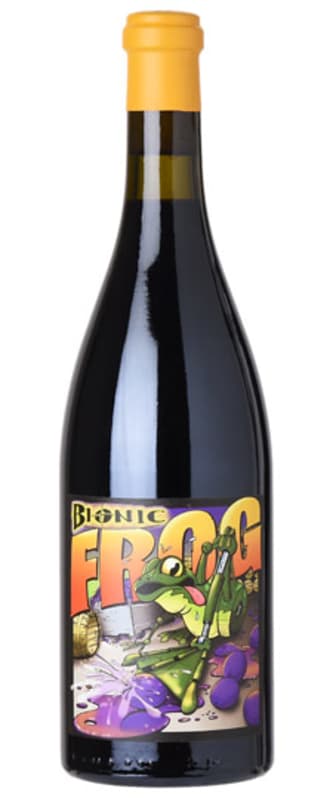


Winemaker Notes
Professional Ratings
-
James Suckling
This has amazing aromas of garam masala and curry powder, as well as green olives and strawberries. Hints of fenugreek and roasted almonds. It’s full-bodied, round and supple, with delicious spicy and peppery layers that build in intensity. Very persistent, with tension at the endless finish. From biodynamically grown grapes. Better from 2028.
-
Jeb Dunnuck
From a site planted in 1998 to ungrafted vines at relative elevation (935 feet above sea level), the 2022 Syrah Bionic Frog has a nose of mustard seed and wildflowers, the mouthfeel a wonder in umami and soy. The medium-bodied palate is dense in blueberry and garrigue, lengthy, balanced, and elegantly fresh.
-
Vinous
The 2022 Bionic Frog tempts the imagination with briny olive, sage and sawdust giving way to musky black currants. It's beautifully balanced, with cooling acidity and soft textures offset by savory herbal tones and tart wild berry fruits. Minerality dazzles the senses, finishing nearly salty in character as the mouth waters and hints of citrus-laced blackberry fade. The 2022 will require patience to find the best version of itself.
-
Robert Parker's Wine Advocate
The 2022 Syrah Bionic Frog comes from biodynamically farmed vines planted in 1998 in silty loam and basalt cobblestones. Matured for 18 months in around 20% new French oak, it has slowly unwinding scents of tar, black cherry, violet, loamy earth and iron-like undertones. Medium-bodied, it floods the mouth with dark, perfumed fruit. It has an elegant frame of silky tannins and vibrant acidity and a long, latent finish.
-
Wine Enthusiast
A spirited red that’s handsomely structured and expressive, with multilayered raspberry, cherry, garrigue and smoky beef tones that zip along the vibrant finish. Drink now through 2034.
-
Wine Spectator
A spirited red thats handsomely structured and expressive, with multilayered raspberry, cherry, garrigue and smoky beef tones that zip along the vibrant finish. Drink now through 2034. 535 cases made.


Marked by an unmistakable deep purple hue and savory aromatics, Syrah makes an intense, powerful and often age-worthy red. Native to the Northern Rhône, Syrah achieves its maximum potential in the steep village of Hermitage and plays an important component in the Red Rhône Blends of the south, adding color and structure to Grenache and Mourvèdre. Syrah is the most widely planted grape of Australia and is important in California and Washington. Sommelier Secret—Such a synergy these three create together, the Grenache, Syrah, Mourvedre trio often takes on the shorthand term, “GSM.”

Responsible for some of Washington’s most highly acclaimed wines, the Walla Walla Valley has experienced a surge in popularity in recent years and is home to both historic wineries and younger, up-and-coming producers.
The Walla Walla Valley, a Native American name meaning “many waters,” is located in southeastern Washington; part of the appellation actually extends into Oregon. Soils here are well-drained, sandy loess over Missoula Flood deposits and fractured basalt.
It is a region perfectly suited to Rhône-inspired Syrahs, distinguished by savory notes of red berry, black olive, smoke and fresh earth. Cabernet Sauvignon and Merlot create a range of styles from smooth and supple to robust and well-structured. White varieties are rare but some producers blend Sauvignon Blanc with Sémillon, resulting in a rich and round style, and plantings of Viognier, while minimal, are often quite successful.
Of note within Walla Walla, is one new and very peculiar appellation, called the Rocks District of Milton-Freewater. This is the only AVA in the U.S. whose boundaries are totally defined by the soil type. Soils here look a bit like those in the acclaimed Rhône region of Chateauneuf-du-Pape, but are large, ancient, basalt cobblestones. These stones work in the same way as they do in Chateauneuf, absorbing and then radiating the sun's heat up to enhance the ripening of grape clusters. The Rocks District is within the part of Walla Walla that spills over into Oregon and naturally excels in the production of Rhône varieties like Syrah, as well as the Bordeaux varieties.