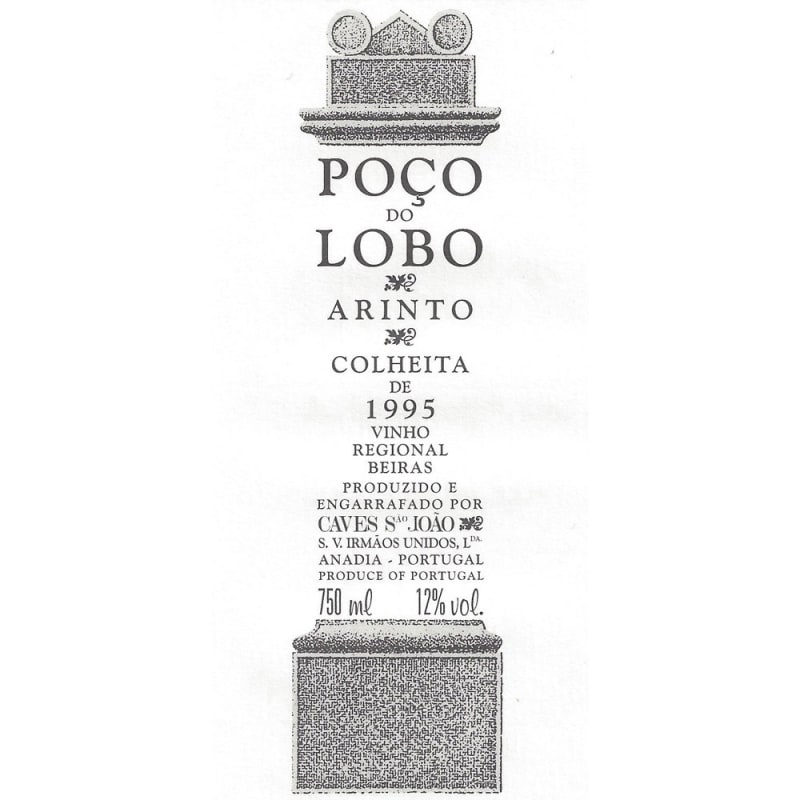

Winemaker Notes
Eye poppingly youthful in all aspects. On the nose, citrus, high toned minerality and stone fruit leap from the glass. Beautiful texture on the palate, with impressively bright acidity. Juicy flavors of lemon curd peach give way to mature floral, mushroom and earth tones. 30 second-plus finish.
Professional Ratings
-
Wine & Spirits
There was a time, back in the 198s, when those of us who were into Portuguese wines took this sort of late release for granted. That was before the EU, when a number of classic producer like Caves Sao Jao held back wines. Now they are called library releases, and only the rare dedicated producer still has them. This 22-year-old arinto was grown on what were, at the time, 45-year-old vines planted in clay-limestone soils. Today, there is nothing old about it, just a complex, luscious and delicious wine that stays with you long enough to help you consider all the different foods that would work so well with its graceful acidity, pale floral notes, fresh lemon-pulp flavors and deep umami resonance. Perhaps hamachi over sushi rice, or miso-glazed black cod, or Cantonese ginger-and-garlic crab...
-
Robert Parker's Wine Advocate
The Arinto "Poço do Lobo" is actually a current item, available from the importer. Arinto ages well and the terroir, not far from the ocean, typically provides good acidity. So, this region does have a reputation for aging well in all colors. This is lovely. To be sure, it is fully mature--and wonderfully complex. It is not going to taste fresh or fruity or perky. But if there is any oxidation, it isn't much. This has a fine core of acidity to still provide tension on the finish. It is surprisingly lively and relatively solid in the mid-palate. It awakens and actually seemed a bit fresher with air and warmth, with some notes of dried pear. It is not at all sweet, but its harmony makes it great to drink on its own. Or, it will go well with any number of restrained fish dishes and gentle, fatty foods. I came back to this another six or so hours later. It showed more mushroom and truffle, but its acidity was still fine and the wine was still great. It actually once again got fresher with air and warmth. How much longer does it have? That is always a fine question for wines that probably have already exceeded many peoples' guesses by a lot. At a certain point, it becomes about the bottle. It still seems to have plenty of time left, but let's exercise a little caution and take that in stages. By the way, the price for something this old and this good is exceptional. If it said "Puligny Montrachet 1er Cru" instead of Beiras, that likely wouldn't be the case.


There are hundreds of white grape varieties grown throughout the world. Some are indigenous specialties capable of producing excellent single varietal wines. Each has its own distinct viticultural characteristics, as well as aroma and flavor profiles.

Best known for intense, impressive and age-worthy fortified wines, Portugal relies almost exclusively on its many indigenous grape varieties. Bordering Spain to its north and east, and the Atlantic Ocean on its west and south coasts, this is a land where tradition reigns supreme, due to its relative geographical and, for much of the 20th century, political isolation. A long and narrow but small country, Portugal claims considerable diversity in climate and wine styles, with milder weather in the north and significantly more rainfall near the coast.
While Port (named after its city of Oporto on the Atlantic Coast at the end of the Douro Valley), made Portugal famous, Portugal is also an excellent source of dry red and white Portuguese wines of various styles.
The Douro Valley produces full-bodied and concentrated dry red Portuguese wines made from the same set of grape varieties used for Port, which include Touriga Nacional, Tinta Roriz (Spain’s Tempranillo), Touriga Franca, Tinta Barroca and Tinto Cão, among a long list of others in minor proportions.
Other dry Portuguese wines include the tart, slightly effervescent Vinho Verde white wine, made in the north, and the bright, elegant reds and whites of the Dão as well as the bold, and fruit-driven reds and whites of the southern, Alentejo.
The nation’s other important fortified wine, Madeira, is produced on the eponymous island off the North African coast.