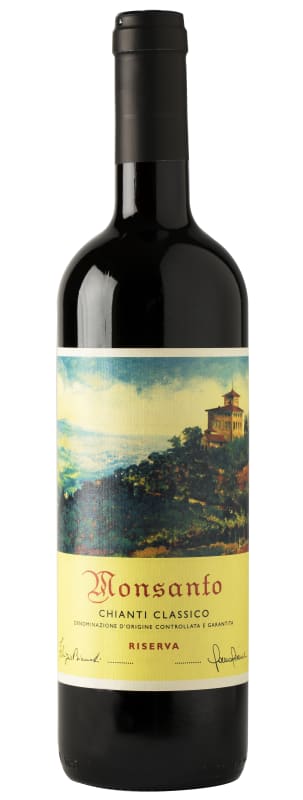


Winemaker Notes
Ruby red tending towards garnet. Rich, intense and complex on the nose with notes of black cherry and spice. Full bodied with rich red berry fruit flavors complimenting a backbone of tannin.
An exceptional compliment to red meats, roasts and game.
Blend: 90% Sangiovese, 10% Canaiolo & Colorino
Professional Ratings
-
Decanter
The intention with Castello di Monsanto’s Riserva is to make a wine with immediate accessibility as well as serious cellaring potential. Gorgeous and precise from the get-go, the 2021 is profuse in aromas of black pepper, flint and earthy brambles. Equally perfumed, the palate ups the ante with rose, bergamot and graphite. A firm tannic spine and linear acidity are matched by fruit depth galore, all intricately and tightly stitched. My instinct is that this is only going to get better, so I prefer to wait. The solution is to buy a few bottles to enjoy its evolution.
-
James Suckling
A deep and complex wine with licorice, dried cherries, pomegranates, bergamot and violets on the nose. Soft on the palate, it’s powerful and extracted yet not without grace due to velvety tannins, a full body and tight-knit acidity. Super-tense finish. Drink or hold.
-
Wine Spectator
This luscious, dense red is packed with cherry, blackberry, pomegranate and violet flavors. Its tannins are ripe and refined, while the vibrant acidity keeps everything focused. An iron streak weaves through the long, energetic finish. This is approachable now yet will be better in 2–3 years. Best from 2026 through 2045.
-
Vinous
The 2021 Chianti Classico Riserva is a wine of pedigree and class. Aromatic, vibrant and delineated, the Riserva captures all the best qualities of the year. Crushed flowers, dark red/purplish fruit, mint, blood orange and pomegranate are some of the many notes that build in the glass. This is a sublime effort.
-
Wine Enthusiast
The Monsanto expressions of Sangiovese are uniformly excellent, but all in marvelously different ways. The Riserva always stands out to me for the depth and texture it offers, and for the riot of Tuscan herbs that sprout on the nose, before ripe, snappy cherry notes light up the palate.
-
Robert Parker's Wine Advocate
From a terrific vintage, the 2021 Chianti Classico Riserva shows a medium-dark garnet appearance. Like the entry-level Chianti Classico, this Riserva delivers lovely primary fruit intensity. That brightness, with plenty of wild cherry and raspberry, is the calling card of Castello di Monsanto. There is a lot of sweet ripeness with fruit preserves, a hint of earthiness and cinnamon.
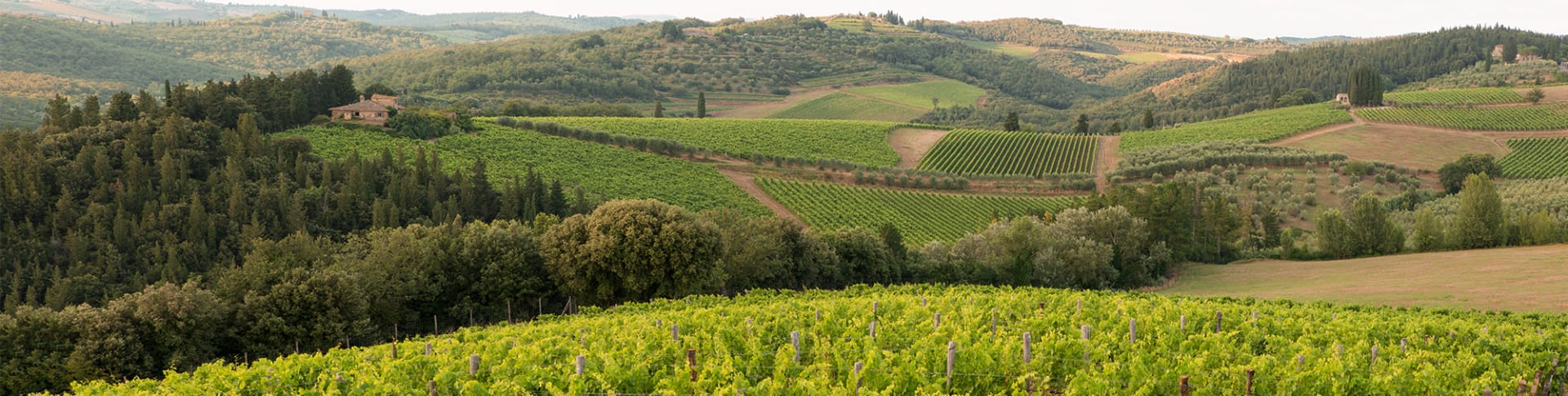




The Castello di Monsanto estate was established by Fabrizio Bianchi in the hillsides of Barberino Val d’Elsa in the province of Florence in the north-central reaches of the Chianti Classico denomination. Bianchi worked to clear a vineyard he named “Il Poggio” (“The Hill”), which would be utilized for production of a single vineyard wine riserva, the first example in Chianti Classico. Always the pioneer, Bianchi began to eliminate the white varieties, Malvasia and Trebbiano, from his Chianti Classico in 1968, preferring to use only the traditional red varieties of Sangiovese, Canaiolo and Colorino.
Cellar innovations in the early years included Slovenian casks for aging, instead of old chestnut barrel, as well as the introduction of stainless steel tanks for fermentation. Furthermore, Castello di Monsanto harvested the first 100% Cabernet Sauvignon, ‘Nemo,’ from the ‘Il Mulino’ vineyard. Today, the Monsanto estate totals 500 acres, of which slightly more than half are woods, while olive orchards occupy an additional 37 acres. Vineyards, situated between 800 and 1,000 feet above sea level, account for 175 acres. Three quarters of the plantings are Sangiovese, the basis for Chianti Classico, while Cabernet Sauvignon and Merlot are the next most widely planted varieties.
One of the most impressive components of Castello di Monsanto is the cellar and its underground tunnel, some 820 feet in length that serves as an aging cellar as well for a potential total of 1,500 barriques. This cave system, one of the most dazzling in all of Italy, took six years to build by hand. The gallery, connecting the new cellar with the original, is located underneath the castle and dates back to 1740.
Today, Fabrizio Bianchi and his daughter, Laura, represent the tradition and elegance that have been associated with the estate throughout its existence. “Il Poggio” was not just an innovation back in 1962; it truly represented a new vision for Chianti Classico. Today, each new vintage is eagerly anticipated as one of the very best bottlings of this wine type.
Each of the wines of Castello di Monsanto, from the award-winning Chianti Classico Riserva, to ‘Nemo’, a Super Tuscan, to the lush and exotic Vin Santo ‘La Chimera’, are true Tuscan treasures. Simply what you would expect from Castello di Monsanto, the grand jewel in the heart of Tuscany.

Among Italy's elite red grape varieties, Sangiovese has the perfect intersection of bright red fruit and savory earthiness and is responsible for the best red wines of Tuscany. While it is best known as the chief component of Chianti, it is also the main grape in Vino Nobile di Montepulciano and reaches the height of its power and intensity in the complex, long-lived Brunello di Montalcino. Somm Secret—Sangiovese doubles under the alias, Nielluccio, on the French island of Corsica where it produces distinctly floral and refreshing reds and rosés.

One of the first wine regions anywhere to be officially recognized and delimited, Chianti Classico is today what was originally defined simply as Chianti. Already identified by the early 18th century as a superior zone, the official name of Chianti was proclaimed upon the area surrounding the townships of Castellina, Radda and Gaiole, just north of Siena, by Cosimo III, Grand Duke of Tuscany in an official decree in 1716.
However, by the 1930s the Italian government had appended this historic zone with additonal land in order to capitalize on the Chianti name. It wasn’t until 1996 that Chianti Classico became autonomous once again when the government granted a separate DOCG (Denominazione di Origine Controllata e Garantita) to its borders. Ever since, Chianti Classico considers itself no longer a subzone of Chianti.
Many Classicos are today made of 100% Sangiovese but can include up to 20% of other approved varieties grown within the Classico borders. The best Classicos will have a bright acidity, supple tannins and be full-bodied with plenty of ripe fruit (plums, black cherry, blackberry). Also common among the best Classicos are expressive notes of cedar, dried herbs, fennel, balsamic or tobacco.