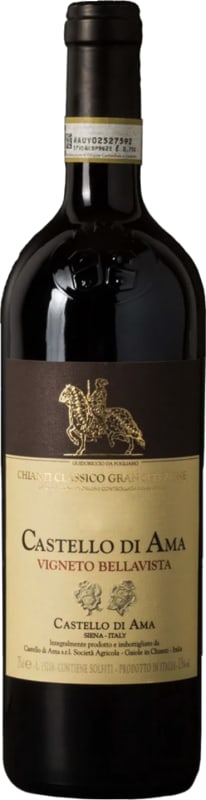


Winemaker Notes
Professional Ratings
-
Robert Parker's Wine Advocate
The glorious Bellavista Vineyard appears under the sunlight over the slope of a hill as you approach Castello di Ama. The 2019 Chianti Classico Gran Selezione Vigneto Bellavista is only produced in the very best vintages, and annual production hovers from 5,000 to 6,000 bottles. Production was skipped in 2017, 2014, 2012 and 2010. This stunning wine reveals beautiful concentration with just the right amount of fruit weight, which feels rich but not heavy. The wine also appears compact and firm, with outstanding depth that is teased across aromas of wild berry fruit, crushed mineral, rose, tobacco and minty herb. The wine's complexity unfolds carefully with time in the glass.
-
Wine Spectator
Dark and brooding, this red evokes violet, black currant and black cherry flavors accented by notes of wild herbs, iron, sanguine and spices. Underlined by a steely structure and vibrant acidity, this shows fine balance and harmony, yet will require more time to ultimately hit its sweet spot. Sangiovese and Malvasia Nera. Best from 2026 through 2047.
-
James Suckling
Blackberry, brambleberry, bark and mushroom aromas follow through to a full body with deep and chewy tannins and a long finish. This is very structured. Needs time to soften. Drink after 2025.
-
Wine & Spirits
This wine’s dark cherry and plum flavors are almost sweet in their ripeness, the flavors enhanced by lively spice notes and floral scents from 20 percent of malvasia nera, which bolsters sangiovese’s fine tannins. The deeply concentrated fruit tones gain notes of roasted mushroom and savory herbs as the wine opens in the glass, maintaining a smooth texture through the long finish.


Disenchanted with Italian winemaking laws in the 1970s, a few rebellious Tuscan winemakers decided to get creative. Instead of following tradition, to bottle Sangiovese by itself, they started blending it with international varieties, namely Cabernet Sauvignon, Merlot and Syrah in differing proportions and with amazing success. However, some Tuscan Blends don’t even include Sangiovese. Somm Secret—The suffix –aia in Italian modifies a word in much the same way –y acts in English. For example, a place with many stones (sassi) becomes Sassicaia. While not all Super Tuscan producer names end in –aia, they all share a certain coy nomenclature.

One of the first wine regions anywhere to be officially recognized and delimited, Chianti Classico is today what was originally defined simply as Chianti. Already identified by the early 18th century as a superior zone, the official name of Chianti was proclaimed upon the area surrounding the townships of Castellina, Radda and Gaiole, just north of Siena, by Cosimo III, Grand Duke of Tuscany in an official decree in 1716.
However, by the 1930s the Italian government had appended this historic zone with additonal land in order to capitalize on the Chianti name. It wasn’t until 1996 that Chianti Classico became autonomous once again when the government granted a separate DOCG (Denominazione di Origine Controllata e Garantita) to its borders. Ever since, Chianti Classico considers itself no longer a subzone of Chianti.
Many Classicos are today made of 100% Sangiovese but can include up to 20% of other approved varieties grown within the Classico borders. The best Classicos will have a bright acidity, supple tannins and be full-bodied with plenty of ripe fruit (plums, black cherry, blackberry). Also common among the best Classicos are expressive notes of cedar, dried herbs, fennel, balsamic or tobacco.