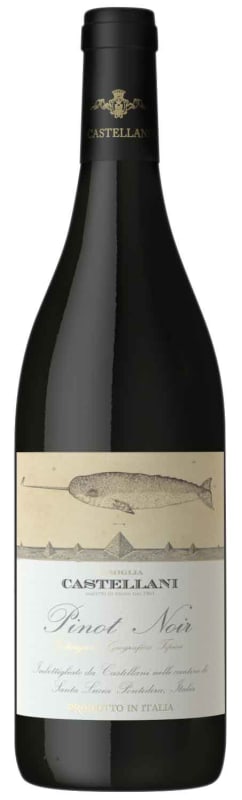


Winemaker Notes
Deep ruby red with violet hues. Delicate with fruity notes of red fruits and wild berries, with light floral hints. Pleasantly soft, velvety and persistent. With some acidity.
Pairs well with both white and red meats, game, roasts and fresh cheeses.
Professional Ratings
-
Wilfred Wong of Wine.com
The 2024 Castellani Collesano Pinot Noir is soft and elegant, offering inviting aromas of warm herbs and cola berries. It pairs beautifully with roast duck finished in a cherry or fig glaze. (Tasted: July 13, 2025, San Francisco, CA)





The Castellani Family produce classic wines in Tuscany since more than 150 years. Every generation continually experiment with their vineyards and cellars in order to select the best Tuscan wines to be bottled under the family brand.
Exporters of wine since 1903, the Castellani family have founded their high-quality wines on the belief that "the quality of the wine starts in the vineyard". For the past 25 years, the family has worked hard to refine the soil types and microclimates that enhance their 'great Tuscan vines', investing in research and new technologies to ensure the Castellani name continues to be associated with 'memorable wines'.
As a warm breeze rustles new sprouts, the picturesque Tyrrhenian Sea serves as the backdrop for rolling hills of grapevines that spread as far as the eye can see. There are many ways to describe the illustrious Central Italian wine region known as Tuscany, but Piergiorgio Castellani and his family use only one word: home. The Castellani family has lived and produced wines for over a century in Tuscany, where the craft of winemaking has been honed and passed down for generations.
A believer in maintaining the balance between nature and the modern world, Piergiorgio and his family reside in the middle of one of his vineyards, which helps influence the personal closeness he feels to the wine his family makes. “I think this is the best way to certify the quality of what you produce; is when you live in the cultivation that you farm,” he says. The special conditions, both climatic and cultural, that exist in Tuscany already offer everything a winemaker needs, but that could quickly change if the land they cultivate is not cared for.
It’s this 360-degree commitment to the environment that enables Piergiorgio to produce high-quality wines year after year. He renounces using chemical treatments and is continually updating his vineyards to maintain organic and natural farming techniques. This confluence between traditional winemaking practices, modern technological advances, and a deep reverence and appreciation for nature fuels the Castellani family’s continued success in producing incredible, robust Italian wines.

Thin-skinned, finicky and temperamental, Pinot Noir is also one of the most rewarding grapes to grow and remains a labor of love for some of the greatest vignerons in Burgundy. Fairly adaptable but highly reflective of the environment in which it is grown, Pinot Noir prefers a cool climate and requires low yields to achieve high quality. Outside of France, outstanding examples come from in Oregon, California and throughout specific locations in wine-producing world. Somm Secret—André Tchelistcheff, California’s most influential post-Prohibition winemaker decidedly stayed away from the grape, claiming “God made Cabernet. The Devil made Pinot Noir.”

A large, geographically and climatically diverse island, just off the toe of Italy, Sicily has long been recognized for its fortified Marsala wines. But it is also a wonderful source of diverse, high quality red and white wines. Steadily increasing in popularity over the past few decades, Italy’s fourth largest wine-producing region is finally receiving the accolades it deserves and shining in today's global market.
Though most think of the climate here as simply hot and dry, variations on this sun-drenched island range from cool Mediterranean along the coastlines to more extreme in its inland zones. Of particular note are the various microclimates of Europe's largest volcano, Mount Etna, where vineyards grow on drastically steep hillsides and varying aspects to the Ionian Sea. The more noteworthy red and white Sicilian wines that come from the volcanic soils of Mount Etna include Nerello Mascalese and Nerello Cappuccio (reds) and Carricante (whites). All share a racy streak of minerality and, at their best, bear resemblance to their respective red and white Burgundies.
Nero d’Avola is the most widely planted red variety, and is great either as single varietal bottling or in blends with other indigenous varieties or even with international ones. For example, Nero d'Avola is blended with the lighter and floral, Frappato grape, to create the elegant, Cerasuolo di Vittoria, one of the more traditional and respected Sicilian wines of the island.
Grillo and Inzolia, the grapes of Marsala, are also used to produce aromatic, crisp dry Sicilian white. Pantelleria, a subtropical island belonging to the province of Sicily, specializes in Moscato di Pantelleria, made from the variety locally known as Zibibbo.