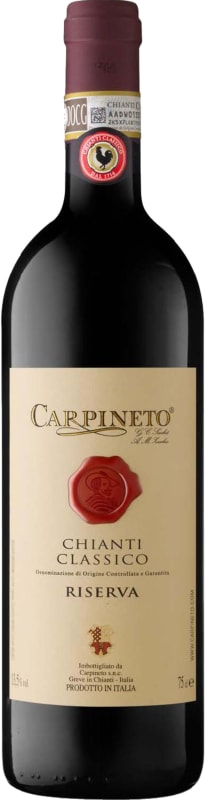


Winemaker Notes
#25 Wine Spectator Top 100 of 2025
In the beautiful olive and cypress-studded countryside between Florence and Siena lay the quaint hilltop villages of the Chianti Classico region. The wine of the same name is produced exclusively in this charming and beautiful area.
Intense ruby red with garnet reflections. Elegant, full, harmonious, and persistent on the nose, with suggestions of vanilla and raspberry. On the palate, it is long, velvety, full, generous, and warm.
Perfect with roasts and game.
Professional Ratings
-
Wine Spectator
This beefy red relies on its dense texture, concentrated flavors of black cherry and blackberry fruit, and muscular tannins to get its message across. Wild herb, iron and earth notes add depth, while the finish is long and spicy.
-
Wine Enthusiast
The nose is savory and umami, with aromas of leather, graphite, underbrush, crushed rocks, bitter herbs and citrus swirling in the glass. Those earthy, bitter notes remain on the palate, but sweet cherries and wild strawberries pop overhead, while charged with powerful tannins and acid.



Carpineto is a partnership between the award winning winemaker Giovanni C. Sacchet and the dynamic Antonio M. Zaccheo, offering a product line of wines spanning from the most prestigious Tuscan DOCG appellations to varietal specific wines of great structure as well as innovative proprietary blends. The winery is widely regarded as one of the quality leaders on the Italian winemaking landscape, exporting the majority of the wine production to over 30 countries worldwide. About 90% of Carpineto's wine production is red wine, 65% of this being "riserva" wines that are aged three or more years before their release date. Since Carpineto generally ages their red wines six to twelve months longer than the minimum time required by DOCG appellation rules the cellars hold at least three consecutive vintages of wine at any given time. This long aging period has allowed Carpineto to build a reputation for high quality and consistency, vintage after vintage.
Carpineto was established in 1967 in the small historic settlement of Dudda, in the township of Greve in Chianti, with the mission of making world class Chianti Classico. This was a radical departure from the marketplace of the Sixties, when the industry was focused on the production of Chianti in the traditional winemaking style sold in the typical "fiasco" bottle. The visionary founders, captured by the Tuscan landscape, the soil and the climate, immediately saw the untapped potential this land possessed to produce great wines. By applying modern viticultural and winemaking methods they set their goals far beyond the quality standards traditional viticultural and winemaking methods were yielding at the time. With this premise, the unyielding determination of their youth, and an uncompromising focus on making the best wines this land could produce the Carpineto mission of marrying tradition with innovation had set sail.
The Carpineto winemaking style is to deliver wines that are full bodied, complex and fruity in character, with a round, supple tannin structure and a long, persistent, clean finish. Despite their approachability upon release, Carpineto's red wines are designed for long cellar aging of twenty years or longer.

Among Italy's elite red grape varieties, Sangiovese has the perfect intersection of bright red fruit and savory earthiness and is responsible for the best red wines of Tuscany. While it is best known as the chief component of Chianti, it is also the main grape in Vino Nobile di Montepulciano and reaches the height of its power and intensity in the complex, long-lived Brunello di Montalcino. Somm Secret—Sangiovese doubles under the alias, Nielluccio, on the French island of Corsica where it produces distinctly floral and refreshing reds and rosés.

One of the first wine regions anywhere to be officially recognized and delimited, Chianti Classico is today what was originally defined simply as Chianti. Already identified by the early 18th century as a superior zone, the official name of Chianti was proclaimed upon the area surrounding the townships of Castellina, Radda and Gaiole, just north of Siena, by Cosimo III, Grand Duke of Tuscany in an official decree in 1716.
However, by the 1930s the Italian government had appended this historic zone with additonal land in order to capitalize on the Chianti name. It wasn’t until 1996 that Chianti Classico became autonomous once again when the government granted a separate DOCG (Denominazione di Origine Controllata e Garantita) to its borders. Ever since, Chianti Classico considers itself no longer a subzone of Chianti.
Many Classicos are today made of 100% Sangiovese but can include up to 20% of other approved varieties grown within the Classico borders. The best Classicos will have a bright acidity, supple tannins and be full-bodied with plenty of ripe fruit (plums, black cherry, blackberry). Also common among the best Classicos are expressive notes of cedar, dried herbs, fennel, balsamic or tobacco.