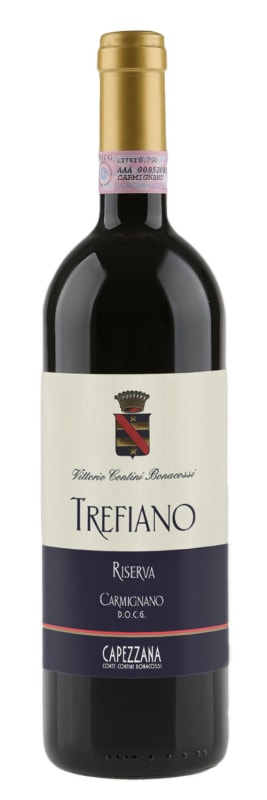


Winemaker Notes
The Trefiano Riserva, made up of predominately Sangiovese alongside Cabernet Sauvignon and Canaiolo, is bottled only in the best vintages, and the fruit comes from a five-hectare vineyard around Villa di Trefiano in Carmignano. The vines, who range between 20-25 years old, grow at 180-222 meters above sea level, upon a mix of clay, limestone, schist, and marl. The wine sees a 13 day extended maceration, and full malolactic fermentation before aging for 18 months in French oak, of which 10% is new.
Professional Ratings
-
Vinous
Spicy, intense and full of potential, the 2019 Carmignano Riserva Trefiano lifts from the glass with a burst of white smoke, peppery rose and crushed raspberries. This displays a radiant core of ripe red and black fruits, opening with a grippy sensation as fine-grained tannins saturate the palate. The 2019 finishes with dramatic length and tension, puckering the cheeks while a staining of primary concentration adds a youthful chewiness. While incredibly young, the balance here is otherworldly.
-
James Suckling
This is spiced and a little earthy with ripe dark fruit, hints of cured meat, walnuts and bark. Medium- to full-bodied with firm, slightly tight tannins. Polished and chalky with juicy fruit underneath. Velvety finish. Drink or hold.
-
Wine Spectator
This austere red's black cherry and blackberry fruit is buried beneath its dense tannins. Earth, iron, eucalyptus and tobacco notes are present, and this finishes with a light astringency. The long finish suggests this is closed at the moment. Sangiovese, Cabernet Sauvignon and Canaiolo. Best from 2026 through 2037. 600 cases made, 125 cases imported.
-
Robert Parker's Wine Advocate
Celebrating a 40th anniversary with a special label, the organic Tenuta di Capezzana 2019 Carmignano Riserva Trefiano is a blend of 80% Sangiovese with Cabernet Sauvignon and Canaiolo. The bouquet starts off with low-key dried fruit, blackcurrant, soft spice and sweet tobacco. The wine's intensity remains reined-in overall, and it shows a mid-weight texture with some tannic tartness.



Few wineries in the world possess the stature, respect and devotion that the Contini Bonacossi family has cultivated and maintained over five generations with their Tenuta di Capezzana winery. The estate is located 12 miles west of Florence in the Carmignano sub-zone, one of the oldest recognized wine producing areas in Tuscany. Ancient Etruscan artifacts have shown that grapevines were cultivated in the area for wine production over 3,000 years ago. The first reference to Capezzana dates to 804 A.D. An ancient parchment stored at the Florentine state archives shows the granting of a lease of vineyards and olive groves for the cultivation of wine and olive oil to a place called Capezzana.
Over the centuries, the estate passed through several families. But the story of today’s Capezzana started when the Count Alessandro Contini Bonacossi and his family returned to Italy after living in Spain and purchased the estate from Raimondo Franchetti’s widow, Sara de Rothschild, in 1920. Not content with this original holding, Count Alessandro acquired the two neighboring farms, “The Poggetto” and “Trefiano,” dividing the property into three distinct estates with more than 120 poderi. The winery was dedicated to the production of high-quality wine and olive oil with the first vintage of Villa di Capezzana in 1925.
Augusto, Alessandro’s son, took over the management of the estate and in 1945, his son, Ugo, joined him. Ugo had completed a degree in Agriculture before heading to the War, and he was devoted to increasing the quality of the family’s wines – a notable endeavor during a time when most producers were still selling their grapes by weight. It was Ugo’s vision that gradually moved the estate away from sharecropping towards a modern-day winery.
Carmignano was first incorporated into the Chianti Montalbano appellation; however, with a unique microclimate, soil composition and the use of international grapes, the Carmignano wines were very different than the Chianti being produced by their neighbors. Due to the tireless efforts of Count Ugo,DOC status was finally granted to Carmignano in 1975. In 1988 the appellation finally received DOCG recognition, making it the smallest DOCG in Tuscany.
In order to qualify as a Carmignano DOCG wine, the blend needs to include a small amount of Cabernet Sauvignon (10-20%). In the 1500s, the Queen of France, Catherine de Medici, had clippings of Cabernet Sauvignon - then known as "uve Francesca" - sent to Carmignano from Bordeaux. Much of those plantings disappeared with the phylloxera epidemic, but Cabernet was replanted by Count Ugo in the1950s. When Carmignano received DOC status in 1975, it became the first sanctioned wine to include Cabernet Sauvignon in Tuscany.
The winery today is comprised of a Renaissance-era villa with historic cellars dating to the sixteenth century, a Frantoio for olive oil production, a Vinsantaia where the estate's legendary Vin Santo is produced, and a fermentation cellar built in 1938 by architect Giovanni Michelucci. The estate's landholdings expand 670 hectares 80ha of vineyards and 140ha of olive groves.
In 2009, Capezzana began farming organically and achieved official certification for the vineyards and wines in 2015. Today,the estate is in the hands of Beatrice, Benedetta and Filippo Contini Bonacossi, fourth generation, and Serena and Gaddo Contini Bonacossi, fifth generation. Together they oversee all aspects of a family business that continues to maintain the stature, respect, and devotion that has been cultivated for centuries.

Legendary in Italy for its Renaissance art and striking landscape, Tuscany is also home to many of the country’s best red wines. Sangiovese reigns supreme here, as either the single varietal, or a dominant player, in almost all of Tuscany’s best.
A remarkable Chianti, named for its region of origin, will have a bright acidity, supple tannins and plenty of cherry fruit character. From the hills and valleys surrounding the medieval village of Montalcino, come the distinguished and age-worthy wines based on Brunello (Sangiovese). Earning global acclaim since the 1970s, the Tuscan Blends are composed solely of international grape varieties or a mix of international and Sangiovese. The wine called Vine Nobile di Montepulciano, composed of Prognolo Gentile (Sangiovese) and is recognized both for finesse and power.