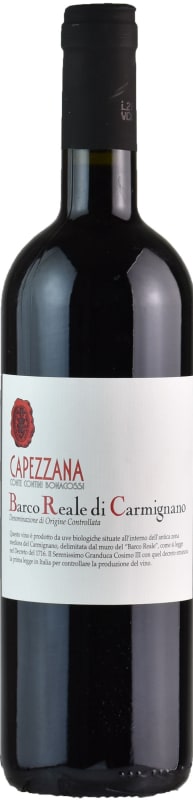


Winemaker Notes
Intense ruby red with violet reflections. Sweet, broad, refined, and very intense on the nose, with fruit and subtle oak notes. On the palate, this wine is soft, voluminous, and broad, with medium-density and sweet tannin in great balance to the acidity. It has a fruity and persistent aftertaste to finish.
Barco Reale di Carmignano pairs perfectly with red meat dishes, roasts and braised meats, as well as with aged cheeses and fine cured meats.
Professional Ratings
-
James Suckling
A dense, compact and well-framed carmignano with aromas of red berries, clay and flowers. It’s medium-bodied with firm tannins. Textured, with a powdery touch. Densely fruited with a focused finish.
-
Vinous
Dusty and floral, the 2022 Barco Reale opens in the glass with a pretty blend of autumnal spices, cedar shavings, Tuscan dust and dried strawberries. It sweeps across the palate with ease, soft-textured and supple, while mineral-tinged red berry fruits slowly saturate toward the close. A web of fine tannins frames the experience as the 2022 finishes with hints of orange citrus and a tart cherry twang.
-
Wine Spectator
Black currant and cherry fruit is prominent in this vibrant, juicy red. There are also flavors of graphite, olive and tobacco underlined by dusty tannins. This leaves a mouthwatering impression. Drink now through 2028. 1,100 cases made, 3,400 cases imported.



Few wineries in the world possess the stature, respect and devotion that the Contini Bonacossi family has cultivated and maintained over five generations with their Tenuta di Capezzana winery. The estate is located 12 miles west of Florence in the Carmignano sub-zone, one of the oldest recognized wine producing areas in Tuscany. Ancient Etruscan artifacts have shown that grapevines were cultivated in the area for wine production over 3,000 years ago. The first reference to Capezzana dates to 804 A.D. An ancient parchment stored at the Florentine state archives shows the granting of a lease of vineyards and olive groves for the cultivation of wine and olive oil to a place called Capezzana.
Over the centuries, the estate passed through several families. But the story of today’s Capezzana started when the Count Alessandro Contini Bonacossi and his family returned to Italy after living in Spain and purchased the estate from Raimondo Franchetti’s widow, Sara de Rothschild, in 1920. Not content with this original holding, Count Alessandro acquired the two neighboring farms, “The Poggetto” and “Trefiano,” dividing the property into three distinct estates with more than 120 poderi. The winery was dedicated to the production of high-quality wine and olive oil with the first vintage of Villa di Capezzana in 1925.
Augusto, Alessandro’s son, took over the management of the estate and in 1945, his son, Ugo, joined him. Ugo had completed a degree in Agriculture before heading to the War, and he was devoted to increasing the quality of the family’s wines – a notable endeavor during a time when most producers were still selling their grapes by weight. It was Ugo’s vision that gradually moved the estate away from sharecropping towards a modern-day winery.
Carmignano was first incorporated into the Chianti Montalbano appellation; however, with a unique microclimate, soil composition and the use of international grapes, the Carmignano wines were very different than the Chianti being produced by their neighbors. Due to the tireless efforts of Count Ugo,DOC status was finally granted to Carmignano in 1975. In 1988 the appellation finally received DOCG recognition, making it the smallest DOCG in Tuscany.
In order to qualify as a Carmignano DOCG wine, the blend needs to include a small amount of Cabernet Sauvignon (10-20%). In the 1500s, the Queen of France, Catherine de Medici, had clippings of Cabernet Sauvignon - then known as "uve Francesca" - sent to Carmignano from Bordeaux. Much of those plantings disappeared with the phylloxera epidemic, but Cabernet was replanted by Count Ugo in the1950s. When Carmignano received DOC status in 1975, it became the first sanctioned wine to include Cabernet Sauvignon in Tuscany.
The winery today is comprised of a Renaissance-era villa with historic cellars dating to the sixteenth century, a Frantoio for olive oil production, a Vinsantaia where the estate's legendary Vin Santo is produced, and a fermentation cellar built in 1938 by architect Giovanni Michelucci. The estate's landholdings expand 670 hectares 80ha of vineyards and 140ha of olive groves.
In 2009, Capezzana began farming organically and achieved official certification for the vineyards and wines in 2015. Today,the estate is in the hands of Beatrice, Benedetta and Filippo Contini Bonacossi, fourth generation, and Serena and Gaddo Contini Bonacossi, fifth generation. Together they oversee all aspects of a family business that continues to maintain the stature, respect, and devotion that has been cultivated for centuries.

Legendary in Italy for its Renaissance art and striking landscape, Tuscany is also home to many of the country’s best red wines. Sangiovese reigns supreme here, as either the single varietal, or a dominant player, in almost all of Tuscany’s best.
A remarkable Chianti, named for its region of origin, will have a bright acidity, supple tannins and plenty of cherry fruit character. From the hills and valleys surrounding the medieval village of Montalcino, come the distinguished and age-worthy wines based on Brunello (Sangiovese). Earning global acclaim since the 1970s, the Tuscan Blends are composed solely of international grape varieties or a mix of international and Sangiovese. The wine called Vine Nobile di Montepulciano, composed of Prognolo Gentile (Sangiovese) and is recognized both for finesse and power.