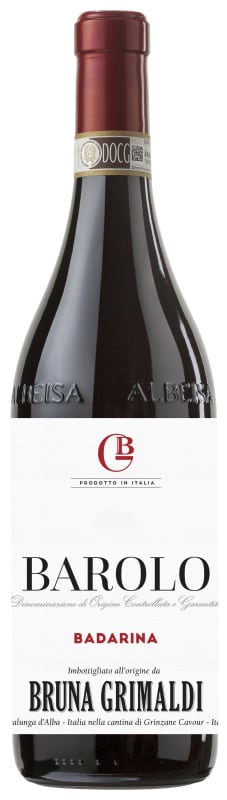


Winemaker Notes
Badarina is the symbolic vineyard of our family. It is the expression of the power and minerality that characterize the terroir of Serralunga d'Alba. Here, a unique microclimate and terroir require more time for the Nebbiolo to ripe. The resulting wine is a Barolo of extraordinary complexity which is distinguished by the intensity of the aromas and the great structure. Ethereal bouquet, with red fruits, raspberries, herbs, balsamic hints that emerge with aging. Important tannins, freshness and minerality, for a Barolo of energy that improves over time.
Professional Ratings
-
Robert Parker's Wine Advocate
The Bruna Grimaldi 2020 Barolo Badarina offers a rich quality of dark fruit that is especially indicative of its roots in Serralunga d'Alba. The wine opens to earthy sensations, dried autumnal leaf and plum. It shows great intensity over medium-plus richness. There is a fun note of roasted hazelnut like the kind you buy on the street in paper wrappers.
-
James Suckling
This is very attractive, fresh and juicy with medium body and compact but well-integrated tannins. It offers plenty of red berries, rose hips, orange peel and hints of crushed stones. Delicious and refreshing, with citrusy nuances in the end.
-
Wine Spectator
Balsamic aromas and flavors of eucalyptus, tomato leaf, wild rosemary, earth and iron swirl around cherry and raspberry notes in the muscular red. There's a deep core of fruit midpalate. This is balanced but needs time to resolve all of its elements. Best from 2029 through 2045. 510 cases made, 100 cases imported.
-
Vinous
The 2020 Barolo Badarina opens with crushed flowers, spice, mint and dried herbs. This mid-weight, rather nervy Barolo offers a good bit of aromatic intensity to match its taut frame. I admire its energy and somewhat quirky personality. Bright acids pull it all together on the finish. This is an especially savory style that is quite typical of the site.



Growing grapes and crafting high quality wines have always been Bruna Grimaldi’s family tradition. Born and raised in the hills that link Grinzane Cavour to Serralunga d’Alba, in the heart of Langhe, Unesco World Heritage, Bruna Grimaldi is a small family-owned winery that since the early 60s produce authentic and terroir-driven wines. Careful work in the vineyard, commitment in the winery, respect for the environment are key aspects of Bruna Grimaldi’s philosophy: a passion for wine that has been handed down for decades in Langhe region where the best plots are selected for the production of Barolo. This history talks about the territory, in full respect of the tradition.
The estate farms organically 14ha (34 acres) of vineyards in the Barolo region and in the neighbouring villages. Bruna and her husband Franco have been recently joined by their son Simone, enologist, and Martina, who both proudly represent the fourth generation and whose aim is to continue the family tradition of producing soulful wines.

Responsible for some of the most elegant and age-worthy wines in the world, Nebbiolo, named for the ubiquitous autumnal fog (called nebbia in Italian), is the star variety of northern Italy’s Piedmont region. Grown throughout the area, as well as in the neighboring Valle d’Aosta and Valtellina, it reaches its highest potential in the Piedmontese villages of Barolo, Barbaresco and Roero. Outside of Italy, growers are still very much in the experimentation stage but some success has been achieved in parts of California. Somm Secret—If you’re new to Nebbiolo, start with a charming, wallet-friendly, early-drinking Langhe Nebbiolo or Nebbiolo d'Alba.

The center of the production of the world’s most exclusive and age-worthy red wines made from Nebbiolo, the Barolo wine region includes five core townships: La Morra, Monforte d’Alba, Serralunga d’Alba, Castiglione Falletto and the Barolo village itself, as well as a few outlying villages. The landscape of Barolo, characterized by prominent and castle-topped hills, is full of history and romance centered on the Nebbiolo grape. Its wines, with the signature “tar and roses” aromas, have a deceptively light garnet color but full presence on the palate and plenty of tannins and acidity. In a well-made Barolo wine, one can expect to find complexity and good evolution with notes of, for example, strawberry, cherry, plum, leather, truffle, anise, fresh and dried herbs, tobacco and violets.
There are two predominant soil types here, which distinguish Barolo from the lesser surrounding areas. Compact and fertile Tortonian sandy marls define the vineyards farthest west and at higher elevations. Typically the Barolo wines coming from this side, from La Morra and Barolo, can be approachable relatively early on in their evolution and represent the “feminine” side of Barolo, often closer in style to Barbaresco with elegant perfume and fresh fruit.
On the eastern side of the Barolo wine region, Helvetian soils of compressed sandstone and chalks are less fertile, producing wines with intense body, power and structured tannins. This more “masculine” style comes from Monforte d’Alba and Serralunga d’Alba. The township of Castiglione Falletto covers a spine with both soil types.
The best Barolo wines need 10-15 years before they are ready to drink, and can further age for several decades.