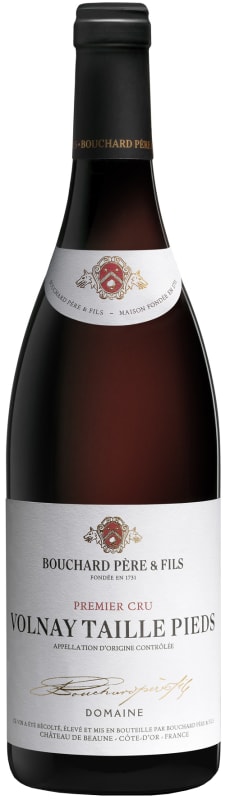


Winemaker Notes
Aromas of red fruit and berries on the nose. With expressive aromas repeated
firmly on the palate, this wine has wonderful liveliness, softening with a bit of time and patience. Good ageing potential.
Pair with poultry and other white meat dishes.
Professional Ratings
-
Robert Parker's Wine Advocate
If the Cuvée Carnot tends to take center stage chez Bouchard, it's the 2020 Volnay 1er Cru Les Taillepieds that's the Volnay to beat to my palate this year. Exhibiting aromas of cherries, raspberries, loamy soil, black truffle and raw cocoa, it's medium to full-bodied, concentrated and elegantly muscular, with terrific depth and mid-palate amplitude, concluding with a long, mineral finish.
Barrel Sample: 93-95 -
Jasper Morris
Another black colour with purple rim. The bouquet wants to offer some elegance despite the massive concentration of the vintage. Succulent dark raspberry, a glossy character also on the palate, firmer tannins behind for sure. Medium plus length and the useful acidity which picks out points of red fruit.
Barrel Sample: 91-93


Thin-skinned, finicky and temperamental, Pinot Noir is also one of the most rewarding grapes to grow and remains a labor of love for some of the greatest vignerons in Burgundy. Fairly adaptable but highly reflective of the environment in which it is grown, Pinot Noir prefers a cool climate and requires low yields to achieve high quality. Outside of France, outstanding examples come from in Oregon, California and throughout specific locations in wine-producing world. Somm Secret—André Tchelistcheff, California’s most influential post-Prohibition winemaker decidedly stayed away from the grape, claiming “God made Cabernet. The Devil made Pinot Noir.”

On the hillsides between Pommard and Meursault, Volnay is one of two villages in the Côte de Beaune of Burgundy that is recognized for its extraordinary Pinot Noir. Pommard is the other; the rest of the villages are most known for some of the most exceptional Chardonnay in the world. While Volnay Pinot Noir tends to be light in color and more delicate than that of Pommard, they typically stand on par with each other in regards to quality and demand.
Volnay can’t claim any Grands Crus vineyards but more than half of it has achieved Premier Cru status. Volnay Premiers Crus vineyards stretch across the entire village from northeast to southwest, abutting and actually falling “into” Meursault. Where they merge is a vineyard called Les Santenots. Pinot Noir grows in this Meursault Premier Cru but since that village is most associated with stellar whites, the Pinot Noir from Les Santenots, takes the name Volnay Santenots. Immediately above it are Volnay’s other prized Premier Cru, Le Cailleret, Champans, Clos des Chênes and Le Cailleret.
Volnay Pinot Noir are earthy with red or blue fruit. Aromas such as smoke, herbs, forest, cocoa and spice are common and on the palate they are gorgeous and concentrated with finesse but won’t truly charm you without some age.