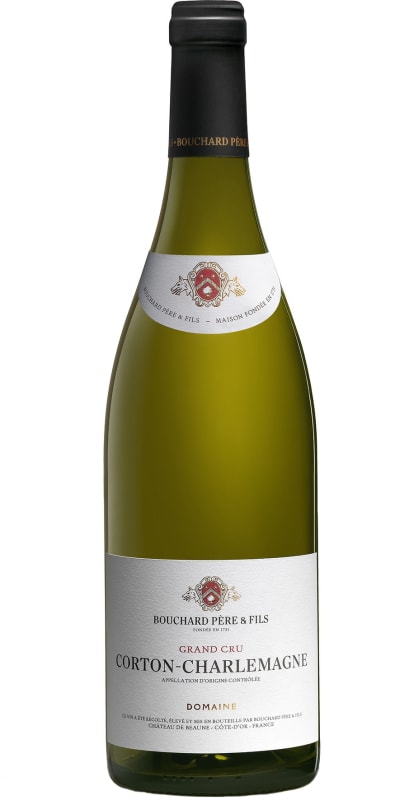


Winemaker Notes
Intense bouquet with aromas of fruit and toast married to mineral notes typical of this appellation. Rich and powerful wine with an assertive personality.
Pairs well with fish and shellfish in sauce and foie gras.
Professional Ratings
-
James Suckling
The nose of this very beautiful Corton-Charlemagne transports me to an Alpine meadow, when all the wild flowers are blossoming. I love the restrained, citrusy richness that is effortlessly interwoven with the stony minerality on the medium- to full-bodied palate of this graceful, yet highly-structured wine. Still quite tight at the very salty finish, but so much to give. From a 3.65 hectare plot at the very top of the hill of Corton, directly below the forest with a yellow mark soil. From organically grown grapes. Drinkable now, but best from 2025.
-
Jasper Morris
The Bouchard holding in Le Corton is made up of white marl on top of limestone slabs, and protected by the forest from the evening sun. Pale lemon and lime. The nose is slightly backward, delicate little flowers, but with the correct stony, almost gravelly aspect. Some riper fruit notes putting their heads above the parapet. A significant saline character too, behind. Drink from 2030-2038.
Barrel Sample: 93-95 -
Robert Parker's Wine Advocate
Aromas of pear, green apple, white flowers and wet stones introduce the 2022 Corton-Charlemagne Grand Cru, a deep, medium to full-bodied wine that's taut, chiseled and racy, with excellent depth at the core and an abundance of chalky structuring extract. As usual, it derives from the domaine's holdings on the Ladoix side.
Barrel Sample: 93-94 -
Wine Spectator
A creamy style, boasting lemon curd, peach and pastry aromas and flavors. Builds to a crescendo midpalate before turning more focused on the lemon-, mineral- and spice-tinged finish. Multidimensional and long.


One of the most popular and versatile white wine grapes, Chardonnay offers a wide range of flavors and styles depending on where it is grown and how it is made. While it tends to flourish in most environments, Chardonnay from its Burgundian homeland produces some of the most remarkable and longest lived examples. California produces both oaky, buttery styles and leaner, European-inspired wines. Somm Secret—The Burgundian subregion of Chablis, while typically using older oak barrels, produces a bright style similar to the unoaked style. Anyone who doesn't like oaky Chardonnay would likely enjoy Chablis.

Prevailing over the charming village of Aloxe, the hill of Corton actually commands the entire appellation. Corton is the only Grand Cru for Pinot Noir in the entire Côte de Beaune. Its Grand Crus red wines can be described simply as “Corton” or Corton hyphenated with other names. These vineyards cover the southeast face of the hill of Corton where soils are rich in red chalk, clay and marl.
Dense and austere when young, the best Corton Pinot Noir will peak in complexity and flavor after about a decade, offering some of the best rewards in cellaring among Côte de Beaune reds. Pommard and Volnay offer similar potential.
The great whites of the village are made within Corton-Charlemagne, a cooler, narrow band of vineyards at the top of the hill that descends west towards the village of Pernand-Vergelesses. Here the thin and white stony soils produce Chardonnay of exceptional character, power and finesse. A minimum of five years in bottle is suggested but some can be amazing long after. Fully half of Aloxe-Corton is considered Grand Cru.