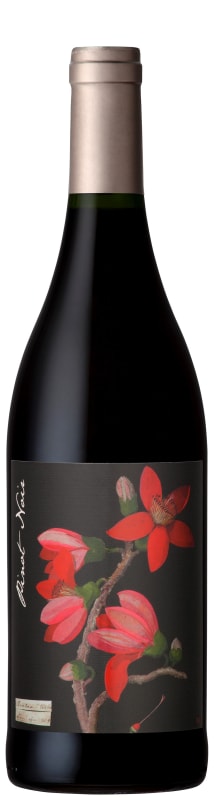


Winemaker Notes
An expressive Pinot which shows hints of herbs and spice on the nose, with layers of bright cherry and strawberry fruit on the palate. Lovely fresh acidity, with a floral lift on the finish.


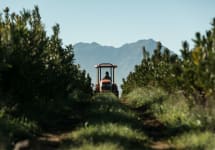
Botanica Wines was founded in 2009 by owner and self-taught winemaker Ginny Povall, an intrepid American who fell in love with the beautiful Cape winelands, purchased Protea Heights farm in Stellenbosch’s Devon Valley and relocated to the southern tip of Africa in 2008. Established in the late 1940s, Protea Heights was the first farm in South Africa to cultivate indigenous protea flowers commercially. Inspired by this horticultural history, it was only natural that Ginny would choose to develop her wine brands and labels with a botanical flair.
Today the estate boasts eight varieties of proteas (four of which are hybridized species unique to the property), largely destined for export to Europe. The 21.6 hectare farm is planted with 10 hectares of indigenous flowers, which bloom throughout the year, and 5 hectares of organically farmed, high density vineyards. Planted between 2009 and 2010, the estate vines provide the Cabernet Sauvignon, Merlot, Cabernet Franc, Petit Verdot and Albariño used to craft Botanica’s Arboretum, Big Flower and Flowergirl ranges.
Protea Heights is also home to Sugarbird Manor, a 4-star luxury guesthouse with nine modern guest rooms and suites and four loft-inspired cottages, offering the perfect winelands retreat.
The Protea Heights vineyards were established in 2009 and 2010, with high density plantings ranging from 5,600 – 10,100 vines per hectare. They are positioned primarily on cooler south to southeast facing slopes, at an altitude ranging from 200 to 250 meters above sea level. Cooling afternoon breezes from False Bay provide natural air conditioning for the vineyards during the warm summer months, cooling the temperatures by an average 10+ degrees. The vineyards were converted to organic farming practices in 2014.

Thin-skinned, finicky and temperamental, Pinot Noir is also one of the most rewarding grapes to grow and remains a labor of love for some of the greatest vignerons in Burgundy. Fairly adaptable but highly reflective of the environment in which it is grown, Pinot Noir prefers a cool climate and requires low yields to achieve high quality. Outside of France, outstanding examples come from in Oregon, California and throughout specific locations in wine-producing world. Somm Secret—André Tchelistcheff, California’s most influential post-Prohibition winemaker decidedly stayed away from the grape, claiming “God made Cabernet. The Devil made Pinot Noir.”

South Africa’s most famous wine-producing district, Stellenbosch, surrounds the historic town with the same name; fine winemaking here dates back to the late 1600s. Its valleys of granite, sandstone and alluvial loam soils between the towering blue-grey mountains of Stellenbosch, Simonsberg and Helderberg have the capacity to produce beautiful wines from many varieties. The climate is warm Mediterranean, tempered by the cool Atlantic air of nearby False Bay.
Perhaps most well-known for its Pinotage and Bordeaux blends, Stellenbosch also produces noteworthy wines from Syrah, Chenin blanc, Chardonnay and Sauvignon blanc. The district’s wards—Banghoek, Bottelary, Devon Valley, Jonkershoek Valley, Papegaaiberg, Polkadraai Hills and Simonsberg-Stellenbosch—all produce distinctive wines from vines with relatively low yields.