


Winemaker Notes
Crystal clear, glimmering with flickers of golden light. Delicate floral aromas interlace with scents of hawthorn and acacia, honey in a display of the bouquet’s infinite finesse. Accents of ripe stone fruits and bergamot bring a lively freshness. A silky texture unfolds with ethereal finesse, bringing subtle elegance and perfect balance. The finish is both long and delicate.
Professional Ratings
-
James Suckling
A sophisticated champagne with extremely refined character and linear phenolics that give it length and class. It's medium-bodied with grapefruit and apples as well as pie crust. Bright acidity at the end. A blend of 72% pinot noir and 28% chardonnay. Dosage 4 g/L. Drink or hold.
-
Wine Spectator
A rich range of black cherry coulis, grilled macadamia nut, poached peach, and crystallized honey and ginger is seamlessly knit with racy acidity and a chalky underpinning in this statuesque Champagne. On first sip, the graceful integration belies the depth and focus, but as this expands on the long, creamy finish, adding hints of lime blossoms, tangerine peel, graphite and brioche, all of its many attributes are on full display.
-
Robert Parker's Wine Advocate
From a relatively cool, mildew-pressured year that did not deliver sufficient fruit for Aÿ to serve as the principal component—and thus precluded the making of La Grande Année—Bollinger instead opted to release the 2016 B16. Disgorged in November 2024 with a dosage of four grams per liter, the wine unwinds in the glass with aromas of yellow apple, mirabelle plum, honeysuckle and bergamot mingled with freshly baked bread and a faint hint of passion fruit. Full-bodied and elegantly muscular, the palate offers a rich, sweet core of fruit, racy acids and an animating pinpoint mousse, concluding with a long, enveloping finish. Vinified entirely in barrels, it comprises 27% Chardonnay and 73% Pinot Noir—principally from Bouzy, Tauxières, Verzy and Verzenay.
-
Decanter
In 2013, Bollinger did not release a Grande Année but did offer its B13, a single-vintage take on a year considered atypical for the Bollinger style. The concept is repeated in the tricky but ultimately fine quality 2016 harvest with the B16. It presents a relatively delicate, cool and understated vintage relative to the Grande Année. The ripeness of the Pinot Noir is certainly present in the juicy stewed apricot and fresh raspberry fruit, but Chardonnay here brings gentle orchard fruit and fresh grapefruit zest beneath subtle richness of toasted nut and oyster shell complexity from ageing. While Grande Année offers more intensity and drama, and the latest PN series offers dynamism and youthful energy, B16 is perfectly pitched between smooth maturity and approachable brightness, all at a temptingly moderate premium over the non-vintage cuvée.



In 1829, Champagne Bollinger introduced an instantly recognizable, dry, toasty style that connoisseurs around the globe have coveted ever since. Six generations of the Bollinger family have maintained that trademark style, and Bollinger is one of the rare Grande Marque houses to be owned, controlled and managed by the same family since it was founded.
With 399 acres of vineyards situated in the best Grands Crus and Premiers Crus villages, Bollinger relies on its own estate for nearly two-thirds of its grape requirements, including the Pinot Noir that gives its Champagne its distinctive roundness and elegance. Bollinger is one of a select few houses that can control the quality of its grape supply so carefully.
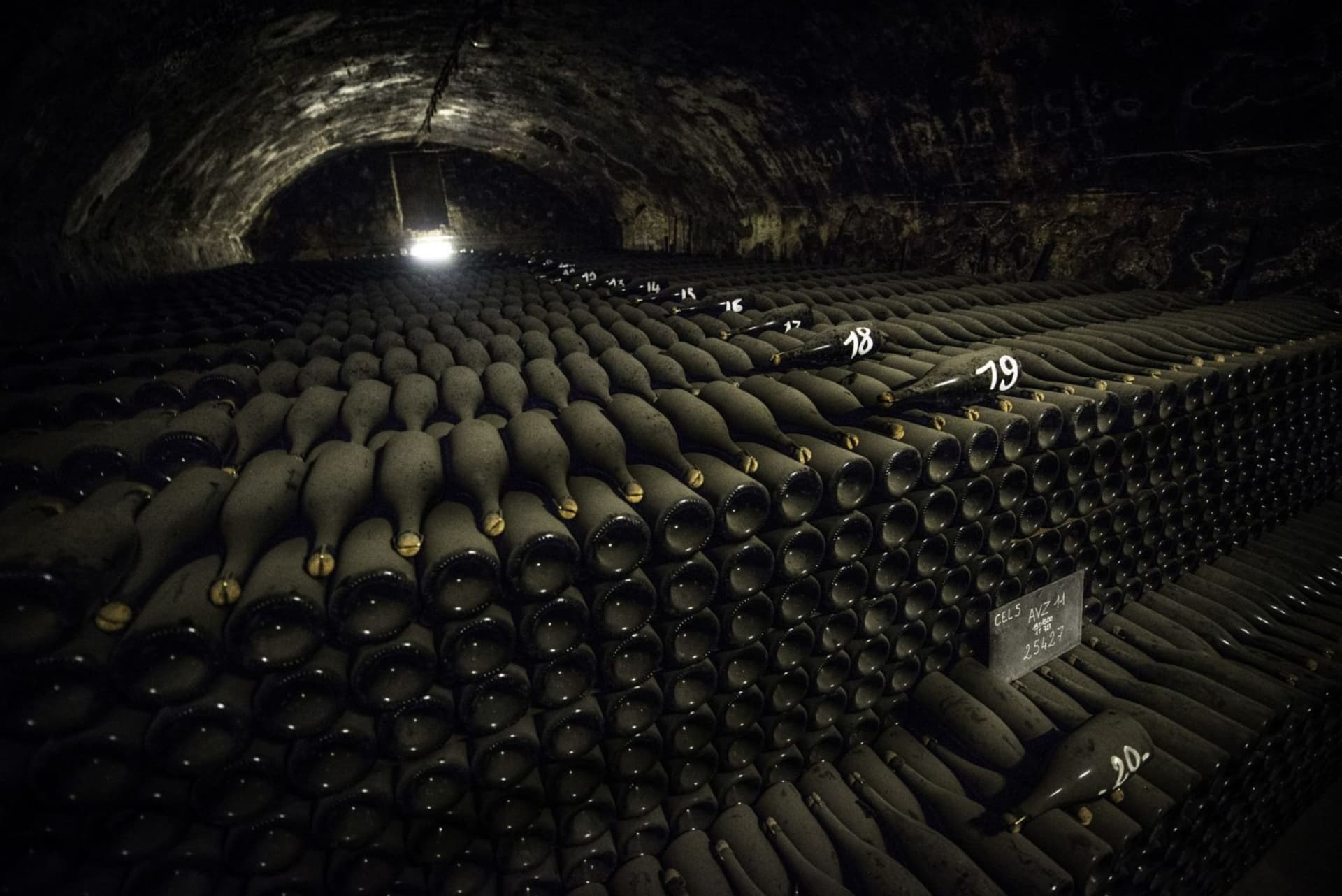
Bollinger is renowned for its stringent quality standards. It adheres to traditional methods, including individual vinification of each marc and cru, barrel fermentation (it is the last Champagne house to employ a full-time cooper) and extra-aging on the lees prior to disgorgement.
Members of the British Royal Court were among the first to embrace Bollinger’s unmistakable quality, and Queen Victoria made Bollinger the exclusive purveyor to the Court by Royal Warrant in 1884. Besides royalty, loyal devotees have included heads of state, celebrities and even famous fictional characters: Agent 007, James Bond, demands the exclusive Champagne Bollinger.

Representing the topmost expression of a Champagne house, a vintage Champagne is one made from the produce of a single, superior harvest year. Vintage Champagnes account for a mere 5% of total Champagne production and are produced about three times in a decade. Champagne is typically made as a blend of multiple years in order to preserve the house style; these will have non-vintage, or simply, NV on the label. The term, "vintage," as it applies to all wine, simply means a single harvest year.

Associated with luxury, celebration, and romance, the region, Champagne, is home to the world’s most prized sparkling wine. In order to bear the label, ‘Champagne’, a sparkling wine must originate from this northeastern region of France—called Champagne—and adhere to strict quality standards. Made up of the three towns Reims, Épernay, and Aÿ, it was here that the traditional method of sparkling wine production was both invented and perfected, birthing a winemaking technique as well as a flavor profile that is now emulated worldwide.
Well-drained, limestone and chalky soil defines much of the region, which lend a mineral component to its wines. Champagne’s cold, continental climate promotes ample acidity in its grapes but weather differences from year to year can create significant variation between vintages. While vintage Champagnes are produced in exceptional years, non-vintage cuvées are produced annually from a blend of several years in order to produce Champagnes that maintain a consistent house style.
With nearly negligible exceptions, . These can be blended together or bottled as individual varietal Champagnes, depending on the final style of wine desired. Chardonnay, the only white variety, contributes freshness, elegance, lively acidity and notes of citrus, orchard fruit and white flowers. Pinot Noir and its relative Pinot Meunier, provide the backbone to many blends, adding structure, body and supple red fruit flavors. Wines with a large proportion of Pinot Meunier will be ready to drink earlier, while Pinot Noir contributes to longevity. Whether it is white or rosé, most Champagne is made from a blend of red and white grapes—and uniquely, rosé is often produce by blending together red and white wine. A Champagne made exclusively from Chardonnay will be labeled as ‘blanc de blancs,’ while ones comprised of only red grapes are called ‘blanc de noirs.’