


Winemaker Notes
The attack is surprisingly pleasant if we remember that this wine does not usually become rounded until it is 4-5 years old. We can find soft tannins with no sharp edges. It has a good, very long finish. This is a wine packed with character and with an evolution which recalls the magnificent 2005 vintage.
Professional Ratings
-
Robert Parker's Wine Advocate
So we moved on to the reds with the 2009 Reserva, a vintage where they harvested quite late and they compare to 2005, a powerful year. The blend is 70% Tempranillo, 15% Garnacho (they use the masculine form of the name here), 10% Graciano and 5% Mazuelo from old terraced vineyards in the lowest part of the Oja valley where the river meets the Ebro. The grapes are fermented with their natural yeast in old oak wooden vats for 20 days with daily pumping-over and aged for two years in barrels, the first year in new ones, and the second year in used ones. The young nose is dominated by dark fruit aromas intermixed with notes of orange rind, licorice, Chinese ink and smoked peat. The palate shows some grainy tannins denoting a young but tender wine, with good intensity and acidity, ideal to have with food. They produce 850,000 bottles of this wine, which is remarkable given its high quality. Very Rioja. Drink 2014-2020.
-
Wine & Spirits
This captures rioja in a ripe vintage, presenting a tight, angular wine with dark red fruit flavor. It opens and breathes with scents of currants and saddle leather, robust in its depths, harmonious in its gentle development. Decant this if you open it now, to serve with roast pheasant or game birds. Best Buy
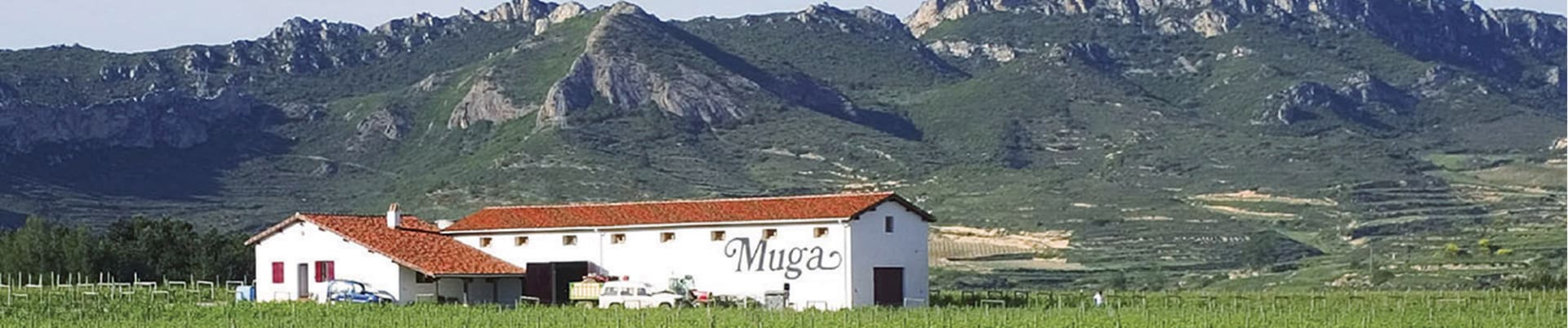





Bodegas Muga is a family firm founded in 1932 by Isaac Muga and Aurora Caño. The first wines were made in an underground cellar, until in 1968 they decided to set up their own winery in a beautiful old 19th-century town-house situated in the city of Haro. The Bodegas Muga outstanding feature is that it always uses the finest materials, combining tradition with the latest advances in winemaking so as always to give its wines the very best quality without losing authenticity. Indeed, it is the only wine cellar in Spain which employs its own master cooper and coopers, who make all the vats for the cellar as well as the oak casks. The winery remains true to traditional winemaking methods such as racking the casks by gravity and fining the wine with fresh egg whites. Bodegas Muga has succeeded in combining the purest family tradition with an updated vision of the future which has allowed them to preserve their own personality and character.

Hailed as the star red variety in Spain’s most celebrated wine region, Tempranillo from Rioja, or simply labeled, “Rioja,” produces elegant wines with complex notes of red and black fruit, crushed rock, leather, toast and tobacco, whose best examples are fully capable of decades of improvement in the cellar.
Rioja wines are typically a blend of fruit from its three sub-regions: Rioja Alta, Rioja Alavesa and Rioja Oriental, although specific sub-region (zonas), village (municipios) and vineyard (viñedo singular) wines can now be labeled. Rioja Alta and Alavesa, at the highest elevations, are considered to be the source of the brightest, most elegant fruit, while grapes from the warmer and drier, Rioja Oriental, produce wines with deep color, great body and richness.