

Winemaker Notes
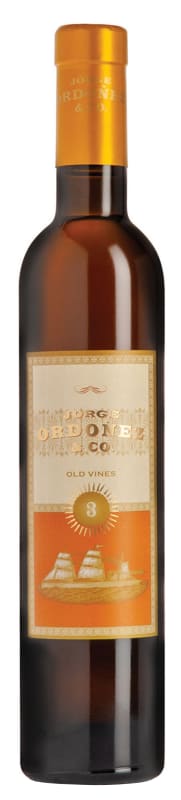
Deep amber, golden color. Full of intense ripe fruit aromatics complemented by honey and jasmine. An unctuous, opulent youth feel balanced out by bright acidity.
Professional Ratings
-
Vinous
The 2023 Moscatel N3 Old Vines comes from El Panderón and Monte Faco. This was planted in 1902 and 1908 and the grapes fermented in a single barrel. A late-harvest wine, it offers dried apricot, dried peach, honey, quince, fennel and raisin on the nose, with a touch of volatility and hydrocarbons. Sweet yet fresh, with date notes on the finish, its acidity offsets the sweetness, delivering purity and drive.
-
Jeb Dunnuck
Monte Faco and El Panderon are the two vineyards that go into the 2023 Vinas Viejas #3, all Moscatel de Alejandria, planted between 1902 and 1908. The grapes are dried at the winery in a cool room, then precisely selected, pressed, and transferred to one 500-liter French oak barrel for fermenting and aging. The barrel impact adds color but not oxidation, resulting in a finely tuned, richly layered expression of apricot and vanilla cookie that ends up at 11% ABV and 350 g/L, tasting full-bodied yet ethereal. The acidity speaks to plenty of aging potential, too.


Apart from the classics, we find many regional gems of different styles.
Late harvest wines are probably the easiest to understand. Grapes are picked so late that the sugars build up and residual sugar remains after the fermentation process. Ice wine, a style founded in Germany and there referred to as eiswein, is an extreme late harvest wine, produced from grapes frozen on the vine, and pressed while still frozen, resulting in a higher concentration of sugar. It is becoming a specialty of Canada as well, where it takes on the English name of ice wine.
Vin Santo, literally “holy wine,” is a Tuscan sweet wine made from drying the local white grapes Trebbiano Toscano and Malvasia in the winery and not pressing until somewhere between November and March.
Rutherglen is an historic wine region in northeast Victoria, Australia, famous for its fortified Topaque and Muscat with complex tawny characteristics.

Known for bold reds, crisp whites, easy-drinking rosés, distinctive sparkling, and fortified wines, Spain has embraced international varieties and wine styles while continuing to place primary emphasis on its own native grapes. Though the country’s climate is diverse, it is generally hot and dry. In the center of the country lies a vast, arid plateau known as the Meseta Central, characterized by extremely hot summers and frequent drought.
Rioja is Spain’s best-known region, where earthy, age-worthy Spanish reds are made from Tempranillo and Garnacha (Grenache). Rioja also produces rich, nutty whites from the local Viura grape.
Ribera del Duero is gaining ground for Spanish wines with its single varietal Tempranillo wines, recognized for their concentration of fruit and opulence. Priorat, a sub-region of Catalonia, specializes in bold, full-bodied Spanish red wine blends of Garnacha (Grenache), Cariñena (Carignan), and often Syrah and Cabernet Sauvignon. Catalonia is also home to Cava, a Spanish sparkling wine made in the traditional method but from indigenous varieties. In the cool, damp northwest Spanish wine region of Galicia, refreshing Spanish white Albariño and Verdejo dominate.
Sherry, Spain’s famous fortified wine, is produced in a wide range of styles from dry to lusciously sweet at the country’s southern tip in Jerez.