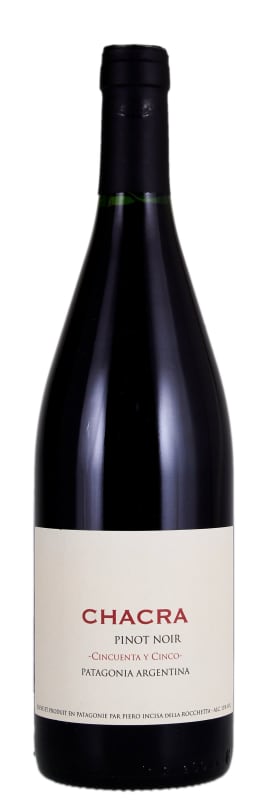


Winemaker Notes
Cincuenta y Cinco comes from vineyards planted in 1955 which gently rest on a sea of pebbles, typical in riverbed soils. It is fermented whole cluster at very low temperatures, enhancing the floral characteristics of the wine. Cincuenta y Cinco has the highest amount of tension of all the Chacra wines while it still retains a comfortable ease. There is a wonderful purity in this wine with dried strawberry and iodine. This refined red mixes crushed bilberry and cherry fruit with undertones of smoke, game and mineral. A fine length.
Professional Ratings
-
Robert Parker's Wine Advocate
They went for a slightly more reductive style in 2013, which shows as austere and backward in the 2013 Cincuenta y Cinco. That, combined with a cooler growing season resulted in a very elegant, subtle wine that is light-colored and has floral (roses, lilies) notes alongside wild strawberries and raspberries. It feels light but has very good concentration of flavors and enough clout, while keeping the poise. The tannins feel very refined, there is good freshness and acidity. It should have a very nice evolution in bottle. This would be the proverbial iron fist in a velvet glove. Bravo!
-
James Suckling
Fabulous aromas of light cloves and other spices plus dark fruits and citrus fruit. Full body, with super structure and richness yet plenty of tannin tension and bright acidity. Very vibrant. Whole berry fermentation with pinot noir that's biodynamically grown. Needs three or four years to come around, but superb.


Thin-skinned, finicky and temperamental, Pinot Noir is also one of the most rewarding grapes to grow and remains a labor of love for some of the greatest vignerons in Burgundy. Fairly adaptable but highly reflective of the environment in which it is grown, Pinot Noir prefers a cool climate and requires low yields to achieve high quality. Outside of France, outstanding examples come from in Oregon, California and throughout specific locations in wine-producing world. Somm Secret—André Tchelistcheff, California’s most influential post-Prohibition winemaker decidedly stayed away from the grape, claiming “God made Cabernet. The Devil made Pinot Noir.”

One of the most southerly regions on the globe for fine wine production, Patagonia has experienced extraordinary vineyard expansion since the early 2000s.
Patagonia vineyards occupy the lower foothills of the Andes at 1,000 to 1,600 feet. Here cold air drops at night from incredibly steep elevations—the Andes reach well over 15,000 feet in this zone—a phenomenon that produces drastic diurnal shifts. Cold nights contrasted with hot summer days produce grapes with striking color, full ripeness, great finesse and aromatic intensity.
Favored for its luxury brands, the Patagonia wine growing region of Argentina focuses on a diverse array of international varieties: Chardonnay, Sauvignon Blanc, Semillón and Viognier among the white grapes, and Cabernet Franc, Malbec, Merlot, Pinot Noir, Syrah and Cabernet Sauvignon for reds.