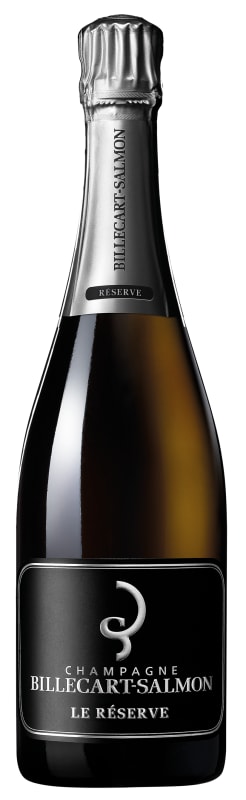


Winemaker Notes
Fine bubbles which rise slowly, persistent mousse. Straw-colored. A nose of ripe pear with some touches of cut hay. Full fruit, but clean in the mouth. All wines from the best sites in the department of the Marne, from more than twenty top vineyards in Champagne. The overall composition of this cuvée has not changed much for almost fifty years.
Fresh and long tasting, the Brut Réserve may be drunk on all occasions.
Blend: 40% Pinot Meunier, 30% Pinot Noir, 30% Chardonnay
Unlock the secrets of your cuvée with MyOrigin. Your digital tool to discover the Champagne you’re about to taste, down to every last detail: grape varieties, dosage, disgorgement date, number of vintages contained in each cuvée, total sugar and food pairings. Billecart-Salmon reveals everything in full transparency thanks to the 6-digit number located on the back label of your bottle, magnum or jeroboam.
Professional Ratings
-
James Suckling
Lovely aromas of raspberries, gingerbread, toast and honey on the nose. I like the generosity and concentration of flavor on the palate, with a medium body and soft, creamy bubbles. Long finish. 43% meunier, 29% chardonnay and 28% pinot noir, with over 50% reserve wines. Blend of 15 vintages, with percentages based on the 2020 vintage, back to 2006.
-
Wine Enthusiast
This Champagne is a classic. The nonvintage wine shows real richness and depth. It is structured, open with a honeyed aroma and ripe, rounded white fruits.
-
Wilfred Wong of Wine.com
COMMENTARY: The Champagne Billecart-Salmon Brut Réserve shows excellent complexity while staying true to its genre. TASTING NOTES: This wine exhibits aromas and flavors of baked bread and ripe apples. Pair it with grilled sea scallops in a cream sauce. (Tasted: May 11, 2023, San Francisco, CA)
-
Robert Parker's Wine Advocate
Based on the 2020 vintage (the youngest vintage serves as the “base” of a bottling, even if it does not represent the majority of the blend) and incorporating 71% reserve wines—half stored as individual vintages and the other half as a perpetual reserve initiated in 2006—Billecart-Salmon’s latest NV Le Réserve is showing nicely. It offers aromas of green pear, honeysuckle, brioche and white peach. Disgorged in early 2024 with a dosage of three grams per liter, this reimagined cuvée has recently undergone a significant reduction in dosage. The sweetness that so often presents itself on the finish of NV Champagnes from Grandes Marques is no more. Medium to full-bodied, lively and charming, with a textural attack and vibrant acidity, it culminates in a long, precise finish.
-
Wine Spectator
Firm and minerally, this well-knit Champagne layers flavors of grainy pear, preserved lemon, toast point and crystallized honey on a creamy mousse. Reveals hints of smoke and saline on the finish.
-
Jeb Dunnuck
The first wine tasted in a short vertical to highlight the evolution of the NV Champagne Brut over the past several years, this release is from the 2016 vintage and is composed of 44% Meunier and 28% each Pinot Noir and Chardonnay, with 64% reserve wine, with 4% cask aging. Pouring a rich straw hue, it opens to generous and lightly toasty aromas of ripe red berries, caramel, and honeycomb. Medium to full-bodied, it’s ripe, rounded, expressive, and approachable, although it feels the touch of dosage in its texture as well as the suggestion of sweetness. Its fruit is ripe and long on the palate, with a hint of walnut skin on the long finish. It is certainly the classic, old school style, and compared to the other wines, has a bit broader shoulders. Its toasty touch likely comes from the malolactic fermentation that was permitted as opposed to oak.



Oldest continuously family-owned House, Billecart-Salmon was founded in 1818 by the marriage of Nicolas Francois Billecart and Elisabeth Salmon. For over two hundred years, the House has developed a renowned expertise in crafting fine, elegant and balanced Champagnes.
Billecart-Salmon was first and foremost the result a union between Nicolas François Billecart and Elisabeth Salmon who, in 1818 and just married, founded their own Champagne House in Mareuil-sur-Aÿ, a small village near Epernay. At their side was Louis Salmon, Elisabeth’s brother and a passionate oenologist who, from the very beginning, dedicated himself to the development of the wines. From then on, their heirs have never stopped aiming for excellence in winemaking. Today led by seventh generation Mathieu Roland-Billecart, each family member has endeavored to pursue the family tradition and stay faithful to the same motto: "give priority to quality, strive for excellence."
Billecart-Salmon rigorously cultivates an estate of 100 hectares, sourcing grapes from an area totaling 300 hectares across 40 crus of the Champagne region.
The majority of the grapes used for vinification come from a radius of 20km around Epernay, where the Grand Crus of Pinot Noir, Pinot Meunier and Chardonnay co-exist, in the vineyards of the Montagne de Reims, the Vallée de la Marne and the Côte des Blancs.
As part of the quest to increase the quality of their champagnes, in the 1950s, the House introduced the technique of cold settling combined with the use of stainless steel tanks for a longer fermentation at a lower temperature. Vinification occurs primarily on small thermoregulated tanks which allows the House to vinify parcels separately, preserving nuances of expression of "terroir". Low temperature fermentation slows down the process, encouraging aromas to delicately develop and allow the purity of the fruit to be fully expressed; absolute signature of the Billecart-Salmon style: finesse, elegance and balance.
Over three years of ageing on lees in the chalk cellars for the non-vintage cuvees and over ten year for the prestige vintage cuvees, the family allows their wines to blossom. Giving the luxury of time to play its role is also behind the grandeur of Billecart-Salmon champagnes.

A term typically reserved for Champagne and Sparkling Wines, non-vintage or simply “NV” on a label indicates a blend of finished wines from different vintages (years of harvest). To make non-vintage Champagne, typically the current year’s harvest (in other words, the current vintage) forms the base of the blend. Finished wines from previous years, called “vins de reserve” are blended in at approximately 10-50% of the total volume in order to achieve the flavor, complexity, body and acidity for the desired house style. A tiny proportion of Champagnes are made from a single vintage.
There are also some very large production still wines that may not claim one particular vintage. This would be at the discretion of the winemaker’s goals for character of the final wine.

Associated with luxury, celebration, and romance, the region, Champagne, is home to the world’s most prized sparkling wine. In order to bear the label, ‘Champagne’, a sparkling wine must originate from this northeastern region of France—called Champagne—and adhere to strict quality standards. Made up of the three towns Reims, Épernay, and Aÿ, it was here that the traditional method of sparkling wine production was both invented and perfected, birthing a winemaking technique as well as a flavor profile that is now emulated worldwide.
Well-drained, limestone and chalky soil defines much of the region, which lend a mineral component to its wines. Champagne’s cold, continental climate promotes ample acidity in its grapes but weather differences from year to year can create significant variation between vintages. While vintage Champagnes are produced in exceptional years, non-vintage cuvées are produced annually from a blend of several years in order to produce Champagnes that maintain a consistent house style.
With nearly negligible exceptions, . These can be blended together or bottled as individual varietal Champagnes, depending on the final style of wine desired. Chardonnay, the only white variety, contributes freshness, elegance, lively acidity and notes of citrus, orchard fruit and white flowers. Pinot Noir and its relative Pinot Meunier, provide the backbone to many blends, adding structure, body and supple red fruit flavors. Wines with a large proportion of Pinot Meunier will be ready to drink earlier, while Pinot Noir contributes to longevity. Whether it is white or rosé, most Champagne is made from a blend of red and white grapes—and uniquely, rosé is often produce by blending together red and white wine. A Champagne made exclusively from Chardonnay will be labeled as ‘blanc de blancs,’ while ones comprised of only red grapes are called ‘blanc de noirs.’