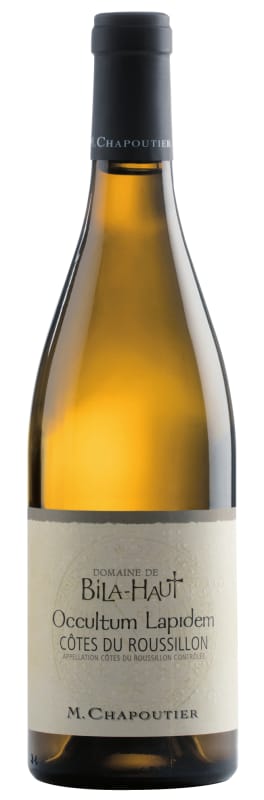


Winemaker Notes
Lovely golden hue. Stone fruit aromas (apricots, peach), a delicately roasted floral touch, minerality and complexity. Lovely and fresh on entry, full of minerality and complexity. Well-balanced wine thanks to the freshness and the fat of the Grenache Blanc. Notes of white flesh fruits with hints of vanilla.
Blend: 60% Grenache Blanc, 40% Grenache Gris
Professional Ratings
-
Jeb Dunnuck
The 2021 Côtes Du Roussillon Occultum Lapidem Blanc brings everything up a notch and is a riveting white from this region. Based on 60% Grenache Blanc and 40% Grenache Gris, it has ample crushed citrus and honeyed lemon-like fruit nuances as well as background honeyed minerality and minty herb notes. I love its concentration, and it's medium-bodied, with bright acidity and a clean, dry, lengthy finish that keeps you coming back to the glass.
-
Wilfred Wong of Wine.com
The 2021 Domaine de Bila-Haut by Michael Chapoutier OCCULTUM LAPIDEM CÔTES DU ROUSSILLON unfolds a light straw color; aromas of sunbaked stone and a faint nutty note drift upward; medium bodied, firmly mineral-driven on the palate, with a tactile, almost concrete-like edge; dried citrus tones weave through; crisp, enduring finish. Pair with grilled Mediterranean sea bream with olive oil and herbs or lemony chicken with thyme. (Tasted: 3/31/26, San Francisco, CA)


With hundreds of white grape varieties to choose from, winemakers have the freedom to create a virtually endless assortment of blended white wines. In many European regions, strict laws are in place determining the set of varieties that may be used in white wine blends, but in the New World, experimentation is permitted and encouraged. Blending can be utilized to enhance balance or create complexity, lending different layers of flavors and aromas. For example, a variety that creates a soft and full-bodied white wine blend, like Chardonnay, would do well combined with one that is more fragrant and naturally high in acidity. Sometimes small amounts of a particular variety are added to boost color or aromatics. Blending can take place before or after fermentation, with the latter, more popular option giving more control to the winemaker over the final qualities of the wine.

An appellation solely for dry red wines from Roussillon, Côtes du Roussillon-Villages is a step up in quality compared to, simply, Côtes du Roussillon. The area is in the northern third of Roussillon, bordered on its southern end by the Têt River, which runs precisely from west to east. Five villages can append their own name to the Côtes du Roussillon-Villages appellation name: Caramany, Latour de France, Lesquerde, Tautavel and the last, south of the Têt River, Les Aspres.
Côtes du Roussillon-Villages red wines are blends made from Grenache, Syrah, Mourvedre and small amounts of Carignan, Cinsault and the lesser known, Lledoner Pelut (a relative of Grenache).