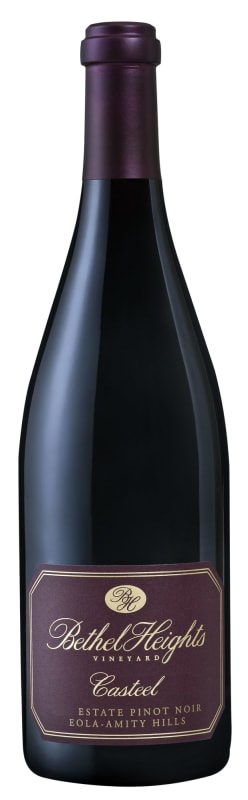


Winemaker Notes
Over the past twenty years Bethel Heights has been known for crafting limited bottlings of distinctive vineyard and block designated Pinot noir wines. In 2002 we took a new path and produced our first Casteel Reserve Pinot Noir, a blend of barrels from several different blocks, selected to express the epitome of that particular vintage. This is the only Bethel Heights Pinot noir that carries our family name rather than a place name, which gives us considerable poetic license to select our favorite barrels from each vintage, regardless of provenance.
Professional Ratings
-
James Suckling
This beautiful pinot noir shows aromas of cherries, almonds and earth. Floral character, too. Medium body, firm and round tannins and a cool and long finish. Drink now or hold.
-
Wine Enthusiast
A barrel-selection, top-of-the-line cuvée, this is intensely aromatic with black cherry, soft leather and baking spices in play. Flavors focus in the midpalate, leading into supple tannins and a smattering of cocoa powder. Overall it's a big wine, full flavored, balanced and already drinking very well.
-
Wine Spectator
Structured and slightly brooding, with black cherry and wet stone aromas and densely layered plum and dark tea flavors that are framed by taut tannins. Drink now through 2022.


Thin-skinned, finicky and temperamental, Pinot Noir is also one of the most rewarding grapes to grow and remains a labor of love for some of the greatest vignerons in Burgundy. Fairly adaptable but highly reflective of the environment in which it is grown, Pinot Noir prefers a cool climate and requires low yields to achieve high quality. Outside of France, outstanding examples come from in Oregon, California and throughout specific locations in wine-producing world. Somm Secret—André Tchelistcheff, California’s most influential post-Prohibition winemaker decidedly stayed away from the grape, claiming “God made Cabernet. The Devil made Pinot Noir.”

Running north to south, adjacent to the Willamette River, the Eola-Amity Hills AVA has shallow and well-drained soils created from ancient lava flows (called Jory), marine sediments, rocks and alluvial deposits. These soils force vine roots to dig deep, producing small grapes with great concentration.
Like in the McMinnville sub-AVA, cold Pacific air streams in via the Van Duzer Corridor and assists the maintenance of higher acidity in its grapes. This great concentration, combined with marked acidity, give the Eola-Amity Hills wines—namely Pinot noir—their distinct character. While the region covers 40,000 acres, no more than 1,400 acres are covered in vine.