

Winemaker Notes
Rovittello Etna Rosso is red ruby with tints of garnet red. The aromas are etheral, intense, and delicate with hints of vanilla, chestnut flowers and noble wood. On the palate, this wine is elegant, harmonic, remarkably persistent and reasonably tannic.
Professional Ratings
-
Wine & Spirits
Grown on 80-year-old vines in Castiglione, on the north side of Etna at 2,460 feet, this wine is remarkably fresh for a 2005, its fruit still blue in tone, its tannins intensely volcanic. The acidity creates a structure in the wine that is tart and angular, allowing space between the flavors that reveals their subtlety. The finish is cool and sappy, ready to last in parallel with the flavors of veal and eggplant involtini.
-
Robert Parker's Wine Advocate
The 2005 Etna Rosso Rovittello is Nerello Mascalese and Nerello Cappuccio that spends a year in French oak barrels. The Rovittello is made in a forward style that emphasizes fruit and a soft-textured, juicy personality. The winemaking approach yielded a generous, fruity wine but one that lacks the aromatic definition that defines this great, indigenous grape. Anticipated maturity: 2010-2020.



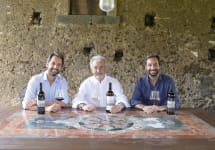
At the end of the 1800’s, Giuseppe Benanti, grandfather of Dr. Giuseppe Benanti, began the production of wines on one of his father’s old farms on the slopes of Mount Etna, at Viagrande (Catania). In 1988, Giuseppe Benanti revived the family’s old passion, with an extensive and selective study of the Etnean soils highly devoted to viticulture. He also investigated particular clones of indigenous vines and new oenological techniques to reproduce ancient fragrances using the most modern practices of vinification, in a perfect union of history and reality. From this five year study, wines of unique taste were produced recreating old flavors and keeping them intact over time.
Our wines have a strong personality and carry the culture and passion for wine of the Benanti family, always driven by respect for the places, terroir and old 'palmenti'. This passion, after revealing the marvels of the Etnean territory, has guided them to Pantelleria and then Pachino. Today the company, also run by Giuseppe Benanti’s sons, Antonio and Salvino, is placed in a market range of high quality level products and the request for its wines is strongly increasing. This is mainly due to the quality of its wines, known throughout Italy and abroad, and attested by many awards given annually by the most important national and international competitions.

Extending across the variable volcanic soils of the slopes of Mt. Etna at some of the highest vineyard altitudes in all of Europe—up to 3,300 feet—Nerello Mascalese is one of Sicily’s most noble red varieties. It makes a beautifully aromatic, firm, cellar-worthy but pale-hued red often comparable to a fine Burgundy or Barbaresco. Somm Secret—Nerello Mascalese takes its name from the black color of its grapes, nerello, and the Mascali plain between Mt. Etna and the coast where it is believed to have originated.

A large, geographically and climatically diverse island, just off the toe of Italy, Sicily has long been recognized for its fortified Marsala wines. But it is also a wonderful source of diverse, high quality red and white wines. Steadily increasing in popularity over the past few decades, Italy’s fourth largest wine-producing region is finally receiving the accolades it deserves and shining in today's global market.
Though most think of the climate here as simply hot and dry, variations on this sun-drenched island range from cool Mediterranean along the coastlines to more extreme in its inland zones. Of particular note are the various microclimates of Europe's largest volcano, Mount Etna, where vineyards grow on drastically steep hillsides and varying aspects to the Ionian Sea. The more noteworthy red and white Sicilian wines that come from the volcanic soils of Mount Etna include Nerello Mascalese and Nerello Cappuccio (reds) and Carricante (whites). All share a racy streak of minerality and, at their best, bear resemblance to their respective red and white Burgundies.
Nero d’Avola is the most widely planted red variety, and is great either as single varietal bottling or in blends with other indigenous varieties or even with international ones. For example, Nero d'Avola is blended with the lighter and floral, Frappato grape, to create the elegant, Cerasuolo di Vittoria, one of the more traditional and respected Sicilian wines of the island.
Grillo and Inzolia, the grapes of Marsala, are also used to produce aromatic, crisp dry Sicilian white. Pantelleria, a subtropical island belonging to the province of Sicily, specializes in Moscato di Pantelleria, made from the variety locally known as Zibibbo.