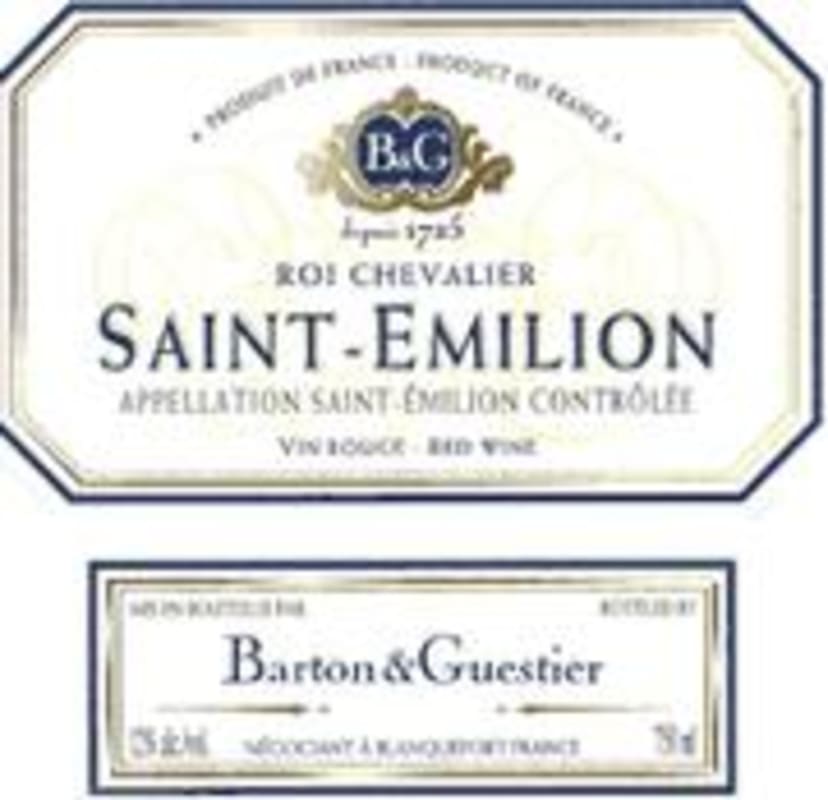

Barton & Guestier St. Emilion 1999 Front Label

Winemaker Notes

The Saint-Emilion vineyard is situated on the Right Bank of the Dordogne river, near Libourne and Pomerol. This hilly region is dominated by calcium based soils in the form of limestone which are covered by clay, sand or gravel. The calcium in the soils enables the Merlot grape to develop great concentration, which it rarely achieves elsewhere. The Merlot provides mellow smoothness, the Cabernet Franc a more tannic aromatic base: a harmony, which gives to the wine richness, great fruit and a potential for improvement with age. VINTAGE 1999 is, once again, a winegrowers year! Early budburst at the end of March and flowering at the end of May which took place under favorable climatic conditions presupposed a very abundant crop. July was hot and stormy and gave rise to fears of mildew and necessitated vigilance on the part of the growers. From August 18th an ideal hot spell lasted for almost one month, which allowed the grapes to ripen under good conditions and to reach a good level of concentration, specifically in potential alcohol. The rain which fell between September 11th and 20th diluted this concentration somewhat except where conscientious growers had controlled the yields on the vines (green harvest) and had encouraged ripening (leaf pruning). In Saint-Emilion, a violent hailstorm on the 5th of September damaged 500 hectares (1200 acres) of the appellation, mainly in the zone of the Grands Crus Classés. WINEMAKING The aim of Barton & Guestier is to produce wines which are typical of the appellation: harmonious, with soft tannins and fruity flavors. While respecting the traditional winemaking techniques (de-stalking and crushing the grapes), alcoholic fermentation took place at 30-32°C, then daily pumping over and a two or three weeks maceration period were necessary. After malolactic fermentation, the wines were aged in oak barrels for a few months. WINEMAKER NOTES Purple with violet highlights. Fine and elegant with aromas of liquorice, spices and red fruit (raspberry). With a supple attack, it is structured and well balanced, with good fruity mouth aromas and a spicy finish.
Barton & Guestier

Barton & Guestier

View all products
Image for Bordeaux Blends content section
View all products

One of the world’s most classic and popular styles of red wine, Bordeaux-inspired blends have spread from their homeland in France to nearly every corner of the New World. Typically based on either Cabernet Sauvignon or Merlot and supported by Cabernet Franc, Malbec and Petit Verdot, the best of these are densely hued, fragrant, full of fruit and boast a structure that begs for cellar time. Somm Secret—Blends from Bordeaux are generally earthier compared to those from the New World, which tend to be fruit-dominant.

Image for St-Émilion Bordeaux, France content section

St-Émilion

Bordeaux, France

View all products

Marked by its historic fortified village—perhaps the prettiest in all of Bordeaux, the St-Émilion appellation, along with its neighboring village of Pomerol, are leaders in quality on the Right Bank of Bordeaux. These Merlot-dominant red wines (complemented by various amounts of Cabernet Franc and/or Cabernet Sauvignon) remain some of the most admired and collected wines of the world.

St-Émilion has the longest history in wine production in Bordeaux—longer than the Left Bank—dating back to an 8th century monk named Saint Émilion who became a hermit in one of the many limestone caves scattered throughout the area.

Today St-Émilion is made up of hundreds of independent farmers dedicated to the same thing: growing Merlot and Cabernet Franc (and tiny amounts of Cabernet Sauvignon). While always roughly the same blend, the wines of St-Émilion vary considerably depending on the soil upon which they are grown—and the soils do vary considerably throughout the region.

The chateaux with the highest classification (Premier Grand Cru Classés) are on gravel-rich soils or steep, clay-limestone hillsides. There are only four given the highest rank, called Premier Grand Cru Classés A (Chateau Cheval Blanc, Ausone, Angélus, Pavie) and 14 are Premier Grand Cru Classés B. Much of the rest of the vineyards in the appellation are on flatter land where the soils are a mix of gravel, sand and alluvial matter.

Great wines from St-Émilion will be deep in color, and might have characteristics of blackberry liqueur, black raspberry, licorice, chocolate, grilled meat, earth or truffles. They will be bold, layered and lush.

CGM42341_1999 Item# 38321