
Winemaker Notes





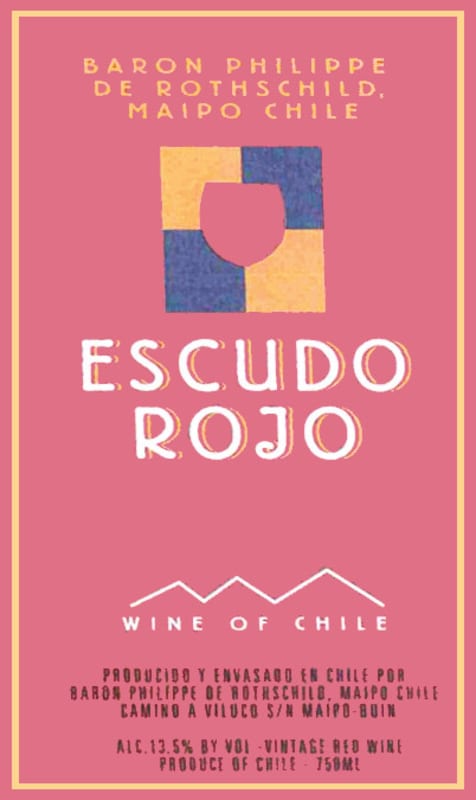
Escudo Rojo is an iconic Chilean brand created by Baron Philippe de Rothschild to produce the best wines in each category and market them worldwide. The wines strike a harmonious balance between freshness, fruit, oak, fullness on the palate and ageing potential. In addition to the flagship blended wine, the Escudo Rojo range includes five varietal wines: Carmenere, Syrah, Cabernet Sauvignon, Chardonnay and Sauvignon Blanc. All the wines in the range express a distinctive character, reflecting the expression of its terroir.
Escudo Rojo is the Spanish translation of the German “Rote Schild” meaning Red Shield. In 1999, the encounter between Chilean soil and Bordeaux expertise gave rise to Escudo Rojo, a branded wine worthy of the Baron Philippe de Rothschild name, synonymous with the high standards of a great winemaking tradition. Vines were first introduced into Chile in the 16th century by the Spanish Conquistadors and their religious orders who needed wine to celebrate mass. Cabernet Sauvignon, Merlot, Sauvignon Blanc and Chardonnay vines were imported from France in the 19th century in order to make finer wines.
Located at Buin-Maipo, 45 kilometers south of Santiago in the famous Maipo Valley, the Baron Philippe de Rothschild Maipo Chile bodega stands in its own 63-hectare (156-acre) vineyard. The wines are made, matured, bottled and packaged at the estate under the supervision of a French winemaker and under the control of an in-house laboratory. For each of its wines, the winery selects the best parcels in Chile’s most highly reputed valleys in order to make wines which consistently combine refinement and character. Regular sources of supply and constant quality are also guaranteed by long-term contracts with partner winegrowers, especially further south, in the Rapel Valley. A rigorous parcel selection procedure has been created, with each parcel being tested for three years in order to ensure that the grapes are of sufficiently high quality to be used to make Escudo Rojo.

Beyond the usual suspects, there are hundreds of red grape varieties grown throughout the world. Some are indigenous specialties capable of producing excellent single varietal wines, while others are better suited for use as blending grapes. Each has its own distinct viticultural characteristics, as well as aroma and flavor profiles, offering much to be discovered by the curious wine lover. In particular, Portugal and Italy are known for having a multitude of unique varieties but they can really be found in any region.

Dramatic geographic and climatic changes from west to east make Chile an exciting frontier for wines of all styles. Chile’s entire western border is Pacific coastline, its center is composed of warm valleys and on its eastern border, are the soaring Andes Mountains.
Chile’s central valleys, sheltered by the costal ranges, and in some parts climbing the eastern slopes of the Andes, remain relatively warm and dry. The conditions are ideal for producing concentrated, full-bodied, aromatic reds rich in black and red fruits. The eponymous Aconcagua Valley—hot and dry—is home to intense red wines made from Cabernet Sauvignon, Syrah and Merlot.
The Maipo, Rapel, Curicó and Maule Valleys specialize in Cabernet and Bordeaux Blends as well as Carmenère, Chile’s unofficial signature grape.
Chilly breezes from the Antarctic Humboldt Current allow the coastal regions of Casablanca Valley and San Antonio Valley to focus on the cool climate loving varieties, Pinot Noir, Chardonnay and Sauvignon Blanc.
Chile’s Coquimbo region in the far north, containing the Elqui and Limari Valleys, historically focused solely on Pisco production. But here the minimal rainfall, intense sunlight and chilly ocean breezes allow success with Chardonnay and Pinot Noir. The up-and-coming southern regions of Bio Bio and Itata in the south make excellent Riesling, Chardonnay and Pinot Noir.
Spanish settlers, Juan Jufre and Diego Garcia de Cáceres, most likely brought Vitis vinifera (Europe’s wine producing vine species) to the Central Valley of Chile sometime in the 1550s. One fun fact about Chile is that its natural geographical borders have allowed it to avoid phylloxera and as a result, vines are often planted on their own rootstock rather than grafted.