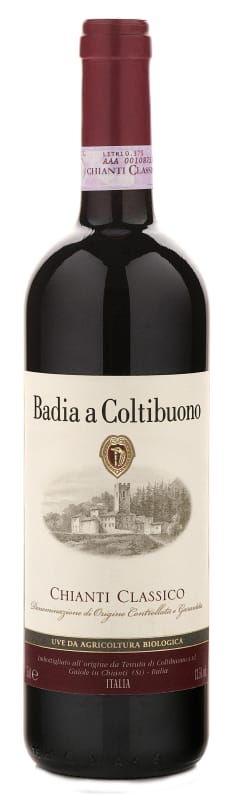


Winemaker Notes
The color is bright ruby, the nose unveils layers of iris, violet, tobacco, black pepper and marasca cherry. The taste is well balanced, tightly knit with supple tannins, mineral notes, a mouth cleansing fresh acidity. Warm and persistent.
Professional Ratings
-
Wine Spectator
A ripe style, this sports cherry, raspberry, violet and mineral aromas and flavors, matched to a tensile structure, revealing fine balance and length.
-
Decanter
Badia a Coltibuono traces its history back to the 11th century when Vallombrosian monks founded the abbey and started planting the area's first vineyards. The Stucchi Prinetti family who now own the property have bottles of Riserva dating back to 1937. Rounded out with a dollop of Canaiolo Nero, Ciliegiolo and Colorino, it is uncluttered by oak nuances. Accented by strawberry, juniper and tarragon, it glides smoothly across the palate with tame, chalky tannins and dusty black cherry on the finish. Accessible now, this has in bones to age gracefully over the next decade. I always appreciate the steadfast, recognisable personality of Coltibuono's elegant Riserva. Drinking Window 2020 - 2030
-
Robert Parker's Wine Advocate
The 2016 Chianti Classico is a terrific wine and perhaps the best vintage made thus far. The wine opens to a medium dark appearance with pretty layers of wild cherry, redcurrant and mild spice. Badia a Coltibuono always does a great job of expressing the cool and somewhat wild nature of Gaiole in Chianti. This is a blend of 90% Sangiovese with 10% Canaiolo and Ciliegiolo. Some 128,000 bottles were made, and this is great news for all you value-wine consumers out there.
-
Wine & Spirits
Yields for this wine were down a bit due to hail in the spring, but the grapes that remained produced an appealing herb-scented wine with juicy red-berry flavors in a midweight frame. Its lively acidity and dried-thyme notes make your mouth water for tomato-based sauces.


Among Italy's elite red grape varieties, Sangiovese has the perfect intersection of bright red fruit and savory earthiness and is responsible for the best red wines of Tuscany. While it is best known as the chief component of Chianti, it is also the main grape in Vino Nobile di Montepulciano and reaches the height of its power and intensity in the complex, long-lived Brunello di Montalcino. Somm Secret—Sangiovese doubles under the alias, Nielluccio, on the French island of Corsica where it produces distinctly floral and refreshing reds and rosés.

One of the first wine regions anywhere to be officially recognized and delimited, Chianti Classico is today what was originally defined simply as Chianti. Already identified by the early 18th century as a superior zone, the official name of Chianti was proclaimed upon the area surrounding the townships of Castellina, Radda and Gaiole, just north of Siena, by Cosimo III, Grand Duke of Tuscany in an official decree in 1716.
However, by the 1930s the Italian government had appended this historic zone with additonal land in order to capitalize on the Chianti name. It wasn’t until 1996 that Chianti Classico became autonomous once again when the government granted a separate DOCG (Denominazione di Origine Controllata e Garantita) to its borders. Ever since, Chianti Classico considers itself no longer a subzone of Chianti.
Many Classicos are today made of 100% Sangiovese but can include up to 20% of other approved varieties grown within the Classico borders. The best Classicos will have a bright acidity, supple tannins and be full-bodied with plenty of ripe fruit (plums, black cherry, blackberry). Also common among the best Classicos are expressive notes of cedar, dried herbs, fennel, balsamic or tobacco.