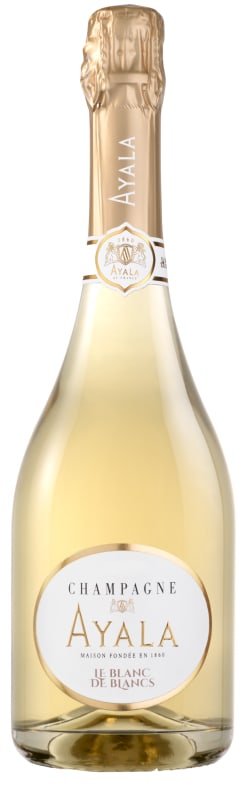


Winemaker Notes
Recognizable by its both pure and creamy style, Le Blanc de Blancs is a genuine ode to Chardonnay. The emblematic cuvée of the House.
Brilliant and contemporary, this prestigious cuvée flourishes in a special bottle, promoting the development of the organoleptic profile during the 6 years of ageing on lees in the cellars.
Professional Ratings
-
Decanter
Delicate, fresh and romantic bouquet of lemon, jasmine, spring flowers and orchard fruits. Very sappy and round, the palate is perfectly balanced and has both a pinpoint mousse and a crystalline texture. Although quite approachable today, it will come into its own when it picks up more complexity and texture with another year or two on the cork. 100% Chardonnay. Dosage of 6 g/L.
-
Jeb Dunnuck
A tricky vintage and an especially complicated vintage for Pinot Noir in 2016, the 2016 Champagne Le Blanc De Blancs is a bright silver-yellow hue and offers an airy and springy floral bouquet in its pastoral notes of white flowers, honeysuckle, fresh pear, and dewy earth. Medium-bodied, it’s more rounded on the mid-palate, with a fluffy mousse and supple notes of quince and fresh brioche dough. It’s elegant and approachable, with its citrus profile lasting on the clean finish. It has more substance but remains elegant and refreshing and does not feel dilute.
-
James Suckling
This is really delicious, with buttered-brioche and bread-dough character. It's full bodied but not heavy. Just rich and plush. Creamy and round-textured. Extremely long aftertaste. Pure chardonnay. Aged six years on the lees. 5 g/l dosage.
-
Wine Enthusiast
A blend of fruit from the Côte des Blancs, this fine, crisp apple-flavored Champagne is taut, tightly textured and with plenty of aging potential. Drink from 2025.
-
Vinous
The 2016 Le Blanc de Blancs is one of the better wines I have tasted here of late. Exuberant and quite expressive, the 2016 soars with cents of lemon confit, marzipan and sweet spice, all in a forward, open-knit style that offers good near- term appeal. All this needs is a bit more focus in its bouquet, but is still a big step up from the past. Light tropical accents linger on the close.





When Edmond died, his three sons took over the business. In 1911 they suffered the "Vinegrowers Rebellion" - a revolt against the practices of certain unscrupulous Houses, who brought in grapes from outside of the region to be vinified and sold as "champagne". Even though Ayala was not on the blacklist (being totally innocent), it and the other Houses on the Boulevard du Nord in Aÿ were burned to ground by the angry mobs because there were no troops to defend them. The House was completely rebuilt and functioning by 1913. A public liability company was formed in 1922 that still exists today under the name "Champagne AYALA, Société Anonyme". Unabled to cope with the global economic crisis of the 1930s, then House was sold to an English bank before being bought by a Champagne vineyard owner: René CHAYOUX.
René CHAYOUX so trusted and respected Jean-Michel DUCELLIER, his partner since 1948, that he appointed DUCELLIER as his successor at the head of his businesses and estate. An estate that was made all the more impressive by the acquisition in 1961 of the illustrious Chateau LA LAGUNE, a Médoc Classified Third Growth in Bordeaux's Haut-Médoc region. Since 1968, Jean-Michel has with both affection and intelligence cared for the fortunes of Champagne AYALA and Chateau LA LAGUNE. The House of AYALA, a family business, is one of the few to have remained independent. Jean-Michel and his son Alain DUCELLIER who is today at the head of the company, both run it with energy and enthusiasm. They devote themselves to the status of the House's name worldwide, and they proudly receive their clients at their superb Chateau de Mareuil-sur-Aÿ.

Representing the topmost expression of a Champagne house, a vintage Champagne is one made from the produce of a single, superior harvest year. Vintage Champagnes account for a mere 5% of total Champagne production and are produced about three times in a decade. Champagne is typically made as a blend of multiple years in order to preserve the house style; these will have non-vintage, or simply, NV on the label. The term, "vintage," as it applies to all wine, simply means a single harvest year.

Associated with luxury, celebration, and romance, the region, Champagne, is home to the world’s most prized sparkling wine. In order to bear the label, ‘Champagne’, a sparkling wine must originate from this northeastern region of France—called Champagne—and adhere to strict quality standards. Made up of the three towns Reims, Épernay, and Aÿ, it was here that the traditional method of sparkling wine production was both invented and perfected, birthing a winemaking technique as well as a flavor profile that is now emulated worldwide.
Well-drained, limestone and chalky soil defines much of the region, which lend a mineral component to its wines. Champagne’s cold, continental climate promotes ample acidity in its grapes but weather differences from year to year can create significant variation between vintages. While vintage Champagnes are produced in exceptional years, non-vintage cuvées are produced annually from a blend of several years in order to produce Champagnes that maintain a consistent house style.
With nearly negligible exceptions, . These can be blended together or bottled as individual varietal Champagnes, depending on the final style of wine desired. Chardonnay, the only white variety, contributes freshness, elegance, lively acidity and notes of citrus, orchard fruit and white flowers. Pinot Noir and its relative Pinot Meunier, provide the backbone to many blends, adding structure, body and supple red fruit flavors. Wines with a large proportion of Pinot Meunier will be ready to drink earlier, while Pinot Noir contributes to longevity. Whether it is white or rosé, most Champagne is made from a blend of red and white grapes—and uniquely, rosé is often produce by blending together red and white wine. A Champagne made exclusively from Chardonnay will be labeled as ‘blanc de blancs,’ while ones comprised of only red grapes are called ‘blanc de noirs.’