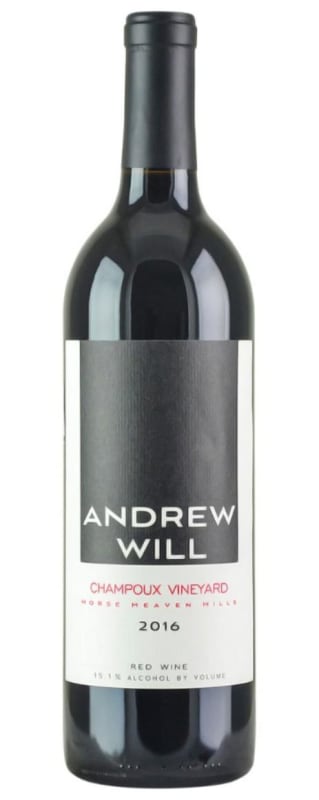


Winemaker Notes
The 2016 Vintage in Washington State started out quick during the spring, but in early June the weather returned to normal and thus lead to a start date of September 12th for picking. Harvest continued until October 25th with Cabernet Sauvignon from Two Blondes vineyard coming in. Right away we saw the high potential of the fruit and how this vintage would end up being another great vintage for us.
Blend: 50% Merlot, 30% Cabernet Sauvignon, 20% Cabernet Franc
Professional Ratings
-
Jeb Dunnuck
One of the finest examples of this cuvée I’ve tasted is the 2016 Champoux Vineyard, which comes from one of the top terroirs in the state and is in the slightly cooler Horse Heaven Hills AVA. The blend in 2016 is 50% Merlot, 30% Cabernet Sauvignon, and 20% Cabernet Franc, all aged 18 months in just 25% new French oak. Young, full-bodied, and primordial, it has incredible potential but is going to need 4-5 years of bottle age. Thrilling notes of blueberries, cassis, lead pencil shavings, and bouquet garni all define the bouquet and it has remarkable purity and elegance. It picks up more floral and high-toned notes with time in the glass and is a brilliant bottle of wine that will keep for 2-3 decades.
-
Robert Parker's Wine Advocate
A blend of 50% Merlot, 30% Cabernet Sauvignon and 20% Cabernet Franc, the 2016 Champoux Vineyard opens with a rich and ripe expression of dark, dusty fruit interlaced with supporting oak tones on the nose. Medium to full-bodied in the mouth, dark cherry, black plum and cassis flood the palate with a structured focus and mineral tension. The fruit structure becomes a touch grippy across the mid-palate, showing firm tannins and representing a style that plays the middle ground between the Ciel du Cheval and Two Blondes bottlings in the same range. The wine ends with a long, complex finish—worth your time and money. With only 498 cases made, you can bet safely on this to last in your cellar.
Rating: 94(+)


One of the world’s most classic and popular styles of red wine, Bordeaux-inspired blends have spread from their homeland in France to nearly every corner of the New World. Typically based on either Cabernet Sauvignon or Merlot and supported by Cabernet Franc, Malbec and Petit Verdot, the best of these are densely hued, fragrant, full of fruit and boast a structure that begs for cellar time. Somm Secret—Blends from Bordeaux are generally earthier compared to those from the New World, which tend to be fruit-dominant.

"Surely this is Horse Heaven!”
Its wide prairies and rolling expanses led an early pioneer to proclaim that the region looked like “horse heaven,” and as a result, the area was appropriately named. Horse Heaven Hills is in south central Washington state, geographically bound on its northern border by the Yakima River and in the south, by the larger Columbia River.
Its proximity to the Columbia River contributes to a variety of climactic factors that dramatically affect its grapes. In particular, an increase in wind from changes in pressure along the river, which flows from the cool and wet Pacific Ocean, inland to Washington’s hot and arid plains, creates 30% more wind than there would be otherwise. These winds moderate temperatures, protect against mold and rot, reduce the risk of early and late season frosts, diminish canopy size and toughen grape skins.
The vineyards bordering the river are on steep, south-facing, well-exposed slopes, with well-drained, sandy-loam soils. But the soils of the appellation are diverse throughout, ranging from wind-blown sand and loess, Missoula Flood sediment, and rocky basalt. Horse Heaven Hills has an arid continental climate with elevations ranging from 200 to 1,800 feet.
The first vines of the appellation were planted in 1972 in an optimal spot now referred to as the Champoux Vineyard. Today it remains the source of some of Washington’s most desirable and expensive Cabernet Sauvignons. In fact, the appellation as a whole boasts many of Washington’s top scoring wines. Its primary grape varieties are Cabernet Sauvignon, Merlot, Syrah, Chardonnay and Riesling.