

Winemaker Notes
Professional Ratings
-
Robert Parker's Wine Advocate
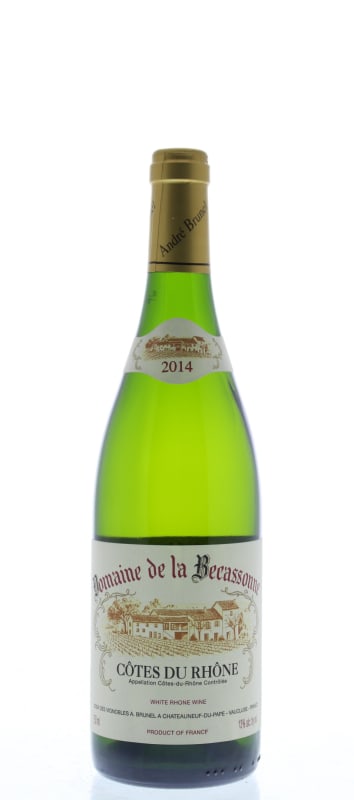
The best vintage of this cuvee to date, Brunel's single vineyard 2014 Cotes du Rhone la Becassonne is a beautiful blend of 50% Roussanne, 30% Grenache Blanc and 20% Clairette. Its medium-gold color is followed by outstanding notes of ripe peach, melon, pineapple and a touch of honey. Medium-bodied, rich, textured and still lively and fresh, it sells for about 15 bucks but tastes like it cost two to three times that. Buy it by the case and drink it over the coming couple of years (although, I would not be surprised to see it evolve nicely for longer).


Full-bodied and flavorful, white Rhône blends originate from France’s Rhône Valley. Today these blends are also becoming popular in other regions. Typically some combination of Grenache Blanc, Marsanne, Roussanne and Viognier form the basis of a white Rhône blend with varying degrees of flexibility depending on the exact appellation. Somm Secret—In the Northern Rhône, blends of Marsanne and Roussanne are common but the south retains more variety. Marsanne, Roussanne as well as Bourboulenc, Clairette, Picpoul and Ugni Blanc are typical.

Typically thought of as a baby Chateâuneuf-du-Pape, the term Côtes du Rhône actually doesn’t merely apply to the flatter outskirts of the major southern Rhône appellations, it also includes the fringes of well-respected northern Rhône appellations. White wines can be produced under the appellation name, but very little is actually made.
The region offers some of the best values in France and even some first-rate and age-worthy reds. Red wine varieties include most of the Chateâuneuf-du-Pape varieties like Grenache, Syrah, Mourvedre, Cinsault, and Counoise, as well as Carignan. White grapes grown include Grenache blanc, Roussanne and Viognier, among others.