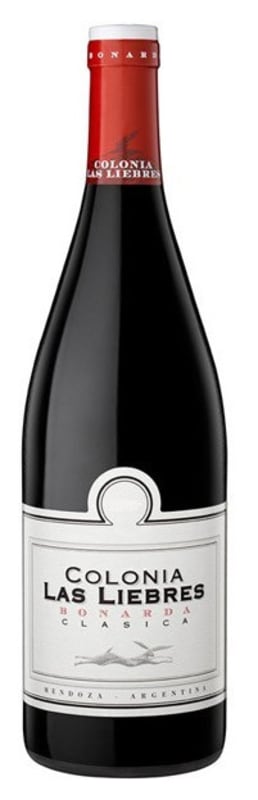


Winemaker Notes
Professional Ratings
-
Robert Parker's Wine Advocate
I had not crossed paths with this wine in a while, so I was looking forward to tasting the 2015 Bonarda Colonia Las Liebres, a sure value and very representative of the grape. It's produced from their own estate vineyards. They aim for a fresher expression of the variety here, with fine-grained tannins, blending grapes from different zones in the province; the grapes are fermented in stainless steel and kept in cement vats, never in contact with oak. 2015 was very warm towards the end of the cycle, and the harvest was 15 days earlier than anticipated. The nose is clean and the palate is soft, a light Bonarda without any oak, a juicy, fresh and easy to drink expression of the variety. It was harvested early and not extracted. The price is almost unbelievable; one to buy by the case. There are four lots of this wine, the first one of 28,434 bottles, but 46,000 liters remain unbottled.


Bonarda is a name given to a handful of distinct grape varieties, mainly growing in Italy and in Argentina. In Lombardy’s Oltrepò Pavese and Emilia Romagna’s Colli Piacentini zones, the grape called Bonarda is actually Croatina. In Novara, Bonarda Novarese, often blended with Spanna (Nebbiolo), is actually Uva Rara. DNA profiling shows that most of the Bonarda in Argentina is actually identical to California’s Charbono—and Charbono is actually the Douce Noire grape from Savoie. Somm Secret—Bonarda Piemontese, an aromatic variety, is the only true Bonarda. Before phylloxera, it covered 30% of Piedmontese vineyard acreage.

With vineyards tretching along the eastern side of the Andes Mountains from Patagonia in the south to Salta in the north, Argentina is one of the world’s largest and most dynamic wine producing countries—and most important in South America.
Since the late 20th century vineyard investments, improved winery technology and a commitment to innovation have all contributed to the country’s burgeoning image as a producer of great wines at all price points. The climate here is diverse but generally continental and agreeable, with hot, dry summers and cold snowy winters—a positive, as snow melt from the Andes Mountains is used heavily to irrigate vineyards. Grapes very rarely have any difficulty achieving full ripeness.
Argentina’s famous Mendoza region, responsible for more than 70% of Argentina’s wine production, is further divided into several sub-regions, with Luján de Cuyo and the Uco Valley most noteworthy. Red wines dominate here, especially Malbec, the country’s star variety, while Chardonnay is the most successful white.
The province of San Juan is best known for blends of Bonarda and Syrah. Torrontés is a specialty of the La Rioja and Salta regions, the latter of which is also responsible for excellent Malbecs grown at very high elevation.